

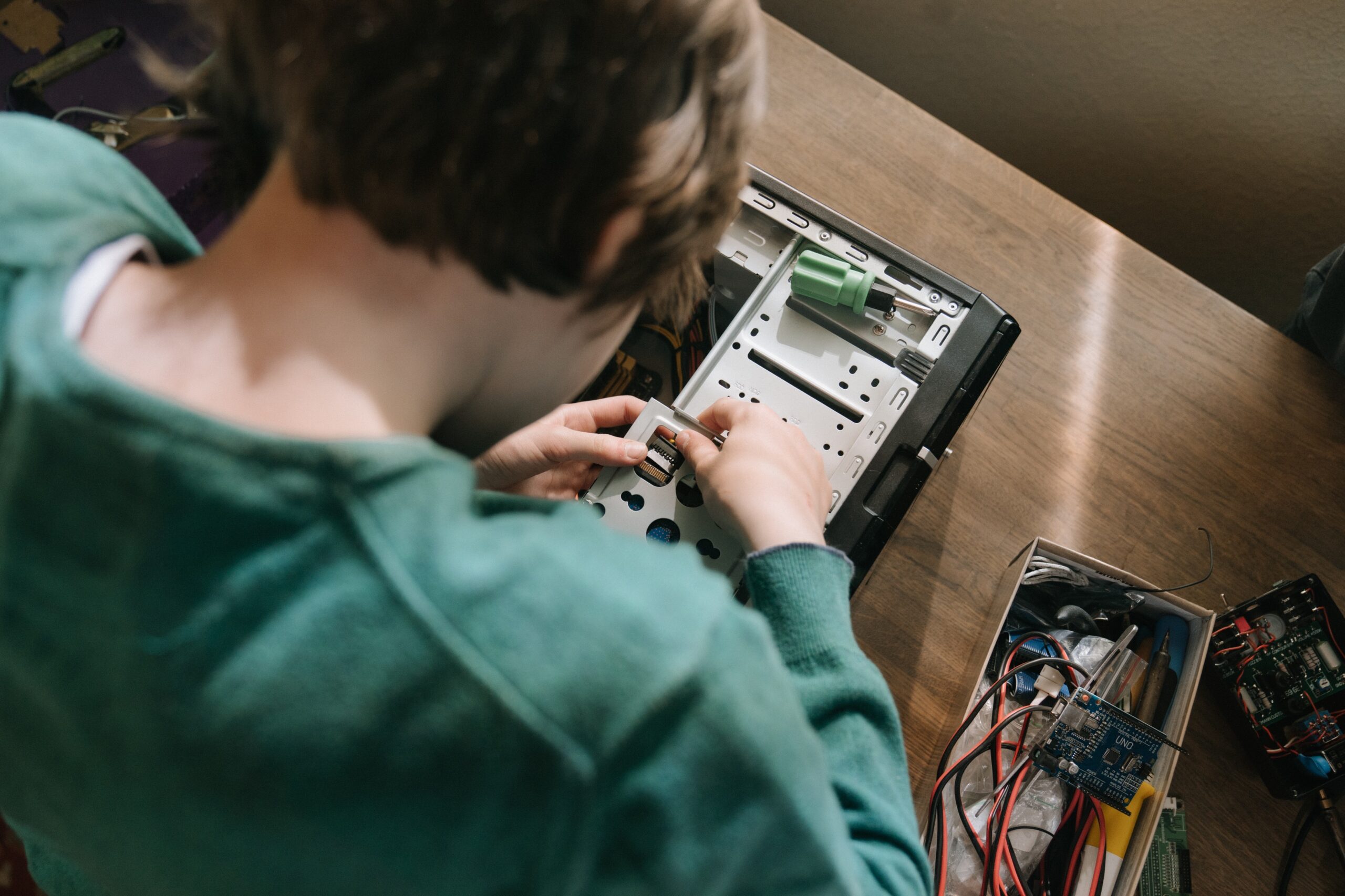

In-house Chromebooks repair program comes to schools
By Peter Vogel
As “right to repair” legislation begins to take hold in some jurisdictions, it was interesting to learn recently about a new program from search and technology giant Google. Its Chromebook Repair Program for Schools was announced on Feb. 3. Initially, the program will be directed at schools in the United States, but it may well migrate to Canada in short order.
Repairing modern electronics is not like fixing your basic two-slice toaster, if you can find the parts, given current supply chain problems. Even then, an electronic device may have embedded digital content that is protected by copyright. Yes, copyright! Software, or code if you prefer, can be, and typically is, subject to copyright.
Here in Canada we don’t yet have universal right to repair laws that would protect end users should they run afoul of copyright law or other legal obstacles. We may not see such legislation until there is sustained demand for it and until Canadians signal they are tired of seeing overflowing electronics bins at their local recycling depots.
A private member’s bill, C-272, designed to address such impediments to consumer repair, was introduced in the last Canadian parliament, but it died when the federal election was called. It may resurface in the current parliament.
So, back to the Google repair program for schools. It was certainly unexpected, and yet it now formalizes what was already happening in some school districts. Schools were beginning to repair computer equipment on their own to reduce downtime. Just as car manufacturers have been hit by electronic chip shortages, so too have computer manufacturers. Warranty repairs are taking longer. Virtual schooling can’t work if students don’t have a device to connect to their online classes.
Google’s Chromebooks became very much in demand during the pandemic, particularly as schooling became mostly virtual for extended periods. Even parents began to notice that the relatively inexpensive Chrome OS devices were highly reliable and useful for most typical online activities.
Big American school districts were buying the devices in blocks of 10,000 or so at a time and placing them in the hands of students. With that came management issues related to damage. Cracked screens, broken trackpads, keyboards damaged through spillage, … you get the picture.
Perhaps a school had online classes part-time, along with in-school days. Backpacks get tossed around, and damage can occur to the strongest of laptop-type devices. Google’s Chromebook Repair Program was set up to allow schools’ devices to be repaired quickly.
And not just by technicians. No, ideally by students, in structured settings. Such students would receive online training on what else but a Chromebook and then be ready to be part of an in-school or district-wide repair centre.
Of course, in its release on the program Google had a spin on the environmental benefits of Chromebooks, claiming a dramatically reduced carbon footprint compared with similar devices. This unsubstantiated statement caught my eye: “Switching 1,000 devices to Chrome OS can reduce greenhouse gas emissions by 90%.”
Count me skeptical on that one, but the second claim seems viable: “In-school (repair) programs like these are not only eco-friendly, but they can also significantly reduce turnaround time, save on costs and help students learn valuable skills.”
For now, the Google repair program is focused on Chromebooks from two major suppliers, Lenovo and Acer. The companies have provided detailed repair guides and generally made it straightforward to set up and run an in-school repair program. Presumably, HP, Asus, and other Chromebook manufacturers will join the program as well.
However, Google is leaving it up to schools to work out the details with the big manufacturers or their regional distributors. This leads to several caveats in the program announcement, which may well give school districts pause.
Here is a flavour of some of that fine print language:
• Before proceeding with any self-repair, we recommend you carefully review your device warranties and terms of sale. Information about devices, components, and repair is provided by third party manufacturers, and Google makes no guarantees as to the accuracy or completeness of such information, nor makes any representations or warranties regarding such information. Google is not responsible for the content of third party websites or information.
• Please be aware that any self-repair may void your OEM warranty.
• Before opening any electronic device, always research proper safety protocols and take necessary precautions.
Chromebooks are widely used in our Catholic schools. Perhaps the repair program will be adopted in some of them when it is made available here in Canada. The regional school model of the Catholic Independent Schools of the Vancouver Archdiocese might be a good fit, with repair classes operating out of the high schools and serving their own needs as well as those of their respective feeder elementary schools.
In its public relations release, Google referred to a case study involving Jenks Public Schools District in Oklahoma, and its technology school intern (TSI) program.
“Once students enter the TSI program, they begin learning how to do simple repairs, such as replacing cracked screens and broken hinges. These common repairs can often be done immediately, which means students, teachers, and parents who bring in Chromebooks can get their devices back in about 10 minutes.”
A 10-minute repair sounds pretty good to me if I’m a student or a parent.
Meanwhile, for me it’s back to checking out that toaster and hoping the repair police don’t come knocking on the door! While I am at it, my own production Chromebook goes end-of-life this year, meaning it will no longer receive regular operating system updates come July. Google has just released Chrome OS Flex, a version of the Chromebook operating system designed to breathe new life into old PCs and MacBooks. Google probably doesn’t want it used on end-of-life Chromebooks, but I intend to do just that with mine. That’s right to repair!
Follow me on Facebook (facebook.com/PeterVogelCA), or on Twitter (@PeterVogel)
How an Italian pianist and composer inspired me with hope.
By Lisa Rumpel
I don’t know if it’s the cold, fog, and rain that have permeated my interior landscape. Or if it’s feeling stuck in a pandemic or having a lack of peace. Whenever I get into a funk, I look for inspiration. It could be from music, a quote from a saint, or a new colourful shirt. Where I need to look for inspiration is from Jesus.
Listening to stories of other people who have come through some sort of trial when I’m stuck in a rut gives me hope.
Alberto Giurioli, an Italian pianist and composer, and I connected on Instagram. He shared his neoclassical piano music, which is available on many platforms. I liked the first few songs I listened to, Following Yourself and Tutto è bellissimo.
I said to him in a direct message, “I’m already editing my column to your piano music.” And he replied, “Cool, glad you like what I do.”
What I found to be heartening is that he is a mental health warrior too. He’s fought to stay here when it got tough. When he was a little boy, he started playing piano. At one point he wanted to give up on learning when bored, and his hands hurt from playing a grand piano. His parents encouraged him to continue, and that is when he began to like it.
Alberto was away from family in London for a while. He was struggling to stay there and fight for his dream. When a journalist’s video of him playing a street piano went viral, that kicked off his career. He has played in many theatres that have sold out and has millions of downloads on Spotify, etc.
It is a struggle to always feel the gift of life when depressed or despairing. Though I am not depressed, I am tired of this winter and so many restraints with COVID. I pray for the end of COVID and the return to more social interactions.
In reading Scripture, the words from Matthew 8:7 jumped off the page for me. “I will come and cure him.” Oh, how I would love to receive a cure from my mental illness. And Jesus doesn’t want us to suffer. He wants us to be free of disease, addiction, and sin. I am learning to hope with greater spirit in his power to heal. I imagine what it would be like for him to heal me too. Especially when reading about the miracles he performed in the Scripture passages.
It is not impossible. It’s something that I never entertained to ask for. Until a few friends asked if I would like to receive prayers for physical healing.
My mind needs restoration. Healing for healthy neurotransmitters and rewiring of fear-based pathways .
My first response is to doubt that Jesus would ever do something this grand for me. I know someone who lives without the problems of bipolar disorder. Even though she has a diagnosis. What faith I would need to have to ask the Lord for what he desires for me!
God is good and won’t let me down. Healing can take time. And it’s amazing how I have everything I need in the moment from him. I am never left without his love.
The gift of being alive is an act of his love. He loves us, and we exist in that love.
It was a pleasure to find Alberto’s music. He offers his talent to add beauty to the lives of others. It is inspiring how he is using his gift for the world.
And when I’m bored, uninspired, or lacking peace, I ask myself if Jesus is in the centre. Have I been putting him first? Or am I disappointed with the distractions of my own making?
“He will come in His own time, and when you least expect it. Hope in Him more than ever” (The Practice of the Presence of God: A 40-Day Devotion Based on Brother Lawrence’s The Practice of the Presence of God).
Trusting God through the long haul even when your path forward isn’t clear is hard to do. I don’t know if I will be cured of my mental illness or if it will be a lifelong challenge. I don’t know how long the pandemic will go on. I do know that winter ends and spring will come.
I look forward to spending more time with Jesus during Lent to believe in his healing love. And to listening to beautiful music from talented artists.
Lisa Rumpel’s podcast, The Will to Thrive: Stories of Resilience, is available on popular streaming services.
The joy of the birds something to imitate
By Colleen Roy
I recently started a long-term kind of experiment, in the natural science realm.
It’s quite simple really and only involves a few easy-to-find supplies. I started by taking a small ice cream lid and duct taped it to a pair of sunglasses. Then I found a bag of bird seed, which I sprinkled on the lid. And then, as quietly as possible, I tiptoed into the backyard and found myself a perch. I wrapped myself entirely, put on the sunglasses, and waited.
Day 1 of the experiment was disappointing. It felt as though the sun dropped and the temperature went down as soon as I found a good spot. But I still sat for about 40 minutes, as still and silent as possible. There were birds that came and went in the trees around me, but I felt that I missed rush hour. To top it off, I had chosen a weighted blanket to wrap myself in, and to sit totally still with 16 extra pounds distributed in awkward places meant that I woke the next morning with knots in my neck and back. Alas.
Day 2 was better. There were definitely more birds about, but the spot I had chosen wasn’t ideal. My back was exposed, and I could hear scuffling behind me. A terror went through me at the thought of a squirrel climbing up my back and sitting on my head to eat the seeds. Squirrels always eat the birds’ seeds, so what would stop them now? Sure enough, it was a squirrel, but it never made contact, thank you, Lord. I watched it climb onto the roof and stare at me.
Day 3, I decided to take the chair off the deck and sit in the yard, facing a busy tree. Birds were flying closer to my head that day, and I started to feel a little hope, until a pair of mourning doves landed about 10 feet away and started hopping towards me. Now I had the thought of these two with their little talons biting my legs. I scuffled my foot and they left.
I came out later for a fourth attempt and sat for maybe half an hour. I will say that this is a real exercise in silence and stillness. It could easily be made into a spiritual experience if it weren’t for the squirrels. I did somehow manage a rosary. Maybe that’s why I was spared the claws in my head. But I still got a foot cramp.
So Day 4 came, and I looked out the window to see birds in their glory. Our yard had flocks of little winged creatures landing and scavenging and bathing in the puddle on top of our hot tub. I quickly finished up the math lesson I was doing and gathered my supplies, determined that it would be my day of triumph.
Well, I’ll spare you the buildup: no birds landed on my face, but the hour I spent in stillness was absolutely not wasted. I don’t know if it was the time of day or the weather, but I felt like I snuck into a private bird party. Behind my head were the juncos, flying to and from the grapevine. Chickadees and swallows were everywhere, pairing up and flying in circles, in and out of the yard. There were bushtits, hummingbirds, and even a few crows. Birds were everywhere, and the symphony that surrounded me actually made me laugh into the blanket! A bald eagle was circling above the park across the street. I felt such a simple, childlike happiness just sitting there silently watching this dance surrounding me. I felt like I was in Cinderella.
I looked up and saw what seemed to be a large pigeon landing on a branch directly opposite me. As it stared at me, I began to think that it seemed awfully large for a pigeon. I slowly lifted a finger to slide my sunglasses down just enough to discover that it was actually an owl. (That owl has been in our yard every day this week.)
So no bird landed on my face, but two did fly close enough that their wings touched the blanket. I have high hopes for Try 5. But in the meantime, the delight I experienced in being allowed to witness the freedom and seeming joy of these little creatures filled my heart up to overflowing. Not one of these would fall to the ground without our Father’s will, and yet we are of more value to him than many sparrows.
As I sat there in a small, glorious moment of birds’ natural worship I wondered at the times we are in. There is sorrow and frustration, confusion and anger. Many of us feel lost as we seek out the freedom that makes us human. The song of those birds spoke out to me, “Stay the course. Find joy, be free, rejoice, and worship with those who take delight in the gifts of God. ‘Even the sparrow finds a home, and the swallow a nest for herself, where she may lay her young, at thy altars, O Lord of hosts, my King and my God. Blessed are those who dwell in thy house, ever singing thy praise!’ (Ps 84).”
La Dolce Vita
By Alan Charlton
Thanks to the wonderful public library collection, I’ve been able to revisit several of my favourite movies of the past. When Fellini’s La Dolce Vita was released in 1960, it was met with shock and disapproval, largely because of the risqué scenes, but also because many saw the film as irreverent.
Of course, as the writer-director Lina Wertmuller noted in an interview included with the Criterion Collection’s superb added features, the film is open to a multitude of interpretations. Though she claims to detest symbols (a view which I cannot believe she really held), I think it is impossible to view the opening and closing scenes of the film as anything but symbolic.
The famous opening in which a statue of Jesus is being flown by helicopter across Rome to the Vatican can be interpreted in several ways. I believe it is meant to ask us to consider what has happened to Christ’s message since it was first given at the time of the Roman Empire (symbolized by the aqueduct) across the centuries (including the Renaissance, symbolized by St. Peter’s and the Vatican), up to the present day, symbolized by the new apartment buildings.
The film then, in a series of vignettes, shows a world in which virtually all the deadly sins are illustrated. In each case, people are shown as empty, unhappy, and choosing a value other than Christian – sex, fame, glorification of media “gods,” art, and false religion are all graphically illustrated.
Throughout, the central character, a journalist, records what he observes, including misogyny and the objectification of others, leading ultimately to despair. All of this is a lead-up to the final scene. After a senseless orgy (shocking by the standards of the time), the participants go to a beach, where a huge fish has been landed. And here I feel that Fellini is drawing on Christian iconography, with the fish (ichthus) again a reminder of Christ. The decadent crowd, with one exception, reject the fish as ugly, though in fact it is exactly as God intended. One woman bends down and comes close to the fish, seeming to see it differently than the others. Surely this is intended as a reminder of the sinful woman in the Gospel of Luke kissing the feet of Christ. At the same time, the principal character sees a young girl inviting him to join her.
Earlier in the film, the reporter has met her and learned that she longs to return to her hometown (a symbol of innocence rejecting all that modern, decadent Rome stands for). Sadly, the reporter finds himself unable to join her, as he continues to reject Christian values, leaving him in the same unsatisfactory and unsatisfied state he has exhibited throughout the film.
Many will, of course, differ with this interpretation, pointing out that Fellini was critical of the Catholic Church (as is clearly shown in his most popular film, Amarcord), but isn’t he there rejecting the trappings of organized religion, particularly clericalism, not the moral and ethical values of Christianity?
In similar vein, he also rejected fascism, even though many applauded some of its achievements. After all, the trains did run on time!
It is true that between the introduction and conclusion of the film, Fellini presents a distressing view of the modern world, one in which he has brought to the screen all that one could want in a film: superb cinematography, brilliant acting, wonderful costuming, and a truly memorable musical score.
Some would regard the result to be seductive and merely pornographic, but Fellini goes to great pains to show the world he depicts so vividly in all its ugliness. He certainly doesn’t make it attractive or alluring.
It may be that he is overstating his case by indulging in so many pathetic and ugly scenes, but that his aim was to “sell” the values illustrated seems unlikely. Moreover, he was too careful a filmmaker to have deliberately included the introduction and the conclusion unless he wanted to frame his portrait of the modern world with a reminder of what has been abandoned by so many.
Viewers today may still find La Dolce Vita objectionable, but any realistic portrait of sin must be objectionable. The very title is meant to be ironic, and Fellini was asking the world to reconsider its values. Those values certainly are not shown as leading to a sweet life! In this regard, the film is as timely as when it was first released.







