

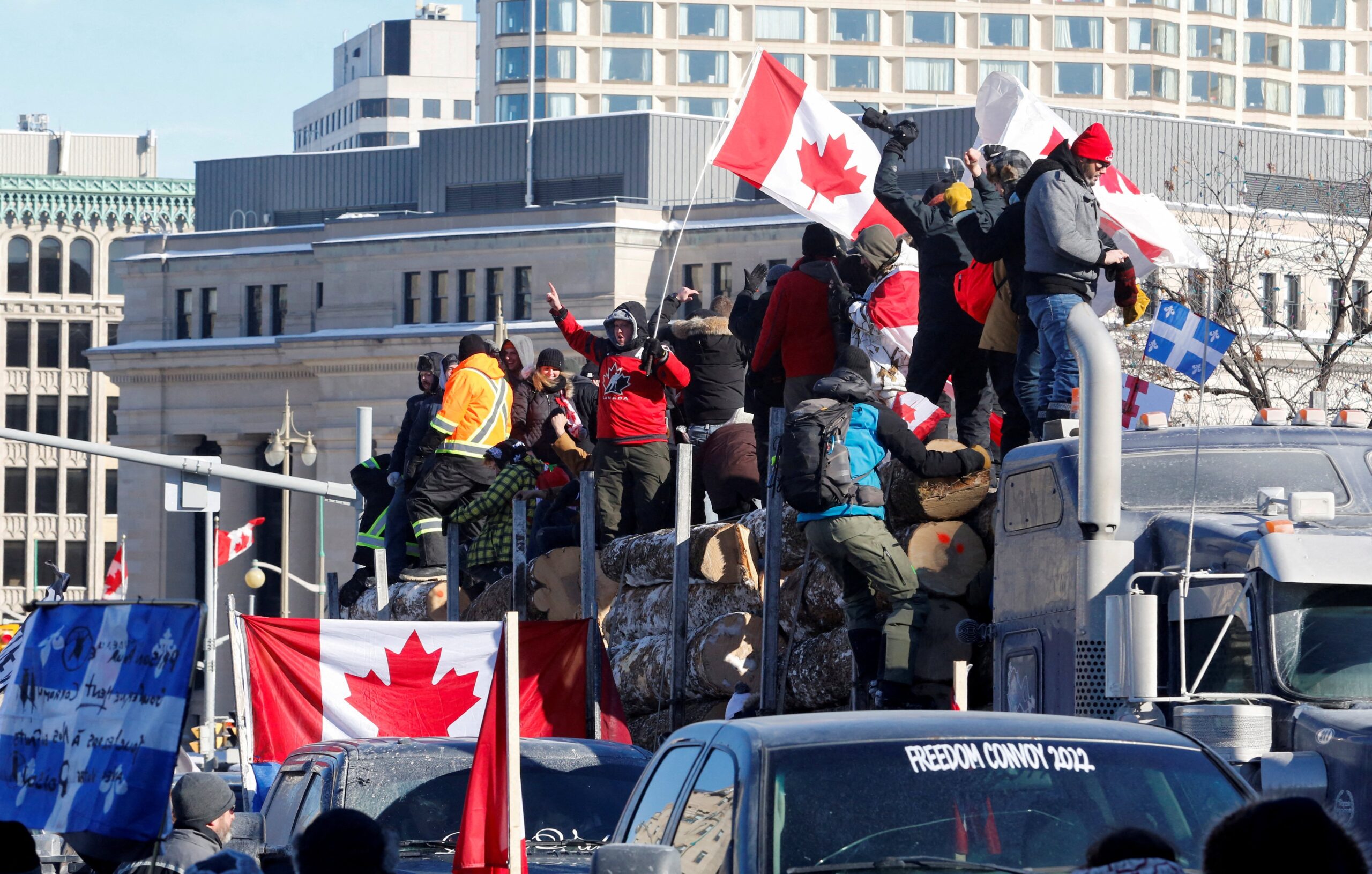

Whatever you believe about Canada’s trucker convoy, there’s no doubt Prime Minister Justin Trudeau got it wrong in labeling them a “small fringe minority.”
It’s also a minority, he said, that holds “unacceptable views.” Possibly. But the majority of that minority are there because they don’t agree with punitive COVID restrictions for all Canadians. For the leader of our country to call all of those people’s views unacceptable is to tell many Canadians that he will not accept or tolerate them. In the case of the truckers, he will not even dialogue with them.
Conversing with others does not mean automatically agreeing with them. Dialogue with someone who holds a different viewpoint enables communication and true progress. Trudeau thus far refuses to take advantage of this opportunity.
In the fall, Trudeau labeled unvaccinated people as racist misogynists who do not believe in science or progress. He further told a Quebec television station that Canadians need to make a choice as to whether they will tolerate “these people.”
Such remarks are not new for Trudeau. He has long fostered division by blaming lockdowns, restrictions, and postponed surgeries on unvaccinated people. He will often add that vaccinated people are very angry (although it should be said they have good cause.)
This phenomenon is not particular to Canada. Other countries around the world, including our neighbours to the south, are having similar experiences with their leaders.
If a person is discontent – and who isn’t these days – and their Prime Minister publicly puts a label on their discontent (anger), and then identifies a cause (the unvaccinated), it’s going to have serious implications for millions of people who are longing to “get back to normal” in society. Suddenly, they’ve been given a reason for their discontent and, apparently, a solution. The unvaccinated should get vaccinated.
But a free society is one where individuals can choose and act of their own free will. Freedom is globally valued, with many country’s anthems singing its merit: “True north strong and free.” “Land of the free.”
Freedom is difficult to achieve on both a macro (world) or micro (family) level. Every parent knows the struggle between allowing freedom and enforcing a standard of behaviour in the home. Sometimes children have to learn from their mistakes. And sometimes parents are wrong.
Between adults the dynamics are different. A mature attitude is one that recognizes every person is free to have their own opinion. Although this sounds logical, the sticking point is when the matter of the opinion evokes strong emotions.
I remember a Freakonomics podcast in which a professor at a prominent U.S. university encouraged listeners to make friends with those who disagree with them. The challenge of conversing with respect, as opposed to hotly debating, helps both parties to be more understanding and to get to know themselves better, he argued. This kind of dialogue enriches communities and fosters unity, which in turn encourages collaboration for the betterment of society.
In contrast, the behaviour of our current world leaders is reminiscent of political theories that advocate class war. Division and segregation are the inevitable outcome.
Understanding needs to become our byword. This does not mean agreement. It means looking at others with respect and compassion. It means recognizing that a person has the right to their own opinions regardless of how we feel. It means promoting dialogue.
This is a hard solution, but it is the only one that ultimately makes sense – to accept that others can freely choose to make decisions that are different from ours.
The consequences that flow from this must be dealt with as they happen. No country or health authority has been very good at predicting the outcome of any aspect of the pandemic. Science has both helped us and been proven wrong.
The surest and only way forward is through unity, which involves primarily tolerance of others’ decisions.
Otherwise, the global motto of “we’re all in this together” is a lie. As Justin Trudeau himself tweeted, “inclusion is a choice.”

Ida Gazzola is the mother of six girls and one boy and a parishioner at Holy Cross, Burnaby. A version of this column originally appeared on Mercatornet.







