


When Archbishop Miller filed a petition with the B.C. Supreme Court last February asking for an exemption from the pandemic-related provincial health order restricting church gatherings, he was very clear about what he was opposing.
It wasn’t the government’s decision to lock down some public places. It wasn’t even the decision to close churches. It was the inconsistent nature of the government’s decision, which allowed churches to be shuttered while pubs remained open. Thirty people could gather for an AA meeting, but they couldn’t open their prayer books for worship.
A similar inconsistency would seem to be at the heart of a Powell River man’s recent complaint to the B.C. Human Rights Tribunal. Health orders allow choirs to perform unmasked in secular settings, but not in worship. So consider a choir performing a public concert at Holy Rosary Cathedral. They conclude with Ave Maria, maskless. Five minutes later Mass begins and when they sing the same piece of music they must be masked.
Such inconsistent and arbitrary approaches underlie many of the regulations now in force in B.C. and across the country. From rules on church gatherings to the definition of essential services, governments are exhibiting extraordinary insouciance when it comes to abrogating Canadians essential freedoms, without attempting to justify them or attempt to accommodate those being disadvantaged.
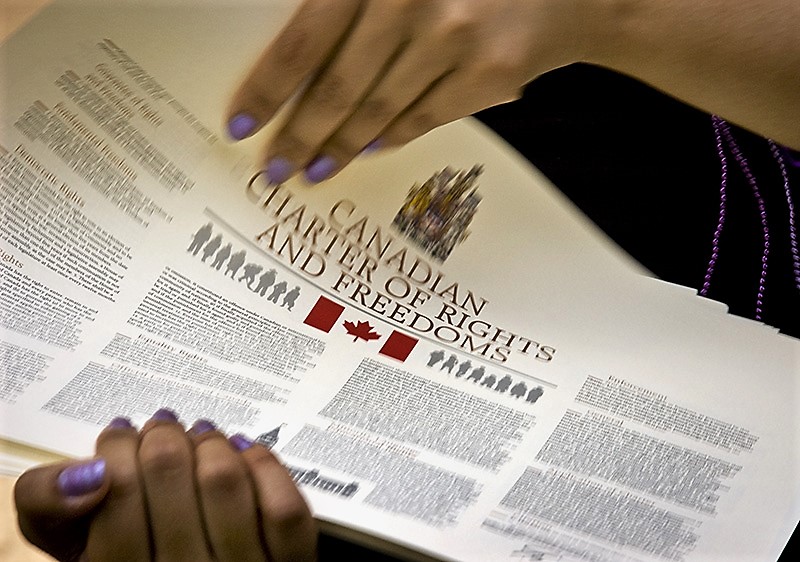
The guarantee of freedom of conscience and religion has preeminence in the Canadian Charter of Rights and Freedoms. But one wouldn’t know that with the behaviour of governments across the country.
Quebec has completely closed churches. In northern B.C., the Northern Health Region has ordered places of worship to require proof of vaccination. All of this is being done without justification or attempting to work with faith leaders to find acceptable compromises.
The following article by Rex Murphy first appeared in The National Post. Murphy is a well known advocate for liberty and in this article voices his concern over the rash manner in which government is crushing individual rights. It serves as an important reminder that a Charter of Rights that can so easily be dismissed is hardly a Charter of Rights at all.
Rex Murphy: Trudeau Liberals no longer care about Canada’s Charter of Rights and Freedoms
The Charter is intended to defend all of our citizens, not just the vaccinated
B.C., or Before COVID, if you were searching for pure rhapsody in political circles, then you had little to explore. Head to any high-toned Liberal gathering, one of their festal summits where the glories and landmarks of Liberal tenure were, almost liturgically, being celebrated, and inevitably some chosen hero of the Liberal moment would expatiate on the monumental achievements of 1982.
Ah. 1982. The moment Canada came of age. The pivot point at which the tired Dominion threw off the cables from mothership Great Britain, took back — repatriated is the sacral term in Liberal conclaves — the Constitution, and “enshrined” — another term of divine reverence, the prime deed of all Canadian democratic government — the Charter of Rights and Freedoms.
Rights and freedoms. These are trumpet terms. These are both the heart and soul of any democratic polity. And it was a Liberal government, under a powerfully intelligent prime minister, who brought this shield and buckler to the defence against any incursion by the state upon the integrity and autonomy of every single Canadian citizen.
Here was the titanium element in the Canadian Constitution, the Charter that locked the state in subservience to the citizen. I.e., demos — the people; cracy — rule. Democracy.

Liberals trembled with pleasure even at its mention; looked skyward when thinking of Pierre Trudeau’s dogged and fearless efforts to bring it to birth; hailed it, like Christians would the Holy Grail found and returned, as the triumph and apogee, the ultimate orbit of Liberalism’s contribution to the very idea of our nation.
There is the state: the Canadian government. And there is the Charter, the map and declaration that the citizens own the state, and the state, never the citizens. This is worth amplification.
The Charter lands ultimate competence, ultimate authority, in the rights of the citizens of Canada. And should a contest ever come, it is the state that must genuflect to the citizen, and never the reverse. That, in the plainest terms, is what the Charter of Rights and Freedoms means.
Or — is supposed to mean.
Read the rest of Rex Murphy’s column here.







