

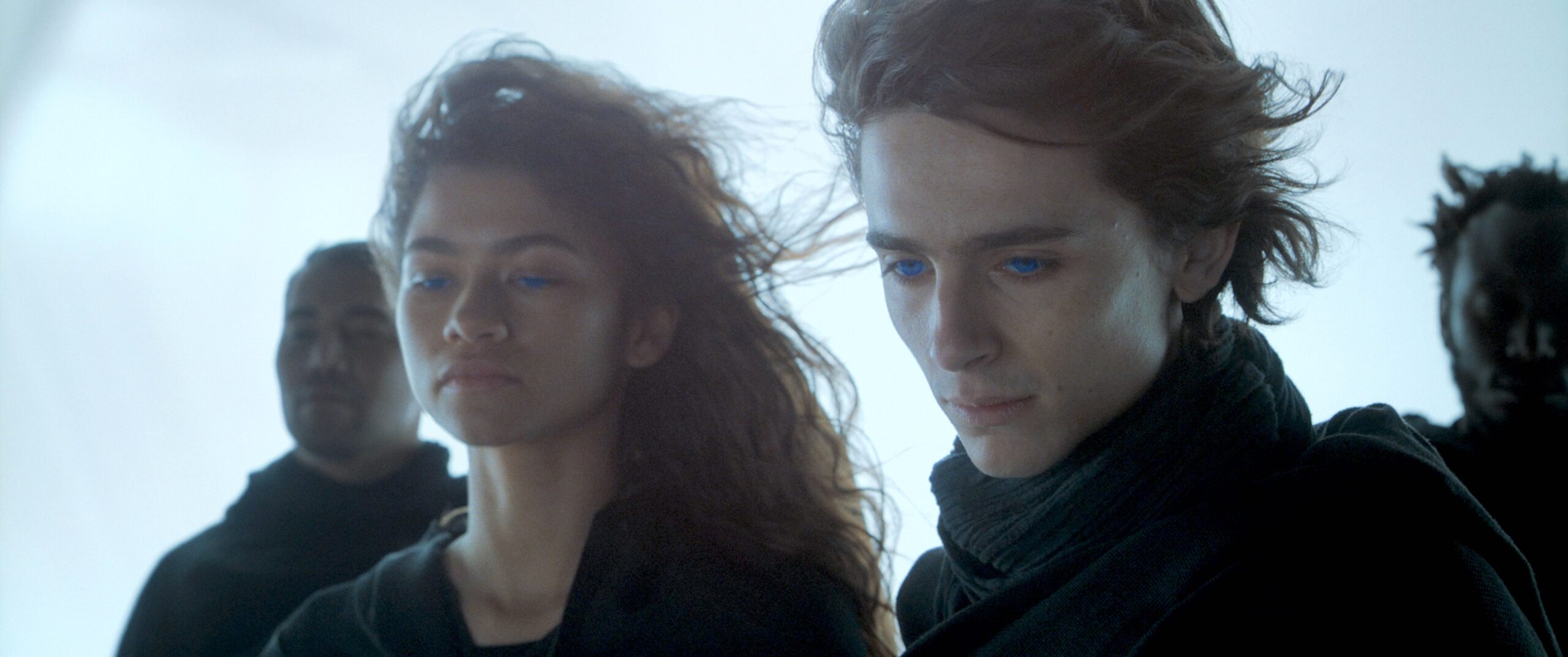

The first problem when reviewing a film version of a book such as Dune is that one should, in fairness, evaluate the film on its own merits, rather than whether or not it captures both the plot and nuances of the book. Fortunately for me, this is a problem easily solved, as I prefer to forget the book.
I recognize that for many science fiction fans, Frank Herbert’s 1964 creation remains the greatest work ever written in the genre, though I personally think Brave New World and 1984 far superior. I remember on first reading that I found much of the plot impossible to follow, while its references to fictional mystical and ancient texts seemed to be merely overblown and decidedly pretentious. Indeed, some 40 years after struggling through the novel’s puzzling complexities, I vaguely remembered only the inclusion of sandworms – giant snake-like creatures which borrow through the desert and swallow everything in their path. A recent rereading of the book proved to be no less confusing than I remembered; I can fully understand why so many have regarded the book as unfilmable!
Revisiting the poorly received David Lynch cinematic version of 1984 did help towards a somewhat better understanding of the storyline. Since the released version was about half of what Lynch created, though, it was hardly acceptable or illuminating.
Therefore, despite widespread critical and audience acclaim, it was with no great sense of anticipation that I attended a screening of Denis Villeneuve’s new adaptation of Dune. I can’t say that I was pleasantly surprised.
The new film does attempt to clarify the complexities of the plot. This, set some 8,000 years in the future, involves a shadowy emperor of the universe sending Duke Leto to take command of the planet Arrakis, from which the former rulers, the Harkonnens, have been ejected. Arrakis is the source of a valuable spice, “melange,” which is claimed to act both as a hallucinogenic drug and an extender of life – though, judging from the number of people who die in the story, this latter claim is questionable.
Early in the movie we learn that Leto’s son, Paul, seems to have a special part to play in things, since many seem to regard him as a messiah. Just to add to the pretentious religious confusion, some call him the Mahdi. The audience is soon introduced to several characters, some of whom prove to be virtuous and some evil, though I must confess I could never understand who was which – or even who was who.
Though many castigated Lynch for conveying the unspoken thoughts and plot developments of several characters through subtitles, an attempt at being faithful to the book, Villeneuve too resorts to this, with at least some clarifying effect.
The complexities of the plot aside, what follows in the film has been hailed as a visual triumph – huge sets, a variety of impressive spaceships, and spectacularly mammoth scenes, all accompanied by ear-shattering music. For those who like this sort of thing, it’s a scenic and aural wonderland!
All this provides an impressive background against which the plot confusedly unfolds. However, on the simplest level, one can take comfort in knowing that messiah Paul is obviously going to fulfill his destiny, though not completely, since this is only Part I of the full story.
Though Villeneuve has managed to come up with a truly impressive set of visuals, the inordinate length of the film does allow ample time for one to consider why a further 8,000 years of history has resulted in astonishing technical advances, but some surprising non-developments. One has lots of time to wonder if the cast has wandered in from some gigantic medieval-themed party where war weaponry has reverted to swords and daggers, people parade around in inefficient dress of veils and cloaks, and the ceremonial entrance of a ruler is marked by a single bagpipe player. Many, however, will be delighted to learn that computers, media platforms, and the like have perished. It is true that Herbert’s book was written before such inventions, but in the light of today’s technology, it all seems rather unconvincing.
There are other puzzles in the film. Does anyone, other than a few servants, do any work? Where are the people who have created all the impressive machinery, airships, and buildings, let alone the tech guys who designed it all? The female population seems to have been relegated to cheering incoming rulers, and all the men seem to have been drafted into an army trained in hand-to-hand combat. One supposes that, despite efforts to the contrary, firearms have largely been outlawed, except for a favoured few. And just what do people eat in a land which is nothing but a desert? That a lengthy scene in the novel involving a dinner party at which the characters are shown plotting has been entirely omitted does nothing to help solve this mystery. At the same time, one may be a little less surprised to know that all planets are ruled by militaristic despots with no hint of democracy.
Distracting as these private musings and questionings are, one is soon torn from them by a multitude of impressive creations, explosions, treacherous murders, and miraculous escapes of Paul’s.
Throughout it all, even Timothée Chalamet in this lead role is called upon, like the rest of the cast, to do little more than stare soulfully into the camera. I was relieved when it was all over, in that I found the new film version of Dune to be no more entertaining than the book, though millions of adoring fans of the latter will doubtless be duly impressed by the special effects of the movie. But in the end, one needs to decide these things for oneself, especially if one is a fan of Dune, the novel – or simply a fan of imitative sci-fi movies in the Star Wars genre. I’m sure they eagerly await the as yet unplanned sequel to tell the rest of the story. Just don’t include me!
While it is apparent that many do not share my feelings in the matter, it is surprising to me that when most of us are feeling some stress and anxiety, horror movies seem to remain the dominant genre in movie houses. They don’t seem destined to cheer us up – unless they remind us that things could actually be worse than they already are.
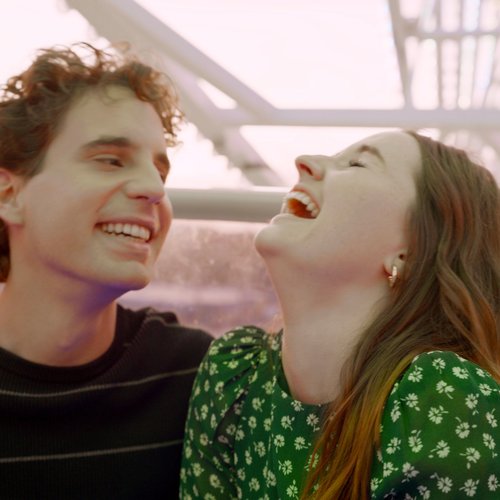
Ben Platt and Kaitlyn Dever in Dear Evan Hansen. “Director Stephen Chbosky has clearly not been able to transfer a stage musical to the screen with much success.” (CNS photo/Universal Pictures)
Personally, I have always felt that well-made horror movies such as Silence of the Lambs successfully achieve their aim in prompting disturbing and nightmare-inducing reactions, while poorly made horror movies, particularly of the “slasher” sort, merely inexcusably appeal to our worst instincts.
In either case, I can certainly manage without them, particularly in these days of a pandemic. That being the case, I searched for a movie in current release that offered the possibility of pleasant, if not challenging, entertainment. And what better example could there be than a musical – particularly the film version of a musical that had played on Broadway, garnering six Tony Awards? And so I turned to Dear Evan Hansen. Was I disappointed!
Now, clearly musicals have changed enormously since the days when plots were predictable and songs as extraneous and irrelevant as “The sun has got his hat on” got the full-production treatment, so it is not surprising that there should be a musical involving teenage suicide. I was not prepared, though, for cast members awkwardly to express their thoughts to tuneless melodies consisting of series of seemingly random notes.
The plot involves a teenage misfit, Evan Hansen, who at his counsellor’s suggestion sends himself a positive note, which gets into the hands of a fellow schoolmate, an equally lonely teen, who commits suicide. When others conclude that Evan and the dead young man were close friends, he goes along with the charade, leading to more complications and even more lies. This provides lots of opportunity for tedious teenage angst and prolonged parental misunderstanding. If there is any point to this, it seems to be the idea that it’s bad to lie, regardless of the circumstance – hardly an enlightening revelation!
Of course, one doesn’t expect profundity from a musical; the appeal largely lies in the execution – by the composer, the writer, the director, and the performers. While star cast members including Amy Adams, Amandla Stenberg, and Julianne Moore bravely attempt to make the whole thing work, their efforts seem doomed from the outset.
Nor does it help that, in the title role, Ben Platt reprises his Tony-winning performance. This might seem to be a good idea, but his stage appearance was five years ago, and he has certainly passed the age when he can convincingly portray a teenager.
At the same time, director Stephen Chbosky has clearly not been able to transfer a stage musical to the screen with much success. Of course, such an adaptation is always a problem, as live theatre is able to handle the artificiality of people suddenly bursting into song and dance far more effectively than is the magnified realism of film.
Past movie productions have creatively solved the problem either by creating a world of ultra-fantasy, as in Moulin Rouge; or plunging the viewer into the persona and mind of a character, as in Chicago; or establishing a plot-driven venue for the performance of the songs as in Cabaret; or revelling in the charming fantasy of the plot-setting as in the mythical Hollywood of Singin’ in the Rain.
The realism of family drama, though, doesn’t quite work in a filmed musical, particularly when the director fails to understand that the broader performance of live theatre becomes unconvincing in the more immediate, gigantic, and yet ultimately intimate setting of film.
In fairness, I must point out that Dear Evan Hansen has been a success in the eyes of many audience members. And while I was disappointed by it, at least I do not regret forgoing the numerous horror movies currently in release. I am still looking for something to engage me dramatically or to cheer me up. I remain hopeful that some worthwhile commercial film – drama or comedy or musical – will come along soon.







