

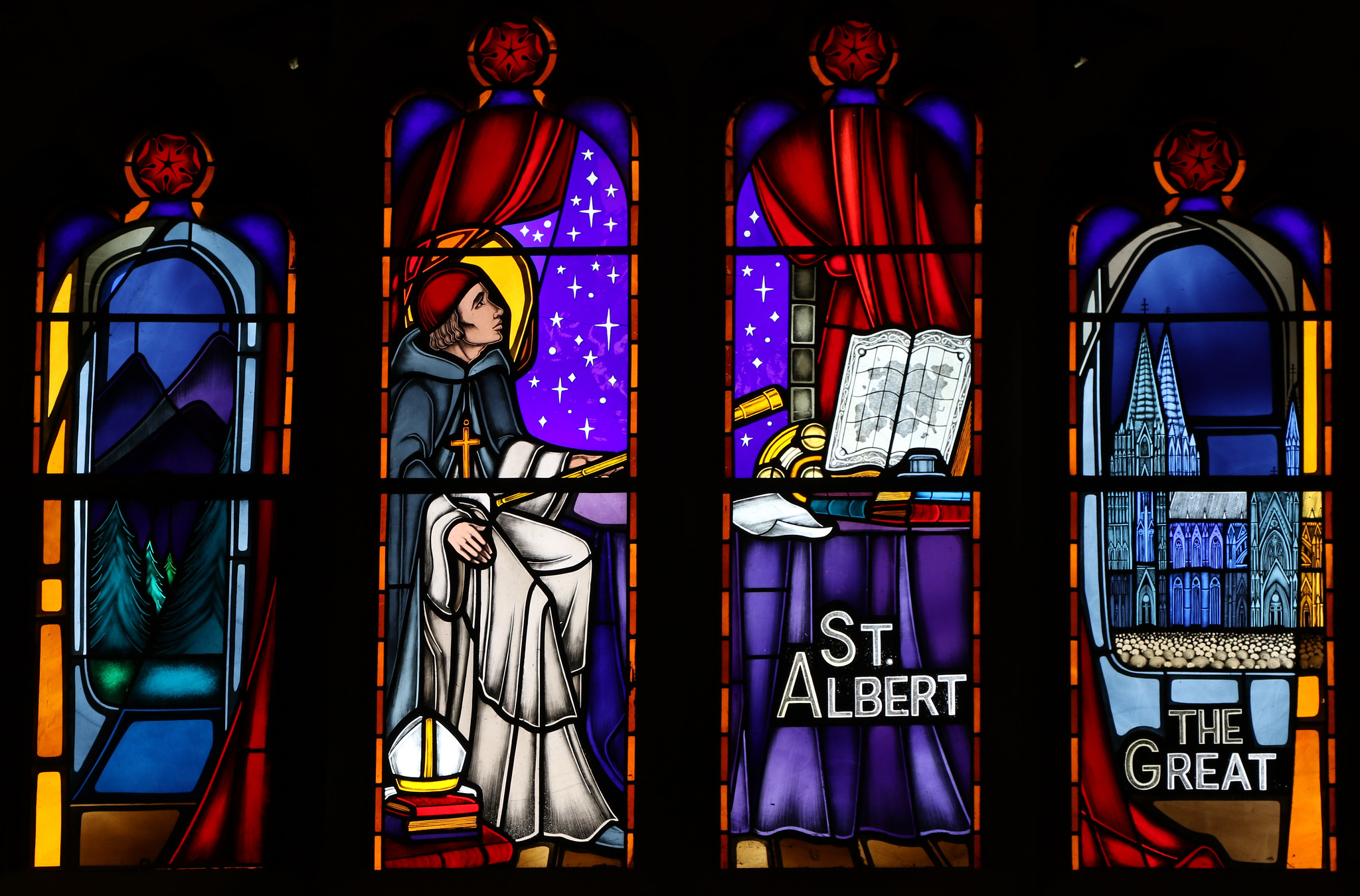

Each year, the Church commemorates St. Albert the Great on Nov. 15 with this prayer: “O God, who made the Bishop Saint Albert great by his joining of human wisdom to divine faith, grant, we pray, that we may so adhere to the truths he taught, that through progress in learning we may come to a deeper knowledge and love of you.”
St. Albert the Great was born in Germany at the beginning of the 13th century. As a young man, he went to Padua, Italy, to study “liberal arts”: grammar, rhetoric, dialectics, arithmetic, geometry, astronomy and music. He attended the church of the Dominicans in Padua, and eventually entered the Dominican Order in 1223.
Albert did theological studies in Germany and was ordained to the priesthood. For the next seven or so years, he taught theology in different Dominican houses of study. In about 1241, he went to the University of Paris to perfect his theological studies. He then moved to Cologne in 1248 to open a theological studium. Among his Cologne students was St. Thomas Aquinas.
Albert became provincial (1253–57) of the German Dominicans and was named Bishop of Regensburg in 1260. After two years, Albert resigned as bishop to return to teaching and writing.
Theologian and author Father Joseph Tylenda wrote, “During his lifetime, he was regarded as a man superior in every branch of learning and was called the wonder and miracle of his age. In addition to his philosophical and theological writings, he wrote treatises on physics, meteors, minerals, sleep, breathing, and botany. In recognition of his theological expertise, he was invited to attend the second Council of Lyon (1274). He died in Cologne on November 15, 1280. Pope Pius XI canonized him in 1931 and declared him a doctor of the Church.”
Pope Benedict XVI said, “St Albert shows that there is no opposition between faith and science… The Bible speaks to us of creation as the first language through which God – who is supreme intelligence, who is Logos – reveals to us something of himself….. With a classical similitude in the Middle Ages and in the Renaissance one can compare the natural world to a book written by God that we read according to the different approaches of the sciences.”
We are created to know, love, and serve God. Our creator gives us the gifts of reason and understanding so that we can know him. God has revealed himself to us in two ways: naturally and supernaturally.
Natural revelation is the knowledge that we acquire about God by human reason through the wonderful works of his creation. Supernatural revelation is the knowledge God discloses in a special way about himself.
A person can know the existence of God by looking both outward and inward. Looking outward, a person sees the wonderful works of creation, which manifest the power, wisdom, and goodness of God. Inwardly, a person hears the voice of conscience and has the desire for perfect and eternal happiness.
The voice of conscience gives us a sense of right and wrong. The source of this voice is beyond us. Some people have tried to ignore the voice of conscience but have not succeeded. This voice is not merely from our parents and teachers, for they themselves are subject to this voice. The voice is from God, and it leads us to him.
Inside us is also the desire for perfect and eternal happiness. Nothing on earth can satisfy our desire. Only God can satisfy us. St. Augustine prayed, “You have made us for Yourself, O Lord, and our hearts are restless until they rest in You.”
The Catechism of the Catholic Church states: “When he listens to the message of creation and to the voice of conscience, man can arrive at certainty about the existence of God, the cause and the end of everything.”
Share your thoughts by sending us a letter to the editor.
雅伯協調科學與信仰
每年11月15日,教會都會通過以下禱文來紀念大聖雅伯:『天主,祢曾恩賜聖雅伯主教特殊的才能,使他知道如何將人類的知識與啓示的真理互相協調,而被譽為當代的偉人;求祢使我們遵循聖人的教誨,藉著科學的進步,更能深切地認識袮,愛慕袮。』
聖雅伯在13世紀初出生於德國。年輕時前往義大利帕多瓦學習「文科」:語法、修辭學、辯證法、算術、幾何學、天文學和音樂。他經常往帕多瓦的道明會的聖堂,並最終於1223年加入道明會。
雅伯在德國從事神學研究,和晉升司鐸。在接下來的七年左右的時間裡,他在道明會不同的學院教授神學。大約在1241年,他前往巴黎大學完善他的神學研究。然後,他於1248年搬到科隆,開設了一個神學研究所。他的科隆學生中有聖多瑪斯·阿奎那。
雅伯成為德國道明會的省會長(1253-57),並於1260年被任命為雷根斯堡主教。兩年後,雅伯辭去了雷根斯堡主教的職務,以重返教學和寫作。
若瑟·泰倫達神父寫道:『在他的一生中,他被認為是在各個學習領域都優越的人,被稱為他那個時代的驚訝和奇跡。除了他的哲學和神學著作外,他還撰寫了關於物理學、流星、礦物、睡眠、呼吸和植物學的論文。為了表彰他的神學專長,他被邀請參加里昂第二次會議(1274年)。他於 1280 年 11 月 15 日在科隆去世。教宗庇護十一世於1931年為他封聖,並宣佈他為聖師。』
本篤十六世說:『聖雅伯表明,信仰和科學之間沒有對立…… 聖經向我們講述創造是第一語言,通過這種語言,天主是至高無上的智慧,祂是聖言向我們揭示祂自己的一些事理。借助中世紀和文藝復興時期的經典比喻,我們可以將自然世界比作天主所寫的一本書,我們根據科學的不同方法閱讀這本書。』
我們受造去認識、愛慕和事奉天主。造物主賞賜我們領悟力和理解力,更給我們本性及超性的啟示,為的是讓我們能認識祂。
本性的啟示,是指天主讓我們用本性的領悟力,從奇妙受造的宇宙去認識祂。通過超性的啟示天主以獨特的途徑把那些超越人理智所能發現的道理教授給我們。
一個人可以從外在看到奇妙的創造,而領悟到天主的全能、上智和美善。人亦可以從內在良知,以及內心對永恒完美福樂的渴望,而覺察到天主的存在。
良知的聲音,固藏在我們的內心,引導我們行善避惡。良知的泉源是超越我們自己,有些人即使蓄意妄顧良知,仍揮之不去。良知也不是源於父母師長;因為他們也受到良知的約束。歸根究底,良知的聲音是發自天主,引領我們最終歸向祂。
蒂固內心的,同時有渴望完美和永恒福樂的自然心態。但事實上,現世根本不能滿完這自然心態,惟有在天主內才有這歸宿。聖奧斯定祈禱著:『祢因祢而創造我們;主,也因此只有在祢內,我們才可憩息。』
天主教教理問答指出:『人聆聽受造物的訊息和自己良心的聲音,就能確實地知道天主的存在,祂是萬物的起因和終向。』







