

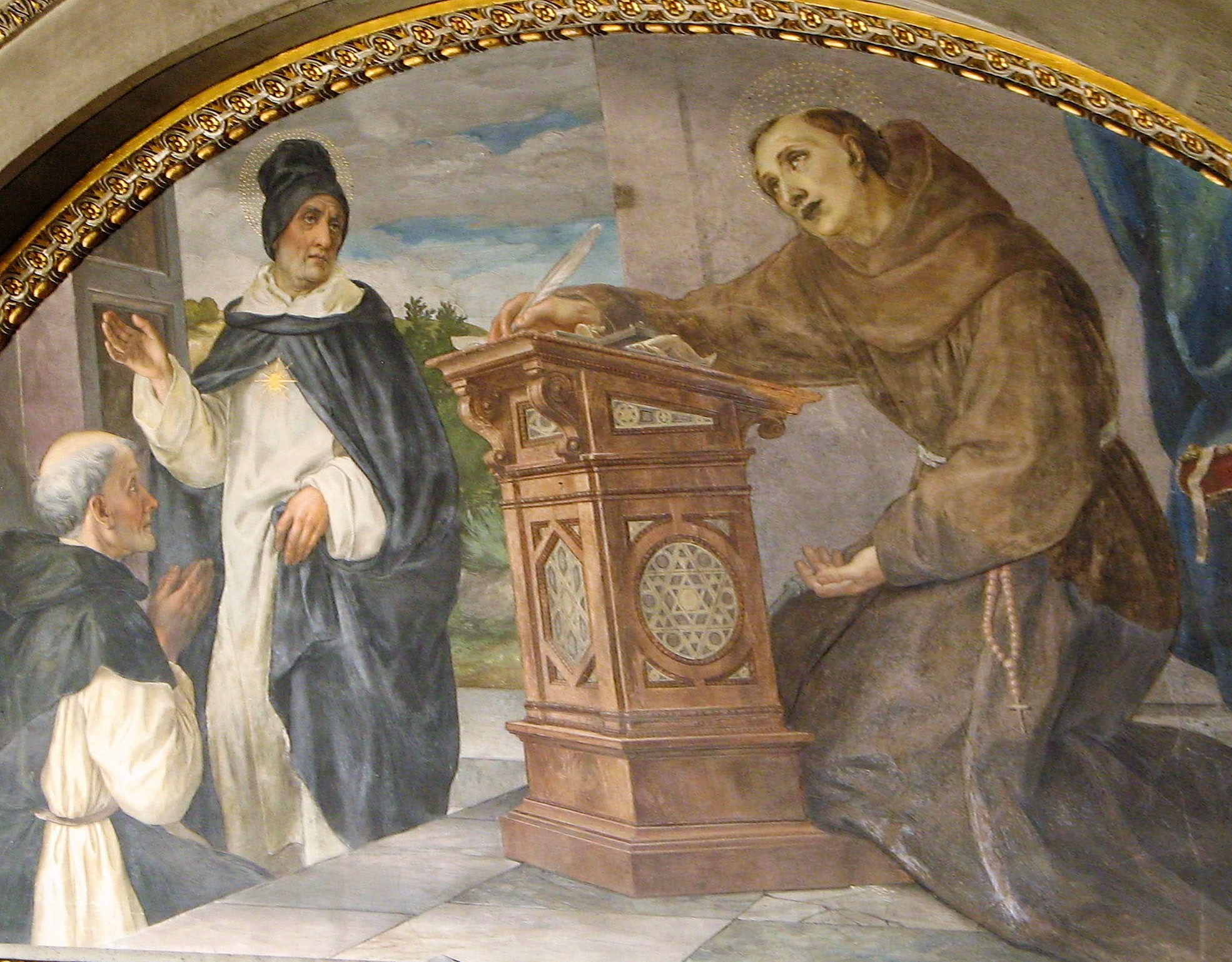

During his General Audience on March 17, 2010, Pope Benedict XVI pointed out the many similarities between St. Thomas Aquinas and St. Bonaventure.
The Holy Father said, “Both scrutinized the mysteries of Revelation, making the most of the resources of human reason, in the fruitful dialogue between faith and reason that characterized the Christian Middle Ages, making it a time of great intellectual vigour, as well as of faith and ecclesial renewal, which is often not sufficiently emphasized.”
Other similarities link them, he said, “Both Bonaventure, a Franciscan, and Thomas, a Dominican, belonged to the Mendicant Orders which, with their spiritual freshness … renewed the whole Church in the 13th century and attracted many followers. They both served the Church with diligence, passion and love, to the point that they were invited to take part in the Ecumenical Council of Lyons in 1274, the very same year in which they died; Thomas while he was on his way to Lyons, Bonaventure while the Council was taking place.”
The Holy Father went on to point out the difference between the two saints. St. Thomas emphasized the primacy of knowledge in theology. We must know God and then act in accordance with God.
According to St. Bonaventure, “wisdom seeks contemplation (as the highest form of knowledge) and has as its intention that we become good.”
The saint added, “Faith is in the intellect, in such a way that it provokes affection. For example, the knowledge that Christ died ‘for us’ does not remain knowledge but necessarily becomes affection, love.”
One day, St. Thomas Aquinas visited St. Bonaventure and asked him from what books he had learned his sacred science. Bonaventure pointed to the crucifix and said, “This is the source of all my knowledge. I study only Jesus Christ, and him crucified.”
Benedict XVI said, “St Thomas and St. Bonaventure define the human being’s final goal, his complete happiness in different ways. For St. Thomas, the supreme end to which our desire is directed is to see God. In this simple act of seeing God all problems are solved. We are happy; nothing else is necessary.
“Instead, for St. Bonaventure the ultimate destiny of the human being is to love God, to encounter him and to be united in his and our love. For him this is the most satisfactory definition of our happiness.
“Along these lines we could also say that the loftiest category for St. Thomas is the true, whereas for St. Bonaventure it is the good. It would be mistaken to see a contradiction in these two answers. For both of them the true is also the good, and the good is also the true; to see God is to love and to love is to see. Hence it was a question of their different interpretation of a fundamentally shared vision. Both emphases have given shape to different traditions and different spiritualities and have thus shown the fruitfulness of the faith: one, in the diversity of its expressions.”
God is Truth and God is Love, the Catechism of the Catholic Church states: “He is the Truth, for ‘God is light and in him there is no darkness’; ‘God is love,’ as the apostle John teaches.”
A traditional catechism states: “To gain the happiness of heaven we must know, love, and serve God in this world.” The sequence is: know, love, and serve. We cannot love someone deeply unless we know the person. And service springs from love.”
Benedict XVI pointed out that for St. Bonaventure, “love goes beyond reason, it sees further, it enters more profoundly into God’s mystery.”
Hence the saint wrote, “If you seek in what manner these things occur (that is, the ascent towards God) interrogate grace, not doctrine, desire, not understanding; the groan of praying, not the study of reading … not light, but the fire totally inflaming, transferring one into God.”
According to St. Bonaventure, true and good theology is not prompted by intellectual pride, but is motivated by love. “One who loves wants to know his beloved better and better.”
Share your thoughts by sending us a letter to the editor.
愛超越理性
在2010年3月17日公開會見教友中,教宗本篤十六世指出了:『聖托馬斯、阿奎那和聖文德之間的許多相似之處。教宗說:「兩人都仔細審視了啟示的奧秘,充分利用了人類理性的資源,在基督徒中世紀特有的信仰與理性之間富有成效的對話中,使其成為一個充滿巨大智力活力的時代,以及信仰和教會更新的時代,這往往沒有得到足夠的強調。其他相似之處將他們聯繫在一起:方濟各會士文德和多明會的托馬斯都屬於行乞修會,這些修會以精神上的新鮮……在13世紀更新整個教會,並吸引了許多追隨者。他們都以勤奮、熱情和愛心為教會服務,以至於他們於 1274 年被邀請參加里昂大公會議,他們同一年去世 ,托馬斯在前往里昂的途中去世,文德在大公會議舉行時去世。』
教宗接著指出兩位聖人之間的差異。聖托馬斯強調知識在神學中的首要地位。我們必須認識天主,然後按照天主行事。
根據聖文德:『智慧尋求沉思(作為知識的最高形式),其意圖是使我們變得善良,特別是這個:變得善良。』聖人補充說:『信仰在於理智,以這種方式激起感情。例如:知道基督「為我們」而死,不是止於知識,而是必然成為感情、愛。』
有一天,聖托馬斯·阿奎那拜訪了聖文德,問他從哪些書中學到了神聖的科學。文德指著十字架說:『這是我所有知識的來源。我只研究耶穌基督,他被釘在十字架上。』
本篤十六世說:『聖托馬斯和聖文德以不同的方式定義了人類的最終目標,完全的幸福。對於聖托馬斯來說,我們的願望所指向的最高目標是:見到天主。在這個見到天主的簡單行為中,所有問題都得到了解決:我們快樂,沒有什麼是需要的。
相反,對於聖文德來說,人類的最終命運是愛天主,與祂相遇,並在祂和我們的愛中結合。對他來說,這是我們幸福最令人滿意的定義。
按照這些思路,我們也可以說,聖托馬斯最崇高的類別是真理,而對於聖文德來說,最崇高的是美善。如果看到這兩個答案的矛盾是錯誤的。對他們倆來說,真也是善,善也是真;看見天主就是愛,愛就是看見。因此,這是一個他們對基本共同願景的不同解釋的問題。這兩個重點都塑造了不同的傳統和不同的靈性,從而顯示了信仰的豐碩成果:同一,其表現形式的多樣性。』
天主是真理,天主是愛。天主教教義說:『祂是真理,「因為天主是光,在祂裡面沒有黑暗」;「天主是愛,」一如若望宗徒所教導的。』
一傳統的要理書說:『為了獲得天堂的幸福,我們必須在這個世界上認識、愛慕和侍奉天主。』順序是:認識,愛慕和侍奉。我們要深深地愛一個人,我們必須先認識這個人。服務源於愛。
本篤十六世指出對於聖文德:『愛超越理性,它看得更遠,更深刻地進入天主的奧秘。』所以這聖人寫道:『如果你尋求這些事情以什麼方式發生(即向提升到天主),詢問恩典,而不是教義,渴望,而不是理解;祈禱的呻吟,而不是閱讀的學習……不是光,而是完全燃燒的火,將一個人轉移到天主』
根據聖文德的說法,真正和良好的神學不是出於知識上的驕傲,而是出於愛。 『一個愛的人想要越來越認識他所愛的』。







