

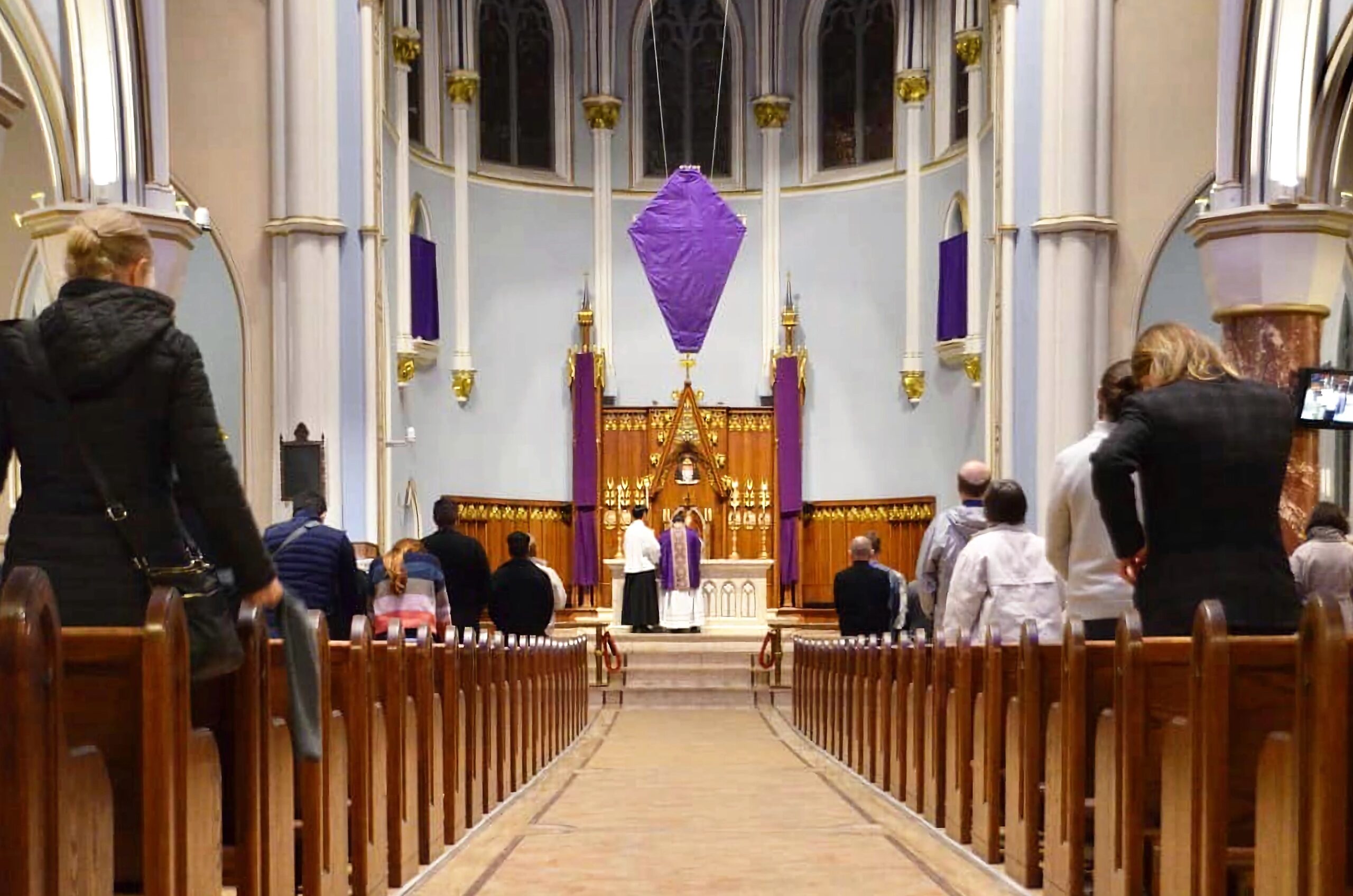

As we round the last corner of Lent, we will soon enter what was once known as Passiontide, beginning on the Fifth Sunday of Lent. As a child, I never really understood why the statues in church were covered with purple cloth at this point, but I remember thinking it was a sure sign that Easter was getting close.
Like many other liturgical practices and theological questions, it wasn’t until my own children asked me why the statues get covered that I had to dig into this seemingly odd custom. There is certainly a counter-intuitiveness about hiding something that helps us to pray, but at this point in Lent, when the commemoration of Jesus’ passion draws near, it is important to strip ourselves of everything that stands between us and our Lord in his time of suffering.
Jennifer Gregory Miller at catholicculture.org explains the tradition of veiling statues for these last two weeks of Lent. She says the roots are found in the “medieval tradition ‘hunger cloth’ which was a huge violet cloth hung in front of the altar to keep the congregation from viewing the altar.”
Miller also notes that “originally Lent was a time that public sinners were ‘banished’ from the church and had to do a public display of penance. Over time the understanding that everyone is a sinner prevailed and sinners were no longer restricted from the liturgy in church, but the hunger cloth gave all attending a ‘fast of the eyes.’ The cloths over time changed to smaller sizes…”
Sitting or kneeling in a church with all statues and even the crucifix covered, the focus naturally goes to the altar – the altar of sacrifice. The altar is where Christ’s sacrifice is re-enacted at every Mass. Because of familiarity and repetition, we can lose sight of what’s really happening on that altar at every consecration. Passiontide is our chance to see the altar for what it really is – the table of offering of the Lamb of God. We are free to focus on that transformation of Christ’s suffering into the greatest gift – the Eucharist, which leads us to eternal life.
It’s no secret that our world is increasingly filled with distractions. Passiontide and the covering of statues is a bold statement in opposition to the world. We need to strip everything away, everything but the essential – Jesus Christ on the altar. We need to contemplate his life, his teachings, and everything that led to his Passion, and then spend time meditating on the Passion itself.
Note that the stations of the cross are not covered. These last two weeks of Lent are a unique time to make that way of the cross journey with Christ. Hopefully, your family has been praying the stations of the cross so far this Lent, and now it’s time to really dig deep and enter into our Lord’s passion. If you haven’t started praying the stations yet, there’s still time!
Another powerful tradition is the “Prayer to Christ Crucified,” meant to be prayed on Fridays throughout the year, but especially emphasized on the Fridays of Lent and particularly appropriate during Passiontide. Those who pray the prayer before an image of Christ crucified on the Fridays of Lent can receive a plenary indulgence when the usual conditions are met (receiving Holy Communion, receiving the sacrament of reconciliation within 20 days, praying for the Pope’s intentions).
The prayer reads: “Look down upon me, good and gentle Jesus, while before Thy face I humbly kneel and, with burning soul, pray and beseech Thee to fix deep in my heart lively sentiments of faith, hope and charity; true contrition for my sins, and a firm purpose of amendment. While I contemplate, with great love and tender pity, Thy five most precious wounds, pondering over them within me and calling to mind the words which David, Thy prophet, said of Thee, my Jesus: ‘They have pierced my hands and my feet; they have counted all my bones!’ Amen.”
This prayer would be particularly weighty said as a family before the 12th Station of the Cross (the Crucifixion of Jesus) or gathered before a crucifix in your home. If this prayer was said once a day (or more if you like) in the last two weeks of Lent, there would undoubtedly be many spiritual benefits.
The deeper we enter into Christ’s passion with him, the greater our joy will be at Easter. We must keep in mind that the covering of the statues leads to the unveiling of the statues and the “Prayer before the Crucifix” culminates in the prayer before the empty tomb.
Lazzuri writes from her home in Nova Scotia, where she lives with her husband, six children, and her mom. She can be reached at clarelazzuri@gmail.com.







