


Passion Sunday, Year A
First Reading: Is 50:4 – 7
Second Reading: Phil 2:6 – 11
Gospel Reading: Mt 26:14 – 27:66
This Sunday’s Gospel Reading recounts not only Jesus’ crucifixion but also his Last Supper.
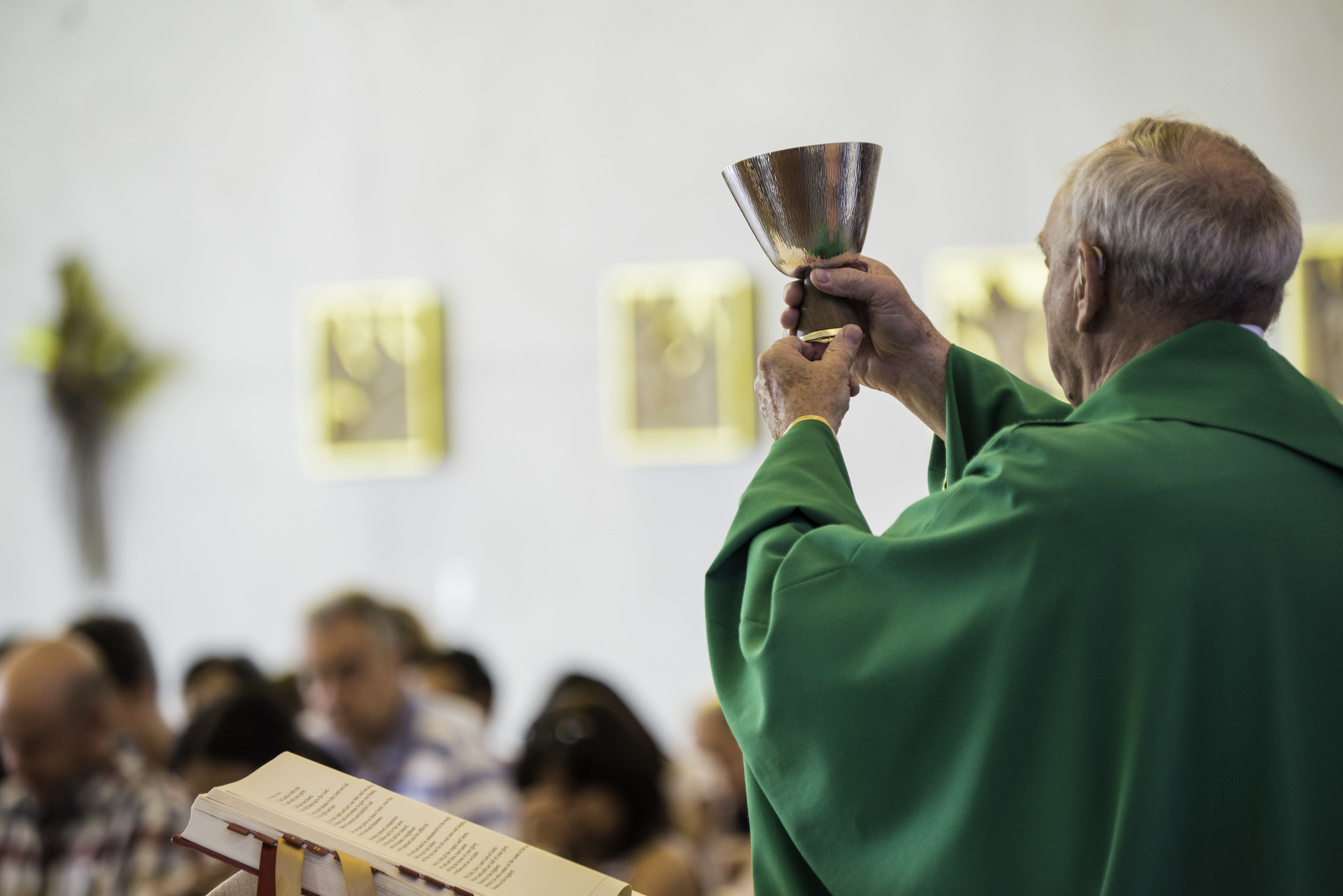
In the course of the Passover meal, “Jesus took a loaf of bread, and after blessing it” – giving thanks to God for it, as the priest does in the Offertory at Mass, using almost the same words – “he broke it, gave it to his disciples, and said, ‘Take; eat; this is my body.’ Then he took a cup, and after giving thanks, he gave it to them, saying, ‘Drink from it, all of you, for this is my blood of the covenant, which is poured out for many for the forgiveness of sins.’”
Now Christ is God the Son. His words must have actually brought about what they meant. What still seemed to be bread and wine, then, were now his body, given for us, and his blood, shed for us.
In fact, the Greek words the evangelists use for given and shed could equally well be translated, “is being given” and “is being shed.” From the moment Christ spoke them, his body and blood were truly present, given and shed, separated from each other as in a sacrifice.
But Christ gave his body and shed his blood for us on the cross. Therefore, what happened at the Last Supper and what happened on the cross were the very same event: namely, Christ’s sacrifice of himself to his Father for our salvation.
The only difference, says the Catechism of the Catholic Church, was that on the cross it was “bloody,” while at the Last Supper it was sacramental.
But then Jesus added, “Do this as a remembrance of me.” Here, the Greek word is anamnesis – practically untranslatable into English. “Remembrance” suggests recollection of the past, but anamnesis means making it present.
Obediently, ever since, Christians have celebrated the Mass – never as merely “a representation, however sacred,” of the Lord’s Supper, says Pope Francis, but in the firm belief that “the sacrifice of Christ” – the Last Supper/crucifixion – ”and the sacrifice of the Eucharist are one single sacrifice.”
In the Last Supper/crucifixion, Christ sacrificed himself for us, once and for all. That sacrifice cannot be repeated. However, “a vague memory” of it would be useless to us; we need to be present.
Accordingly, the Catechism says, Jesus left us “a visible sacrifice (as the nature of man demands).” The Mass continuously re – presents his one sacrifice to us sacramentally, perpetuating its memory and applying its saving power to the forgiveness of our daily sins. It becomes visible to the eyes of faith at the consecration of the Mass, when Christ appears on the altar as sacrificed; that is, with his blood (under the appearance of wine) separated from his body (under the appearance of bread).
“The body of Christ is sacrificed,” but, “precisely as sacrificed, is living,” said Pope Benedict XVI. Christ did not remain among the dead; he passed through death and rose again with his wounded body glorified. Accordingly, at Mass, the priest “mingles” his body and blood in the chalice, for in his Resurrection, Christ’s blood was reunited to his body, flowing again in his veins as before.
The Mass, then, is the anamnesis of Christ’s saving actions; in their “liturgical celebration,” the Catechism says, “they become in a certain way present and real.”
On Holy Thursday evening, therefore, if people ask us where we are going, we can truly say “to Christ’s Last Supper.” On Good Friday, if they ask Were You There When They Crucified My Lord? we can truly answer “Yes!”
The Mass is not a “spectacle,” says Pope Francis. As we enter the church, we should think: I am going to participate in Jesus’ Last Supper, to see him crucified on Calvary.
We go to Mass not “to get something out of it,” but to acknowledge, in thanksgiving (eucharistia), what God has done for us and for our salvation.
Father Hawkswell is again teaching The Catholic Faith in Plain English, with new insights in both print and YouTube form at beholdvancouver.org/catholic-faith-course. Father is also teaching the course in person on Sundays from 2 to 4 p.m. at the John Paul II Pastoral Centre (4885 Saint John Paul II Way, 33rd Avenue and Willow Street, Vancouver) and on Mondays from 10 a.m. to noon in St. Anthony’s Church Hall, 2347 Inglewood Avenue, West Vancouver. Next week’s topic is “Holy Week.”







