


When asking my students about their favourite Scripture passages, I heard a wide range of responses. Some relate to Adam and Eve, or to Noah; others appreciate the New Testament, specifically the parable of Good Samaritan. One girl shared her love of the story of Jesus washing the disciples’ feet, and I told them that my favourite account is that of Jesus seeking out the Samaritan woman at the well.
Each of these stories reveals something different about God. God created us in his image, out of love; yet we live in a sinful world because of the Fall. God saved Noah and others from death because of faith. God sent Jesus to show people how to love one another through service, and to remind us that we need to seek out the marginalized, just as he did.
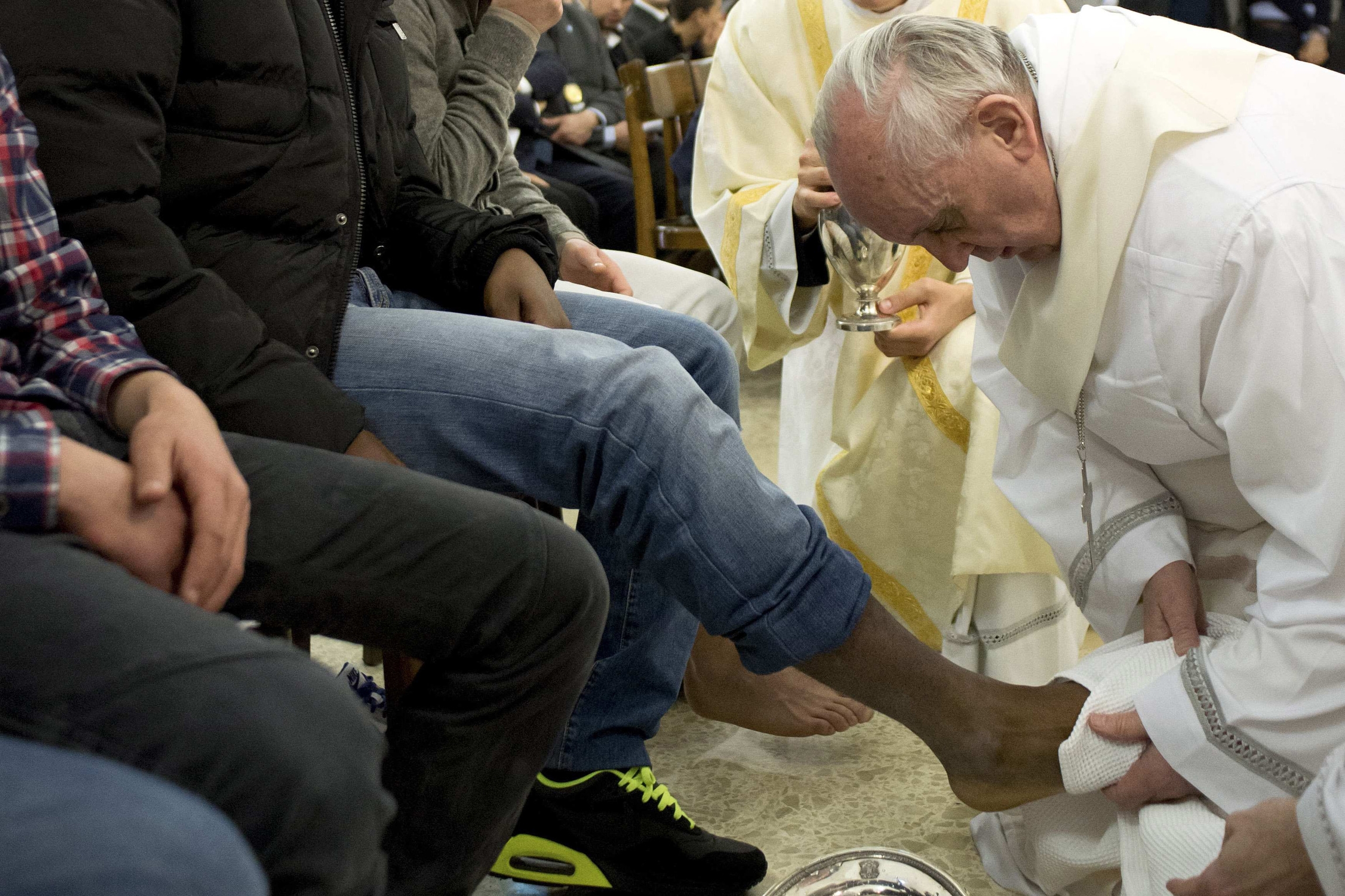
Ten years ago, in the early days of his papacy, Pope Francis brought these final two messages together. I remember the media coverage: our new Pope had impressed secular news agencies with his breaking of tradition. Throughout the world, during Holy Thursday Mass, priests symbolically wash the feet of 12 people as a remembrance of Jesus’ act of service to his 12 apostles at the Last Supper.
Popes in modern times have traditionally washed the feet of other priests either in St. Peter’s or in the Basilica of St. John Lateran, but Pope Francis made history by visiting the Casal del Marmo Youth Detention Centre on the outskirts of Rome, where he washed the feet of 12 prisoners, including two women and two Muslims.
In the Gospel of John, we hear of how Jesus washed the disciples’ feet before the Passover meal. He went on to tell them, “If I, therefore, the master and teacher, have washed your feet, you ought to wash one another’s feet. I have given you a model to follow, so that as I have done for you, you should also do” (Jn 13: 14-15). It is one thing to accept Christ’s love for us and yet another to realize that the acceptance of this gift comes with the expectation that we share love with others, through service.
Pope Francis not only re-enacted the symbolic washing of the feet, but truly acted upon his call as a humble servant of Christ. In his homily at the prison he stated, “It is the example of the Lord. He was the most important but he washed the feet of others. The most important must be at the service of others.” Recognizing his new role as “the most important” earthly figure in the Catholic Church, he likewise knew that regardless of position, we must all unite in the Body of Christ.
In John 4, we hear how Jesus deliberately sought out a woman with a sinful past. She had, presumably, visited the well in the heat of the day to avoid meeting others. Jewish people did not associate with Samaritans; unmarried men and women wouldn’t have interacted; and a woman filled with shame would avoid people to avoid criticism and judgement.
I love this story because despite these factors, Jesus sought out this woman. He knew exactly where to find her, he compassionately spoke with her, revealed his divinity to her through his knowledge of her life’s story, and asked her for a drink. In exchange, he offered her the living water (Jn 4: 7-10).
Pope Francis acts upon this Gospel as well in the washing of the prisoners’ feet. He knew where to find these people who had made mistakes in their lives. Instead of avoiding them, he made the effort to go and meet them where they were. He offered them the gift of Christ’s love through his service and asked other priests to do the same: “We need to go out, then, in order to experience our own anointing (as priests) … to the outskirts where there is suffering, bloodshed, blindness that longs for sight, and prisoners in thrall to many evil masters.”
As we celebrate the 10th anniversary of Pope Francis’ papacy, let us follow his lead in embracing Christ’s call to serve others and to seek the lost and marginalized in our daily lives.







