

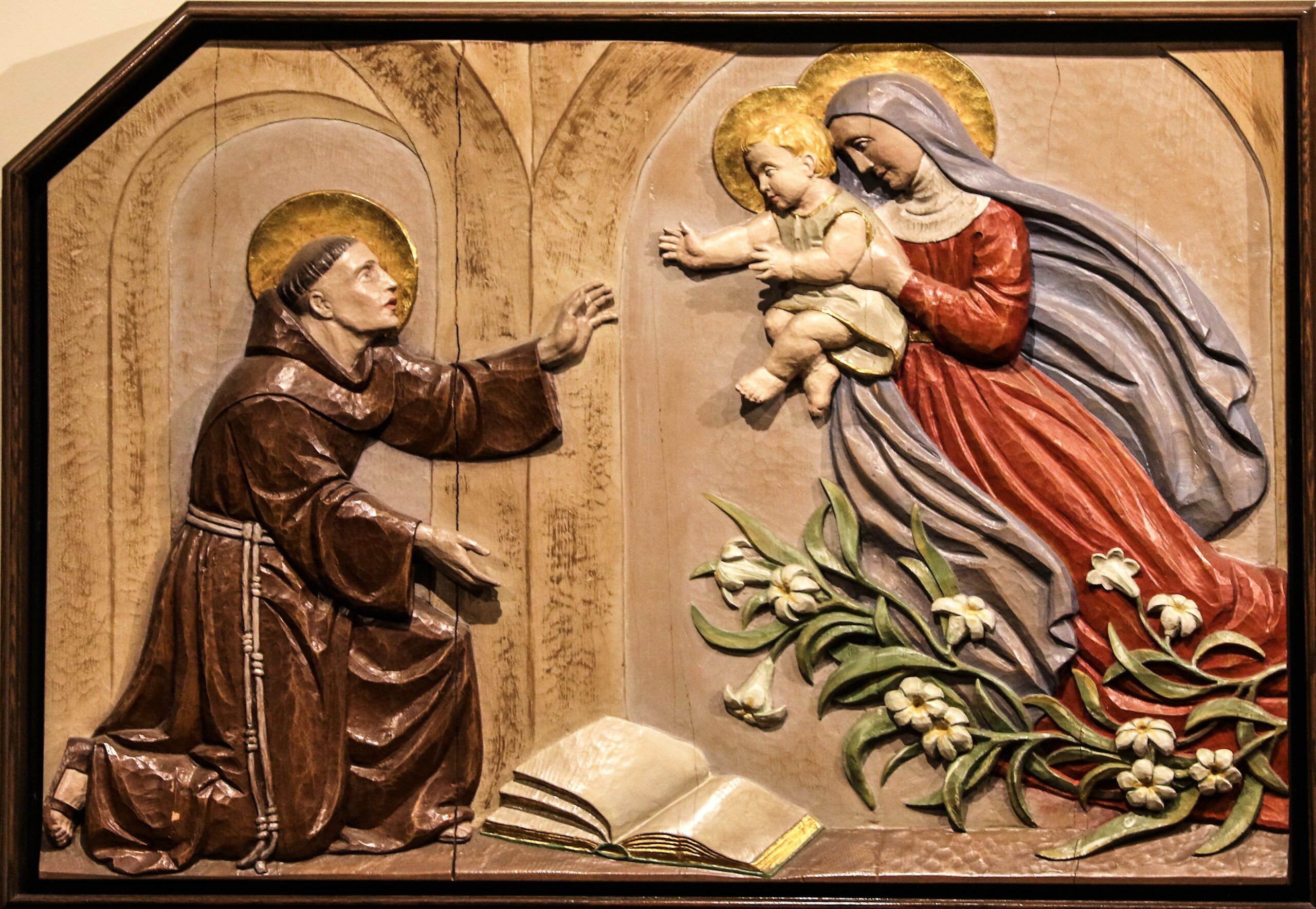

St. Anthony of Padua, or of Lisbon, was born Aug. 15, 1195, in Lisbon, Portugal. He is one of the most popular saints and is venerated all over the world as the patron saint for lost articles.
Anthony’s baptismal name was Fernando. He entered the Canons who followed the Rule of St. Augustine, first at St. Vincent’s Monastery in Lisbon and later at that of the Holy Cross in Coimbra. He immersed himself into the study of Sacred Scriptures and of the Church Fathers. In 1220, the relics of the first five Franciscan missionaries who were martyred in Morocco were exposed for veneration. Their example inspired Fernando to join the Franciscans.
When he joined the Franciscans, Fernando took the name Anthony. He set out to Morocco with the desire for martyrdom. But he got extremely sick and needed to return to Portugal. The return voyage was blown off-course and the party arrived in Italy. In 1221, Anthony participated in the “Chapter of the Mats” in Assisi and met St. Francis. Due to his poor health, Anthony lived quietly for a period in the hermitage of San Paolo at Forli in northern Italy.
One day, at a celebration of a priestly ordination, the scheduled speaker failed to arrive and Anthony was asked to improvise for the occasion. Anthony showed himself to be endowed with such knowledge and eloquence that the superiors assigned him to preaching. Hence, Anthony spent the last 10 years of his life preaching in Italy and France, working for the conversion of lost souls. St. Francis also asked Anthony to teach the friars theology. Pope Benedict XVI said, “Anthony laid the foundations of Franciscan theology which, cultivated by other outstanding thinkers, was to reach its apex with St. Bonaventure of Bagnoregio and Bl. Duns Scotus.”
According to St. Anthony, prayer is structured in four indispensable attitudes. Benedict XVI explained: “The first step in prayer is confidently opening one’s heart to God; this is not merely accepting a word but opening one’s heart to God’s presence. Next, is speaking with him affectionately, seeing him present with oneself; then a very natural thing presenting our needs to him; and lastly, praising and thanking him.”
The Holy Father said, “It is only the prayerful soul that can progress in spiritual life: this is the privileged object of St. Anthony’s preaching. He is thoroughly familiar with the shortcomings of human nature, with our tendency to lapse into sin, which is why he continuously urges us to fight the inclination to avidity, pride, and impurity; instead of practising the virtues of poverty and generosity, of humility and obedience, of chastity and of purity.”
These moral teachings of St. Anthony remind me of the beautiful Prayer of St. Ephrem, which is widely used by the Eastern Churches during Lent:
“Lord and Master of my life, spare me from the spirit of indifference, despair, lust for power, and idle chatter. Instead, bestow on me, your servant, the spirit of integrity, humility, patience, and love. Yes, O Lord and King, let me see my own sins and not judge my brothers and sisters; for you are blessed forever and ever. Amen.”
The Franciscan theology is Christ-centred and invites people to contemplate the mysteries of the Lord’s humanity. St. Anthony saw the dignity of the human person reflected on Jesus crucified. He said, “Nowhere other than looking at himself in the mirror of the Cross can man better understand how much he is worth” St. Anthony contemplated the mystery of the Incarnation and one of the most well known incident of his life is the apparition of the Child Jesus.
St. Anthony had a great love for Our Lady. It is said that he urged people to daily recite three Hail Marys. When he was close to death, Anthony longed to be taken to the St. Mary Mother of God Friary in Padua. After receiving the anointing of the sick, he intoned his favourite Marian hymn, O Glorious Lady. He died on 13 June, 1231, and due to the many miracles received through his intercession, he was canonized on May 30, 1232. In 1946, he was declared a Doctor of the Church.
Share your thoughts. Send us a letter to the editor.
聖安多尼為迷失的靈魂而辛勞
帕多瓦的聖安多尼,或里斯本的聖安多尼,於1195年8月15日出生於葡萄牙里斯本。他是最受歡迎的聖人之一,被全世界尊為失落物品的主保聖人。
安多尼的洗禮名字是費爾南多。他進入了遵循聖奧斯定規則的修院,首先是在裡斯本的聖文德修道院,後來是在科英布拉的聖十字修道院。他沉浸在對聖經和教父的研究中。1220年,在摩洛哥殉道的前五名方濟各會傳教士的聖髑被展視和受敬禮。他們的榜樣激勵了費爾南多加入方濟各會。
當他加入方濟各會時,費爾南多取名安多尼。他帶著殉道的願望出發前往摩洛哥。但他病得很重,需要返回葡萄牙。回程被吹離航線,一行人抵達義大利。1221年,安多尼參加了阿西西的『墊子大會』,並遇到了聖方濟各。由於健康情況不佳,安多尼在義大利北部弗利的聖保羅修道院安靜地生活了一段時間。
有一天,在一次司鐸晉鐸慶祝活動上,預定的演講者沒有到達,安多尼被要求作臨時的講者。安多尼表現出自己被賦予了如此多的知識和口才,以至於長上指派他去講道。因此,安多尼在生命的最後十年裡在義大利和法國傳道,為迷失的靈魂的皈依而努力。聖方濟各還請安多尼教授方濟會士神學。教宗本篤十六世說:「安多尼奠定了方濟各會神學的基礎,在其他傑出思想家的培養下,與班約里的文德和真福懂思高一起達到了頂峰。
根據聖安多尼的說法,祈禱是由四種不可或缺的態度構成的。本篤十六世解釋說:『禱告的第一步是有信心地向天主敞開心扉;這不僅僅是接受一句話,而是向天主的同在敞開心扉。接下來,是深情地與祂交談,看到祂與自己一起;然後是一件非常自然的事情,向祂提出我們的需要;最後,讚美和感謝祂。』
教宗說:『聖安多尼講道的重要主題:只有虔誠祈禱的靈魂才能在靈修生活中進步。他完全熟悉人性的缺點,熟悉我們陷入罪惡的傾向,這就是為什麼他不斷敦促我們與貪婪、驕傲和不純潔的傾向作鬥爭;反而是要實踐貧窮和慷慨、謙卑和服從、貞潔和純潔的美德。』
聖安多尼的這些道德教義讓我想起了美麗的聖厄弗冷祈禱文,它在四旬期被東方教會廣泛使用:
『我生命的主宰和主,請饒我脫離冷漠、絕望、權力慾望和閒聊的精神。相反,請賜予我,你的僕人,正直、謙卑、耐心和愛的精神。是的,主、君王啊,讓我看到自己的罪,不要審判我的兄弟姐妹;因為你是聖的,直到永遠。亞孟。』
方濟各會神學以基督為中心,邀請人們默想主人性的奧秘。聖安多尼看到人的尊嚴反映在耶穌被釘十字架上。他說:『除了在十字架的鏡子裡看著自己之外,沒有其他地方人可以更好地理解他的價值。』聖安多尼思考道成肉身的奧秘,他一生中最著名的事件之一是聖嬰耶穌的顯現。
聖安多尼對聖母有著極大的愛。據說他敦促人們每天背誦三篇聖母經。當他接近死亡時,安多尼渴望被帶到帕多瓦的聖瑪利,天主之母修道會。在接受病人傅油聖事後,他吟唱了他最喜歡的瑪麗安讚美詩“哦,光榮的聖母”。他於 1231 年 6 月 13 日去世,由於他的代禱帶來了許多奇跡,他於 1232 年 5 月 30 日被封為聖人。1946年,他被宣佈為聖師。







