


4th Sunday of Lent, Year C
First Reading: Josh 5:9a, 10-12
Second Reading: 2 Cor 5:17-21
Gospel Reading: Lk 15:1-3, 11-32
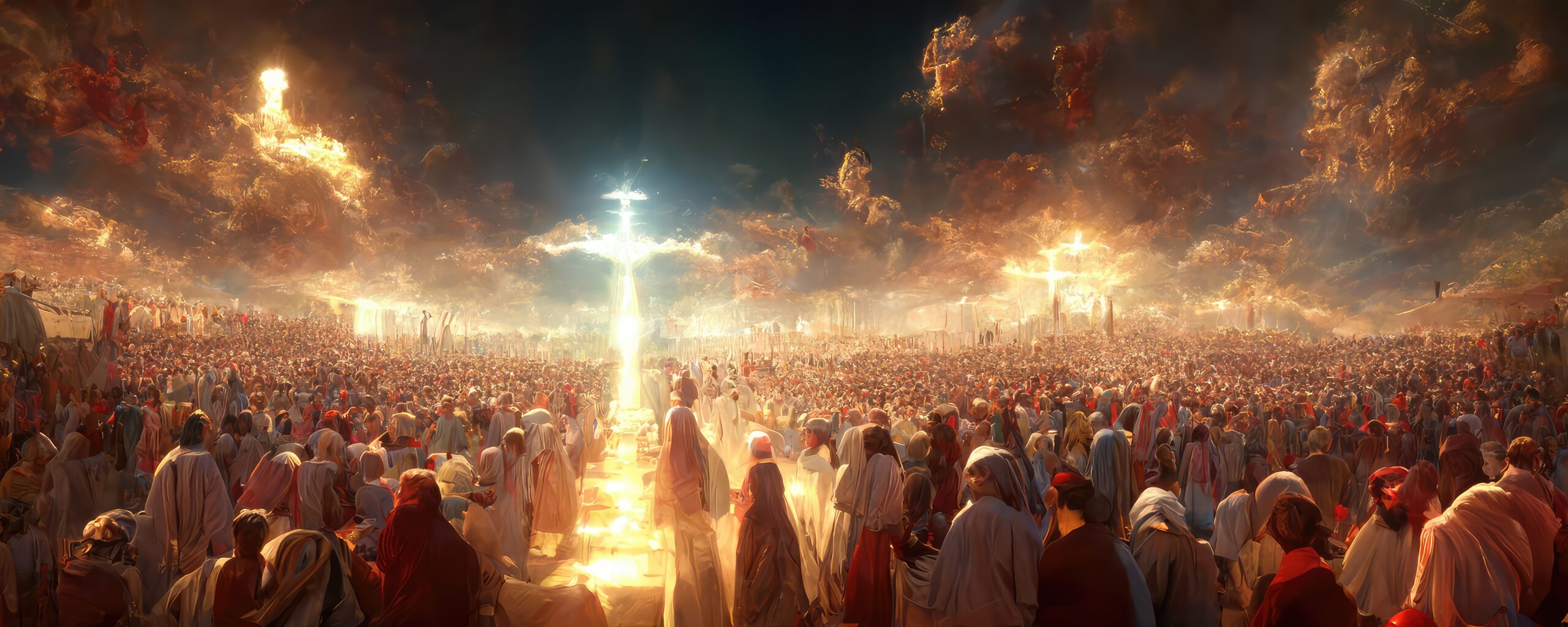
We cannot even imagine what God has prepared for those who love him. However, the images in this Sunday’s readings can help.
Jesus, “the light of the world,” opens the eyes of a blind man. “The Lord does not see as mortals see; they look on the outward appearance, but the Lord looks on the heart.” Once you were darkness, “but now in the Lord you are light.” Therefore, “live as children of the light – for the fruit of the light is found in all that is good and right and true.”
Light and seeing mean knowledge or understanding. In heaven, we will know.
“Don’t keep me in the dark,” we say. “Suddenly a light went on”; it “dawned on him.” We discuss things “in light of” our knowledge. We ask the knowledgeable to “shed light on the subject.” We lament that some people are “not very bright.”
We all want to know, to see. Indeed, the desire to “be in the know” is what attracts many to “New Age,” which the Vatican’s 2003 document on the subject calls “a contemporary variant of Western esotericism.”
“Esoteric” comes from the Greek esoterikos, meaning “inner” and hence “secret,” denoting “something meant for only a few experts or initiates.” New Age esotericism dates back to Gnostic groups “which grew up in the early days of Christianity” and “gained momentum at the time of the Reformation in Europe” by claiming to know “the mysteries of the universe,” says the Vatican document.
Gnosticism, which comes from the Greek gnosis (“knowledge”), is the theory of salvation by knowledge: the recurring error of those who claim to have exclusive knowledge of divine things from their own religious experience, even in contradiction to the Church’s teaching authority.
In contrast, Christians claim that God is light and Jesus the light of the world. In fact, “light” appears in some 260 verses of the Bible.
For God, “darkness itself is not dark, and night shines as day.” In the beginning, God said, “let there be light.” When the Egyptians would not release the Israelites, God cast Egypt into dense darkness, but “all the Israelites had light where they dwelt.” When the Israelites did leave Egypt, God went before them as “a column of fire to give them light,” so that they could travel by night as well as by day.
God’s law is our light. “The command of the Lord is clear, enlightening the eye.” “The revelation of your words sheds light, giving understanding to the simple.” “The path of the just is like shining light, that grows in brilliance till perfect day.”
Since God has become man, “the people who walked in darkness have seen a great light.” “He came among us a man to lead mankind from darkness into the light of faith.”
“No follower of mine shall ever walk in darkness; no, he shall possess the light of life,” Jesus said. “I have come into the world as its light, to keep anyone who believes in me from remaining in the dark.”
John, the evangelist who says most about love, says almost as much about light. “Here, then, is the message we have heard from him and announce to you: that God is light; in him there is no darkness.” In fact, love is light. “The man who claims to be in light, hating his brother all the while, is in darkness.” “The man who continues in the light is the one who loves his brother.”
The Catechism calls baptism “enlightenment,” because the baptized “are enlightened in their understanding.” As members of Christ’s Mystical Body, they are “the light of the world,” because they are configured to the Word, “the true light that enlightens every man.”
At our own baptism, the priest prayed, “You have been enlightened by Christ. Walk always as a child of the light and keep the flame of faith alive in your heart.”
Father Hawkswell is again teaching The Catholic Faith in Plain English, with new insights in both print and YouTube form at beholdvancouver.org/catholic-faith-course. Father is also teaching the course in person on Sundays from 2 to 4 p.m. at the John Paul II Pastoral Centre (4885 Saint John Paul II Way, 33rd Avenue and Willow Street, Vancouver) and on Mondays from 10 a.m. to noon in St. Anthony’s Church Hall, 2347 Inglewood Avenue, West Vancouver. Next week’s topic is “Sin and Forgiveness.”







