


3rd Sunday of Lent, Year A
First Reading: Ex 17:3-7
Second Reading: Rom 5:1-2, 5-8
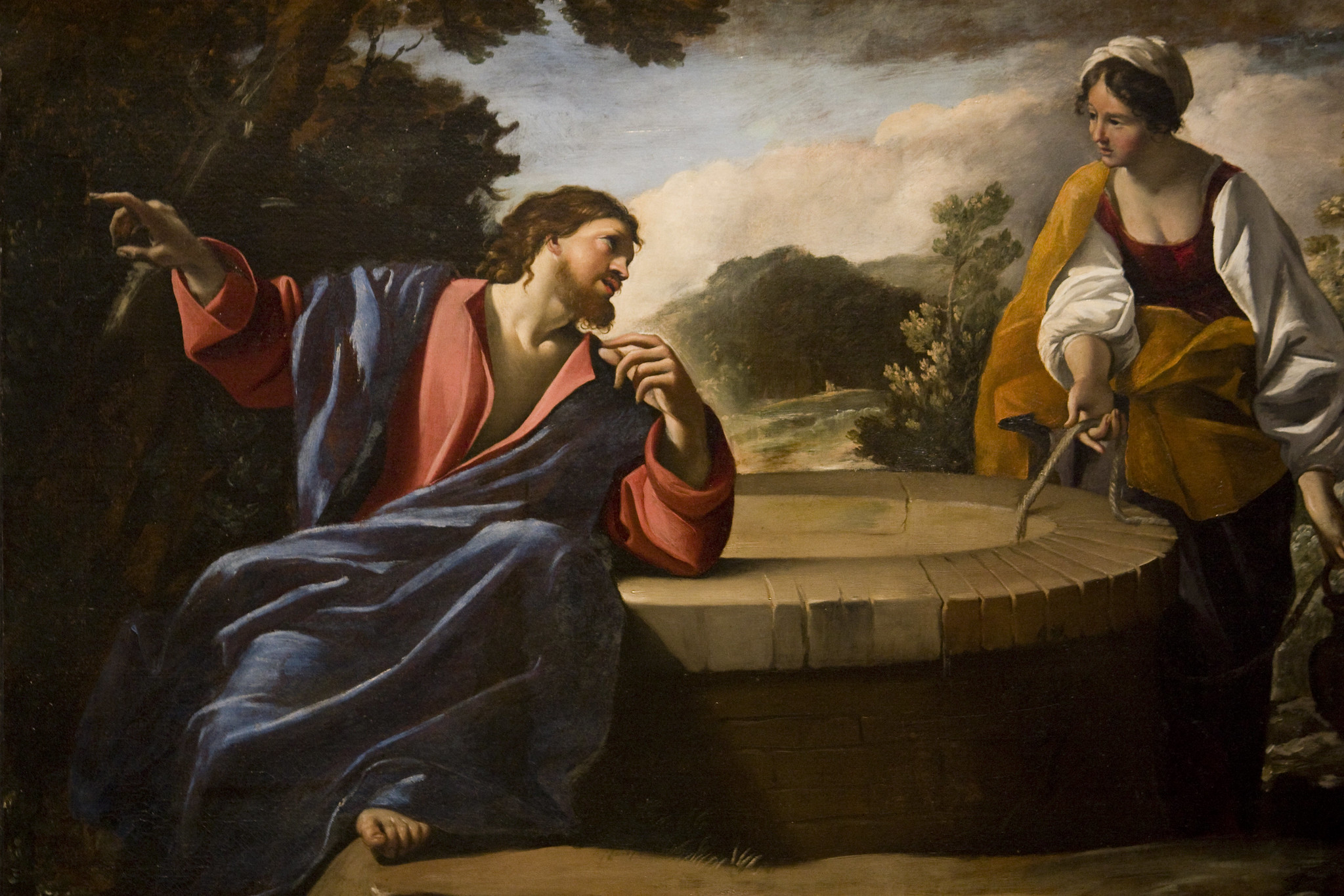
Gospel Reading: Jn 4:5-42
In the beginning, God created humans, like a potter making pots or a child forming play-dough. He impressed upon them the image of himself. He even planned to divinize them: to make them gods, like himself, as the Catechism of the Catholic Church says.
By nature, they were merely his artifacts, things he had made, but he endowed them with the knowledge and freedom they needed to relate to him in inter-personal love—or, unavoidably, in scorn and rejection.
Adam and Eve did reject him. The pot rejected the potter who had made it; the play-dough turned on the child who had formed it, “as though what is made should say of its maker, ‘He made me not!’ or the vessel should say of the potter, ‘He does not understand.’”
“I am the Lord, there is no other,” God said. “I form the light, and create the darkness. I make well-being and create woe: I, the Lord, do all these things…. Woe to him who contends with his Maker: a potsherd among potsherds of the earth!”
However, God did not abandon us. “I went down to the potter’s house and there he was, working at the wheel,” Jeremiah says. “Whenever the object of clay which he was making turned out badly in his hand, he tried again, making of the clay another object of whatever sort he pleased. Then the word of the Lord came to me: ‘Can I not do to you, house of Israel, as this potter has done?’ says the Lord. ‘Indeed, like clay in the hand of the potter, so are you in my hand, house of Israel.’”
Like that potter, God decided to re-make us. For centuries, he prepared us for our re-making.
He chose a people for himself, and “with mighty hand, and with an outstretched arm,” rescued them from slavery in Egypt. When they complained, “Why did you bring us out of Egypt, to kill us and our children and our livestock with thirst?” he patiently provided them with water.
Finally, he sent his own son as one of us to woo us back to him. Notice Jesus’ tact, kindness, sensitivity, and respect toward the Samaritan woman: a woman of a race with whom Jews have no dealings, who has had five husbands and is now living with a man who is not her husband.
However, he did not just teach us how to live; he actually died for us to redeem us from Satan.
The key to God’s amazing behaviour is that he loves us; not just as a sculptor takes pride in his artifacts, but as a father loves his children or a bridegroom his bride.
In general, a father loves his children and a bridegroom his bride because they are lovable – at least partly. In contrast, God loves us not because we are lovable, but because he is love. “While we were still weak … Christ died for the ungodly,” St. Paul says. “While we were still sinners, Christ died for us.”
God is on fire with love for us. He will do anything to win us for himself. Indeed, he has done all he can possibly do: he has taken on our sins and adopted us as his children, making us co-heirs with Christ to his kingdom.
He has even given us his Holy Spirit, through whom his love “has been poured into our hearts,” St. Paul says.
“For a brief moment I abandoned you, but with great tenderness I will take you back,” God said. “In an outburst of wrath, for a moment I hid My face from you; but with enduring love I take pity on you.”
In the face of such love, how can we not love him? As we pray in the Mass’ Opening Prayer, “Father, when we are discouraged by our weakness, give us confidence in your love.”
Father Hawkswell is again teaching The Catholic Faith in Plain English, with new insights in both print and YouTube form at beholdvancouver.org/catholic-faith-course. Father is also teaching the course in person on Sundays from 2 to 4 p.m. at the John Paul II Pastoral Centre (4885 Saint John Paul II Way, 33rd Avenue and Willow Street, Vancouver) and on Mondays from 10 a.m. to noon in St. Anthony’s Church Hall, 2347 Inglewood Avenue, West Vancouver. Next week’s topic is “The Last Seven Commandments.”







