

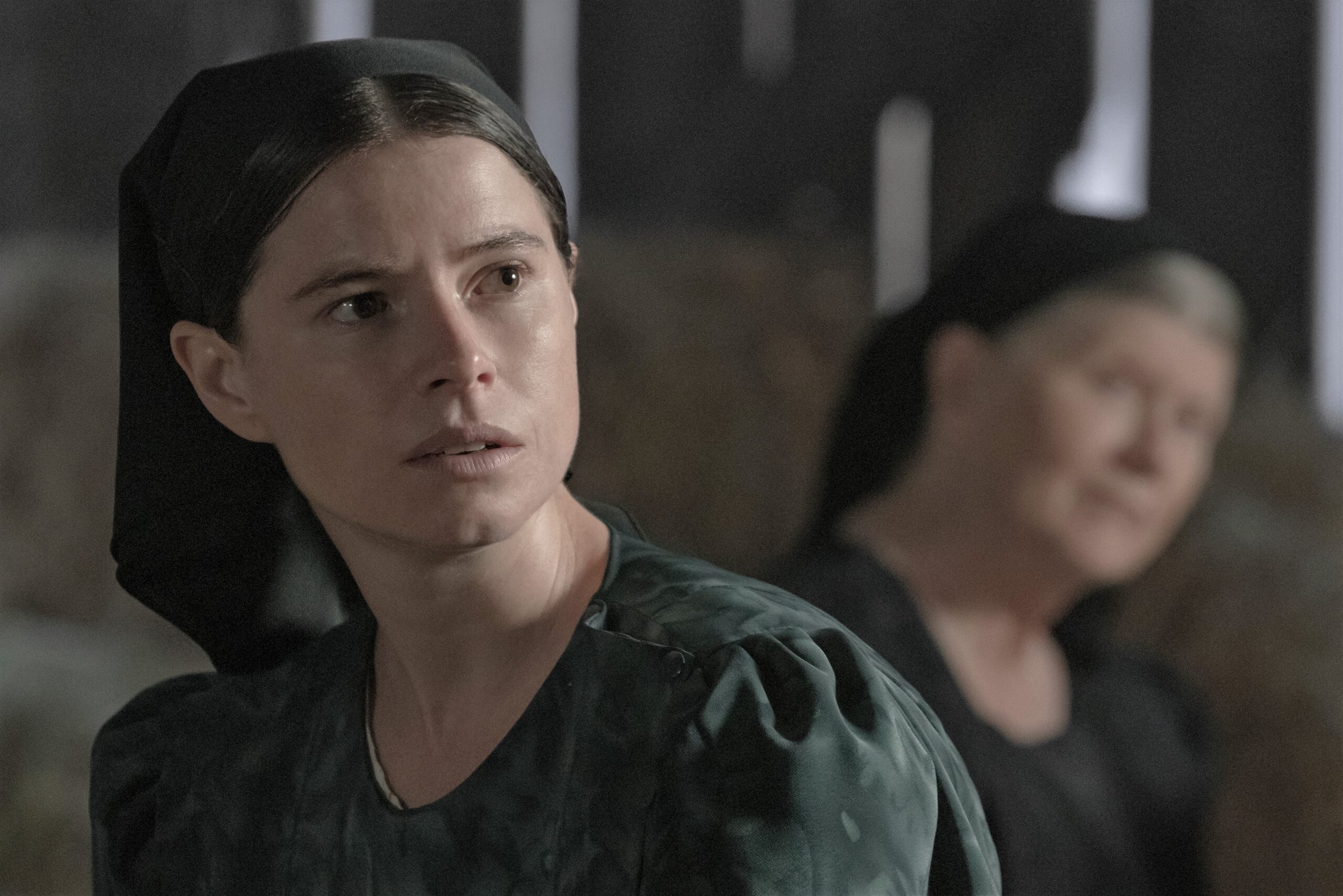

Despite being frequently announced as a possible award winner in a number of categories, Women Talking is a film which is unlikely to prove widely popular among moviegoers.
Filmed in washed out colour so that it’s virtually a black and white movie, the film focuses on a group of women living in a strict religious community somewhere in North America – though Canada seems the likely place as the film is based on Canadian writer Miriam Toews’ best-selling novel. As such, its staring point is actually the horrendous event which took place some years ago in Bolivia when 100 men in a religious sect were found guilty of mass rape and abuse of women members of the community. The result, as the film avows at the start, is a product of Toews’ artistic imagination – not, in any way a pseudo-documentary and certainly not a depiction of an actual Amish or similar community.
Using the core of the historical events as a starting point, Women Talking posits the idea that a few women representatives in the tight-knit faith-bound community have to decide what to do after one of their number has been raped. While the men have left them to go to town to “rescue” the perpetrator, the women have to decide whether to say nothing, to leave the community, or, as ordered by the men, to forgive the criminal at risk of eternal damnation if they do not forgive as their religion dictates.
The only witness to all of this is a young male schoolteacher returning to the community after the death of his exiled mother.
The film is essentially concerned with portraying the debate as the small group of women weigh the pros and cons of the issue. And this may well be the first problem for the viewer as the film, for much of its relatively short running time, lives up to its title and consists simply of women talking.
Of course, a very talky movie can be successful, as is evidenced by the enduring appeal of Twelve Angry Men. However, while the script does allow for a number of incidental dramas, including a budding romance between one of the women and the young school teacher – the son of an exiled woman, who has recently returned to the colony – some may find such incidents inadequate to maintain interest. Moreover, talk and depiction of the abuse the women routinely suffer may be a further reason viewers may not wish to continue watching the film.
A further problem for some may be that because of the slow pacing of the film one has time to question events indicated in the film.
Does the inclusion of the male schoolteacher, albeit in a neutral observational role, really make sense? Would the men really abandon the women entirely for a day and a night? Would the women really be able to organize themselves so that they are willing democratically to turn over to a few representatives such a revolutionary decision? Would the women really be able to carry out a speedy “escape” if that is what the representatives determine? Would illiterate women so suppressed really be able to argue so cogently about mores to which they have been forced to comply from childhood?
These concerns, distracting as they may be, are decidedly unfortunate as the film is superbly acted by a talented ensemble, brilliantly directed by Sarah Polley, beautifully photographed, and varied in tone from the horrifically serious to the lightly comical.
Its main focus, however, is the current issues brought to the forefront by the “Me Too” movement. In fact, this may well be yet another distraction as the viewer may simply see the film as an allegory of the history of women’s progress towards social equality with men.
Talk of the subservient role of women, the risks involved in demanding freedom and equality, and the challenges feminine demands faced from both sexes, may appear to be just a sketch of feminist history in western countries, a history which is still unfolding.
The film has a far greater relevance when one considers the current plight of women in other countries. Indeed, it is only in this light that the plot makes sense as the women in the film are aware that there is a larger world, outside their community, where things are different – where women play a leading role in society, where they are able to get an education, where they have freedom and are not suppressed by male supported religious tenets.
This is a further enormous difficulty as the film may be interpreted simply and unfairly as an anti-religious tract. Some may view it above all as a reflection of inherently anti-feminist values of important religious creeds and, therefore, as a reason to reject religion altogether. This is a film which needs to be approached with critical caution.wever, those who are able to stay with the film
Women Talking is a well-made film, though it is one which may have narrow appeal and one which is decidedly flawed. However, because of its very obvious merits, one can understand why it is in contention for so many film awards, unlikely as it is to be chosen for many.







