The B.C. Catholic is starting a regular page featuring excerpts from homilies and other talks in the Archdiocese of Vancouver. This week we offer a selection of edited remarks from Archbishop Miller. We’re currently looking for a name for the series, so if you have a suggestion please send it to Letters to the Editor at letters@rcav.org.
The disciples had ‘slow moments’ as well
“In today’s Gospel, Jesus reprimands the disciples who were discussing the shortage of bread they confronted because they had neglected to replenish their supply before getting into the boat to return to the other side of the lake. Not for the first time, the Lord scolds them for being slow on the uptake, for not seeing what he is really doing among them, for being stuck in the purely mundane and ordinary rather than open to higher, spiritual realities – to something new.”
“In a strange way this is a kind of consolation to me – and it might also be for you. How so? When I realize that I have missed many an opportunity to respond generously or wholeheartedly to the mission entrusted to me, I can take comfort in the fact that the first disciples had their slow moments as well.”
…
In a series of questions, Jesus reproves them for their spiritual blindness. He even says, “Why are you talking about having no bread? Do you still not perceive or understand? Are your hearts hardened?” (Mk 8:17).
This expression of “hardness of heart” occurs many times in Jesus’ teaching … Everywhere Jesus encountered people who were closed or suspicious of his message. He was “saddened by their hardness,” their closed hearts. Even though faced with this hardness, he sees his mission to make hearts more docile, to make them open and receptive to his teaching. Perhaps we, too, on occasion have let a hardness of heart creep into our way of dealing with certain situations, when we might have preferred security instead of launching into the deep.”
Homily during meeting of the Assembly of Western Bishops St. Paul’s, Richmond, Feb. 14
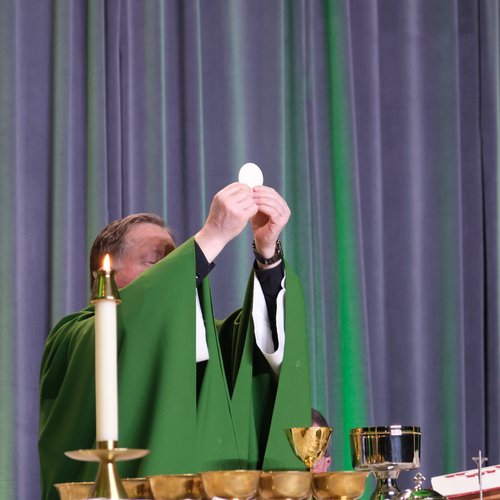
Archbishop Miller celebrating Mass at the Catholic Educators’ Conference. (Nicholas Elbers photo)
Thanks for our educators
“Thank you for fostering in your students a personal relationship with Jesus Christ in the family of the Church.”
I pray that you will never underestimate the value that your witness plays in shaping the lives of the young people entrusted to your care. You mould, shape, and sculpt the citizens and saints of tomorrow. Among all the professions that serve humankind yours surely ranks first in pride of place. Despite the inevitable discouragement and frustration that at times accompany your vocation as Catholic educators, always remember that yours is a noble, supernatural calling. Your vocation and mission are at the heart of the Church of today and tomorrow.”
…
“Let us give the Lord thanks and praise for calling us, each one of us in our own way, to be educators who share in the Church’s evangelizing mission, and who give Gospel witness to their students and colleagues. As long as we’re behind him, and not presuming to be out front, Jesus is drawing us to himself.”
Remarks at Catholic Educators’ Conference Vancouver Convention Centre, Feb. 17
“Communicate the beauty of God’s word”
“As leaders in the parish family, you are called to foster the unity in mission of all those engaged in ministry to others.
You have a vocation, not because of a personal feeling, but because you have accepted God’s invitation to place yourself at the service of Christ and your parish community.
Effective leaders, those after the Lord’s own heart, are men and women of deep faith, a faith that is founded and fed on their encounter and friendship with Jesus and the Sacraments of the Church. They must also be able to communicate the beauty of God’s word, always by the witness of striving to live according to the Gospel, but also sometimes by reverent proclamation of God’s love revealed in Jesus Christ. Those engaged in ministry must know and adhere to the Church’s teaching, be team players and have a missionary spirit, exuding the joy of the Gospel.
According to Pope Francis, every parish, like St. Mary’s, should be completely mission-oriented, although he admits this has not yet been sufficiently achieved. Every dimension of parish life is to be understood from this perspective of missionary outreach.”
Address to St. Mary’s Ministry leaders John Paul II Pastoral Centre, Feb. 18
‘We come and go’
“The ashes we shall receive indicate that a life of worldliness, one lived only for oneself, is like the dust that is carried away by a slight gust of wind. They remind us that we are but weak, frail, mortal beings. They recall “who we are and whence we come. They bring us back to the essential truth of our lives: the Lord alone is God and we are the work of his hands.” Centuries and millennia pass, and we come and go.”
…
“Dear brothers and sisters, let’s begin Lent this year with a firm desire for an inner change of heart. The ancient gesture of receiving ashes “is essentially an act of humility that means: I recognize myself for what I am, a frail creature, made from earth and destined to return to earth, yet also made in the image of God and destined for him.” At the end of our Lenten journey, we will encounter with joy the Lord of life, who alone gives meaning to the ashes we shall receive on our forehead.”
“Let’s face it. It’s not always easy to accept the Church’s teaching authority, especially if it runs counter to what I instinctively hold to. A couple of reasons are behind this unease.
“First, the modern mind has grown up with the idea of being emancipated or liberated from any authority, and not just Church authority. Thinking for yourself, judging for yourself, and having the courage to use your own reason shape the fundamental attitude of our contemporaries.”
…
“Many people today think that truth can never really be attained; it can only be pursued. This leads to the often-spouted line “my truth is just as good as yours.” All teaching authority, ecclesial or otherwise, is thus regarded with suspicion and as an enemy of tolerance. With this cultural baggage, it’s no wonder that people find it difficult to accept the Magisterium.”
…
“Catholics should show a fundamental openness, a docility to all Church teaching, and mustn’t deny the Pope’s or bishop’s right to teach authoritatively. The kind of response expected, however, does vary according to the way in which the Magisterium proposes a specific teaching.
“Docility to episcopal and papal teaching doesn’t do away with the need to offer necessary constructive criticism of persons or institutions in the Church. Yet such criticism should be offered with charity where remedies can be applied, not theatrically and in public.”
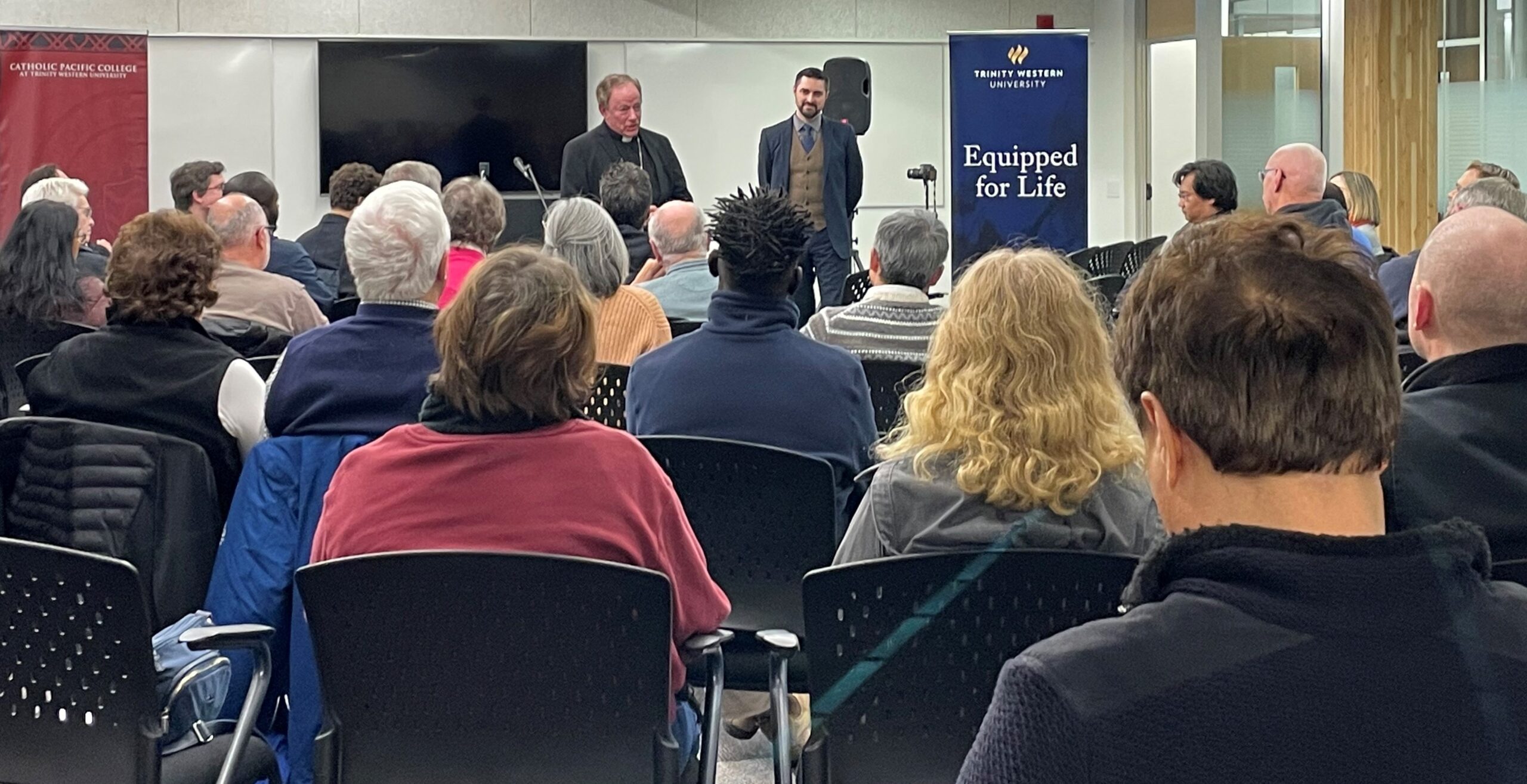
Lecture, Who Has Authority in the Catholic Church? Catholic Pacific College, Jan. 25