

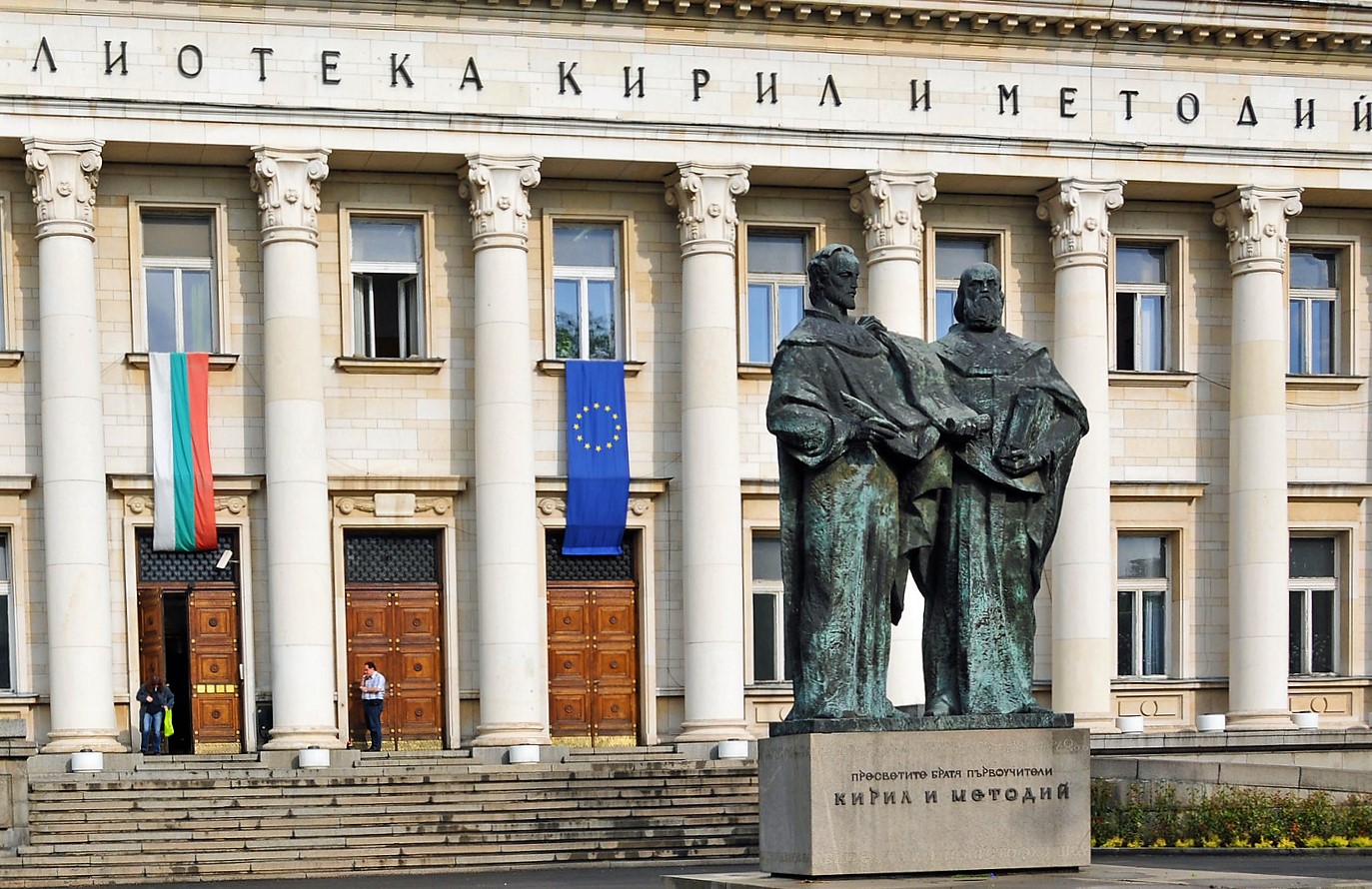

Saints Cyril (826-869) and Methodius (815-885) were blood brothers born in Thessalonica (modern-day Salonika), Greece. Their baptismal names were Constantine and Michael and received the names Cyril and Methodius when they became monks. In those days, a monk’s monastic name had to begin with the same letter as his baptismal name.
The two brothers knew the Slavonic language because many Macedonian Slavs lived in their area. Constantine became a priest and a teacher. He taught so well that he earned the nickname “Philosopher.” In the meantime, his brother Michael became a monk on Mount Olympus after an administrative career and was given the name “Methodius.”
In 862, Ratislav, the Duke of Greater Moravia (in today’s Czech Republic) requested missionaries capable of instructing the Slavs in their own language, and the two brothers were chosen for the task. In preparation for their mission, Constantine invented a Slavic alphabet and translated the Gospels and liturgical books into what is now known as Old Church Slavonic. Their mission was very successful. By translating the liturgy into the Slavonic language the two brothers earned immense popularity.
However, because the brothers used Slavonic and not Latin in the liturgy, they ran into difficulty with the Bavarian priests in the same area. In order to justify themselves, the two brothers travelled to Rome in 867. On the way they stopped in Venice, where they had a heated discussion with the champions of the “trilingual heresy” who claimed that there were only three languages in which it was lawful to worship God: Hebrew, Greek, and Latin.
Pope Adrian II welcomed the two brothers and approved their use of the Slavonic liturgy. Constantine became seriously ill in Rome. Before his death, he became a monk and took the monastic name of Cyril. He prayed: “Lord, my God … hear my prayers and keep the flock you have entrusted to me faithful … Free them from the heresy of the three languages, gather them all in unity, and make the people you have chosen agree in the true faith and confession.”
Cyril died on Feb. 14, 869. His brother Methodius was consecrated bishop and returned to Moravia to continue his missionary work. He died at Velehrad (today’s Czech Republic) on April 6, 884.
Pope Benedict XVI said, “Cyril and Methodius are in fact a classic example of what today is meant by the term ‘inculturation’: every people must integrate the message revealed into its own culture and express its saving truth in its own language. This implies a very demanding effort of ‘translation’ because it requires the identification of the appropriate words to present anew, without distortion, the riches of the revealed word.”
Effort of inculturation is sustained by the conviction of the power of the word of God. Pope Benedict XVI wrote, “The word of God, like the Christian faith itself, has a profoundly intercultural character; it is capable of encountering different cultures and in turn enabling them to encounter one another … inculturation is not to be confused with processes of superficial adaptation, much less with a confused syncretism which would dilute the uniqueness of the Gospel in an attempt to make it more easily accepted. The authentic paradigm of inculturation is the incarnation itself of the Word.”
The Holy Father said, “Cyril asked Christ to deign to speak in Slavonic through him. He introduced his work of translation with the solemn invocation: ‘Listen, O all of you Slav Peoples, listen to the word that comes from God, the word that nourishes souls, the word that leads to the knowledge of God’… Cyril and Methodius were convinced that the individual peoples could not claim to have received the Revelation fully unless they had heard it in their own language and read it in the characters proper to their own alphabet.”
St. John Paul II said, “‘Acculturation’ or ‘inculturation’ will truly be a reflection of the incarnation of the Word when a culture, transformed and regenerated by the Gospel, brings forth from its own living tradition original expressions of Christian life, celebration and thought.”
The Holy Father wrote, “The test of true inculturation is whether people become more committed to their Christian faith because they perceive it more clearly with the eyes of their own culture.”
聖人昆仲引入本土禮儀
聖濟利祿和聖默多狄(815-885)是血緣兄弟生於希臘塞薩洛尼基(現在的薩洛尼卡)。他們領洗的名字是君士坦丁和彌額爾。他們作隱修士時被命名為濟利祿和默多狄。在那些日子里,隱修士的名字必須以與他的洗禮名字相同的字母開頭。
兩兄弟懂斯拉夫語,因為許多馬其頓斯拉夫人住在他們的地區。君士坦丁成了一位神父和教師。他教得非常好,以至於他贏得了「哲學家」的綽號。與此同時,他的兄弟彌額爾在行政生涯結束后成為奧林匹斯山上的一名隱修士,並被命名為『默多狄』。
862年,大摩拉維亞公爵拉蒂斯拉夫(今捷克)要求傳教士能夠用自己的語言指導斯拉夫人,因此兩兄弟被選中執行這項任務。為了準備他們的使命,君士坦丁發明了一種字母表,並將福音和禮儀書籍翻譯成現在被稱為舊教會斯拉夫語的譯本。他們的任務非常成功。通過將禮儀翻譯成斯拉夫語,兩兄弟很受歡迎。
然而,由於兄弟倆在禮儀中使用斯拉夫語而不是拉丁語,他們受到該地區巴伐利亞的神父們所為難。為了證明自己的合理性,兩兄弟於867年前往羅馬。在途中,他們在威尼斯停留,在那裡他們與“三語異端”的擁護者進行了激烈的討論,他們聲稱只有三種語言可以合法地崇拜天主:希伯來語、希臘語和拉丁語。
教宗阿德二世歡迎兩兄弟,並批准他們使用斯拉夫禮儀。君士坦丁在羅馬病重。在他去世之前,也成為一名隱修士,並取了修士名字濟利祿。他禱告說:『主啊,我的天主…垂聽我的禱告,保守你託付給我的羊群忠心。把他們從三種語言的異端中解放出來,把他們聚集在一起,使你所選擇的人在真正的信仰和悔罪中達成一致』。濟利祿於869年2月14日去世。他的兄弟默多狄被祝聖為主教,並返回摩拉維亞繼續他的傳教工作。他於884年4月6日在韋萊赫拉德(今捷克)去世。
教宗本篤十六世說:『濟利祿和默多狄實際上是今天「本土化」一詞的一個典型例子。」:每個民族都必須將所揭示的資訊融入自己的文化中,並用自己的語言表達其救贖真理。這意味著「翻譯」需要付出非常高的努力,因為它需要識別適當的詞語,以重新呈現,而不扭曲,啓示聖言的豐富性。』
本土化的努力是由對天主聖言力量的信念所維持的。教宗本篤十六世寫道:『天主的聖言,就像基督徒的信仰本身一樣,具有深刻的跨文化特徵;它能夠遇到不同的文化,反過來使他們能夠彼此相遇……本土化不應與膚淺的適應過程相混淆,更不要與混淆的混合主義相混淆,因為混合主義會稀釋福音的獨特性,試圖使其更容易被接受。本土化的真正範式是這世界上的道成肉身。』
這教宗說:『濟利祿請求基督屈尊通過他用斯拉夫語說話。他莊嚴地介紹了自己的翻譯工作:「你們所有斯拉夫人民啊,請聽從天主而來的聖言,滋養靈魂的聖言,導致認識天主的聖言。」…… 濟利祿和默多狄確信,除非他們用自己的語言聽到啟示並用適合他們自己的字母表的字符閱讀啟示,否則各個民族不能聲稱已經完全接受了啟示。』
聖若望保祿二世說:『「文化適應」或「本土化」將真正反映道成肉身,當一種文化被福音改變和重生,從自己的活生生傳統的原始表達中帶來基督徒生活、慶祝和思想。』教宗寫道:『真正本土化的考驗是人們是否更加忠於他們的基督徒信仰,因為他們用自己文化的眼睛更清楚地感知它。』







