

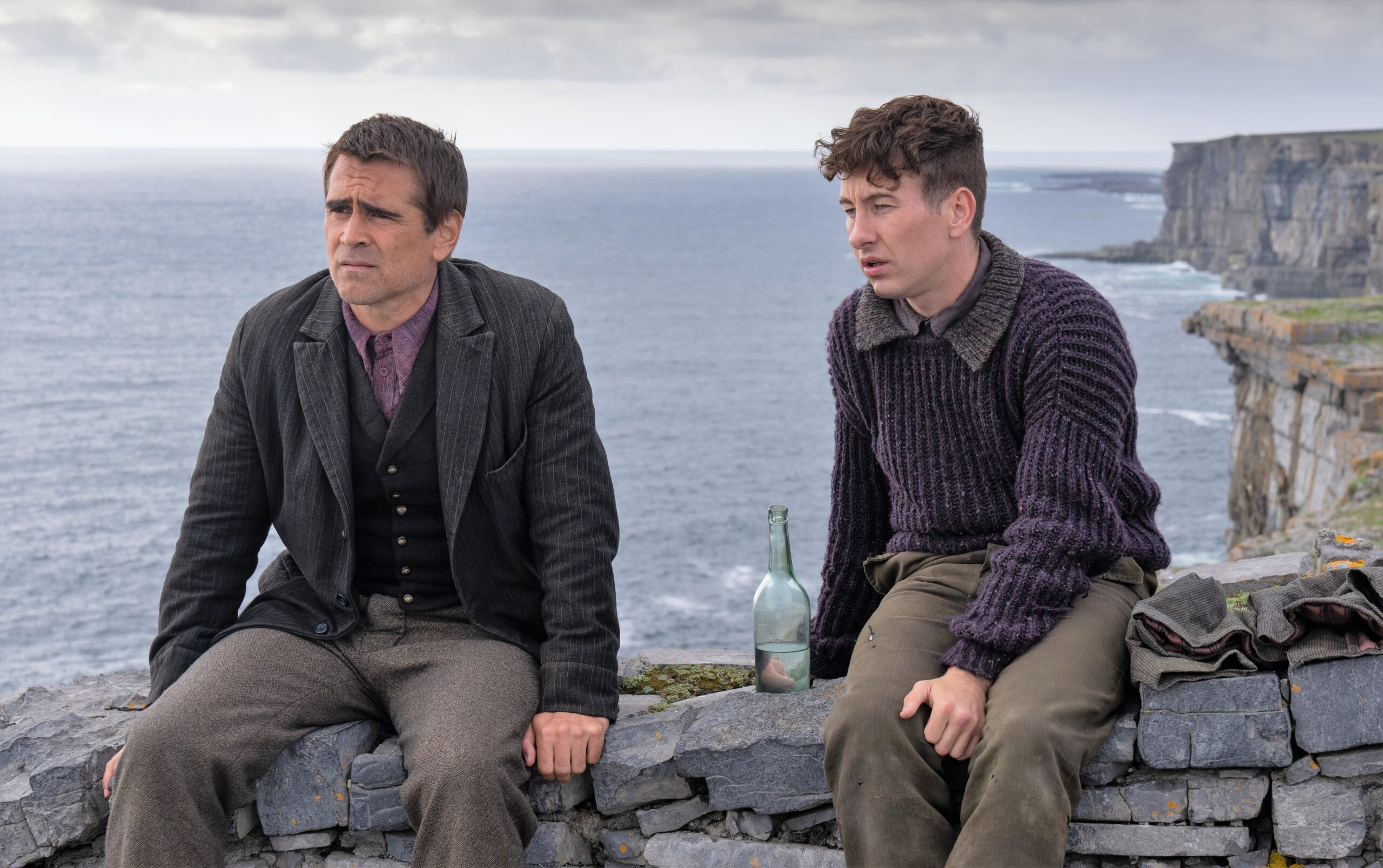

Although it is among the best films of 2022, it is doubtful that The Banshees of Inisherin will find the audience it deserves, partly because if its very quirkiness, partly because it is a comedy with a decidedly dark aspect, and partly because of its weirdly odd premise.
That premise involves two life-long friends who live on a small (and fictitious) island off the coast of Ireland, Inisherin. For no obvious reason, one of the two men informs the other that their life-long friendship is over and that every time his former friend attempts to renew their acquaintance he will cut off one of his own fingers. This inexplicable decision is even more baffling in that if he goes through with the threat, he will be unable to continue to play the violin, for which he is attempting to compose a definitive tune in the Irish folk tradition.
What follows is the logical development of this unusual plot premise. The audience is thus introduced to a memorable group of characters, a series of interactions between the two protagonists and others, and an exploration of life on the island.
In fact, what is being presented is essentially a colour-by-numbers allegory of the civil war that has taken place in Ireland over the last century and the problems posed by the small island being split in its allegiances, both political and religious.
The border (or meeting ground) between north and south is represented by the village pub, the official army by the village policeman, the Church by the parish priest, while the collateral damage of the conflict is represented by the fate of innocent animals, and so on.
All of this may sound dangerously cold, clinical and calculated, but thanks to the effective (and affecting) dialogue, the surprising developments, and the brilliant acting, the result is a film which is always engaging and, surprisingly, often outrageously funny. In large measure, this is because of the clever script, the wonderful supporting cast, and above all, the performances of Colin Farrell and Brendan Gleeson in the lead roles. Those who remember the two actors’ work in In Bruges will not be surprised at this. Together they make The Banshees of Inisherin a memorable and engaging film – and even if parts of it may dismay the viewers, they can always take comfort in the glorious scenery. Indeed, the tragedy of the beautiful land of Ireland is emphasized by the underlying message of all that has been threatened and lost because of the tragic events of its history: its art, its life of fulfillment, and, above all, its sense of united community.
Sadly, the conclusion of the film offers little hope of a more optimistic future. Writer/director Michael McDonagh clearly wishes to identify with neither side of the conflict but rather chooses to emphasize the sad, destructive reality of what apparently still remains a conflict to which there seems to be no final and satisfactory resolution – a conflict which, in his opinion, is quite unreasonable.
The Banshees of Inisherin is indeed a comedy with a tragic message, but the film remains an artistic and unforgettable triumph in its own right – definitely one of the best of 2022.
There is something rather perverse about the film industry in that most of the films currently trending as award worthy are decidedly dark. As society experiences a number of real challenges, including inflation, COVID, the rising spread of influenza, an overdose epidemic, a return of measles, the war in Ukraine, and ongoing concern about environmental disaster, there are apparently few movies of note designed to lift our spirits.
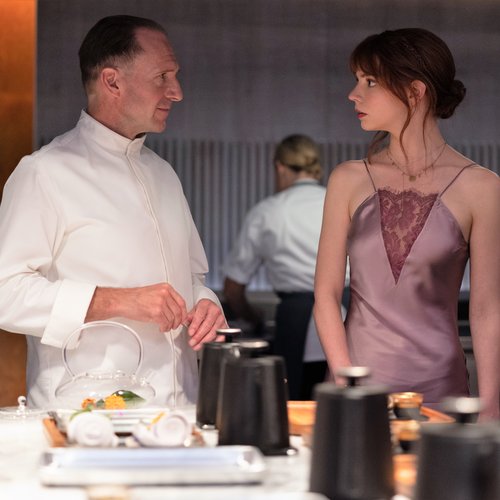
Ralph Fiennes and Anya Taylor-Joy in The Menu, a skillfully made contender for upcoming movie awards, says Alan Charlton. (Eric Zachanowich/Searchlight Pictures)
To date we have been offered, among others, Tar (sexual predator), Emily the Criminal (from innocence to murder), The Banshees of Inisherin (self-mutilation), and Bones and All (cannibalism). Now one can add to the list a comedy/horror movie The Menu.
Like the films listed above, The Menu is skillfully made, well acted and directed, and in creditable contention for upcoming movie awards, and many fans of horror movies will embrace this latest offering in the genre.
The film tells of a group of people attending a dinner on an island, where they have been promised by the world’s greatest chef a dinner to die for. From the beginning, the comedic aspect of the film becomes apparent as one watches a number of wealthy people paying homage to a menu of wildly inventive courses. As they utter the cliches of ecstasy so often mouthed by people apparently trying to impress others (and perhaps themselves) with the sensitivity of their pampered palates, one cannot help but feel that this is all too easy a target for satire. Can they really taste “hints of …”, “subtle infusions of…,” and “daring use of…” esoteric ingredients – or do they merely want to appear to be superior to ordinary diners?
The “ordinary diners” are represented by a woman, Margot, whom one of the guests, Tyler (Nicholas Hoult)oult) , has invited as a last-minute substitute for his intended date. Tyler is determined to impress his date by letting the chef know that he is not only the host’s greatest admirer, but also able to compete in food appreciation jargon with the other gourmets, including food critics and wealthy businessmen.
As the evening progresses, the audience witnesses a menacingly bombastic chef determined to get revenge on those of his patrons who are, in his mind, his enemies. Clearly, the role is inspired by certain real-life chefs popularized on television and is played by Ralph Fiennes with all the restrained savagery he brought to his role in Schindler’s List.
That he is determined to exact revenge provides the horror element – though to the extent that such deeds can be, they are rather less gore-indulgent than one might expect. A subtly threatening maître d’, Elsa (the superb Hong Chau) and a regiment of enthusiastic, chef-worshipping sou-chefs further add to the horror as the film tension mounts to a well-predicted though highly inventive climax. The tension is not lessened despite being laced with heavy-handed satire.
Just in case the audience feels adrift in this world of high-end dining, they still have the character Margot (played superbly by Anya Taylor Joy) to serve as a down-to-earth counterpoint and perhaps a path into the movie for the ordinary viewer – one who is less impressed with the satirized pretentiousness of foodies and over-priced gourmet cooking and who ultimately seeks more plebian taste. Whether Margot’s message that one should always engage in one’s work, at whatever level, with love, actually rings true is certainly questionable considering her own life choices. And in the midst of all the horror, the message certainly becomes overshadowed. But who attends a horror film looking for social significance?
As comedy-horror films go, The Menu is perfectly designed for those who have a taste for it. Those seeking something more pleasing to their palate will have to look elsewhere.
As more and more movies line up in the race for the coming awards season, it becomes increasingly difficult for movie fans to determine which ones to watch. In the light of the widespread positive reception it has already received, many will doubtless want to view Glass Onion, A Knives Out Mystery – soon to be released on Netflix as well as in local movie theatres.

Daniel Craig and Janelle Monáe in Glass Onion: A Knives Out Mystery, “a wildly farcical and entertaining take on the old-fashioned whodunnit genre,” says Alan Charlton. (OSV News photo/John Wilson, Netflix)
Many enjoyed the over-the-top approach of the original Knives Out – a wildly farcical and entertaining take on the old-fashioned whodunnit genre. Glass Onion is clearly an attempt to take advantage of its predecessor’s popularity. To some extent it does follow the formula. A number of people are ingeniously invited to participate in a murder mystery game on the Greek island of a tycoon known to all of them through past association. Unexpectedly, the “world famous” detective Benoit Blanc who played such a significant role in Knives Out is also invited.
To its credit Glass Onion does make a clear attempt to be less predictable than one might expect, while still observing certain essential genre developments. As the guests assemble and are greeted by their host Miles Bron (played by a convincingly slimy Edward Norton), it is apparent that certain tensions among them exist, not least prompted by the presence of a stunning model Cassandra Bran (even her name is a clue in the unfolding mystery). In further observation of the mystery formula, the audience is introduced to the rest of the varied cast of characters, all of whom seem to be equally detestable and potential murderers.
As the introductions are made, accompanied by innumerable chuckles arising from cultural references, the proceedings are set against what seems to be an homage to the James Bond franchise (perhaps prompted by the appearance of Daniel Craig as Benoit Blanc). Its titular dome structure boasts a magnificent car parked on the roof (because there are no roads on the island), a Matisse and a Degas as mere bathroom decorations, and, most importantly, another famous masterpiece which plays a pivotal role in the plot.
In short, the opulent island mansion seems to be as much a set-up for 007 as for a murder mystery, particularly since the plot involves a possibly earth-destroying secret source of energy. All of this is set against a light-hearted comment on the challenges posed by COVID – though some may find the joke a little awkward.
The result of all this is a complex and lengthy (perhaps, too lengthy) set-up for the inevitable murder, though not before certain dark secrets about the group’s past have been revealed.
In fact, though the proceedings are presented with flair and gusto, the whodunnit aspect of the film takes second place to the grandiose style of the setting and the humourous exploration of the past and present lives of the unsavoury host and guests. The result may be somewhat disappointing for murder-mystery fans, especially as when the “solution” is at last revealed it does seem to be more of an afterthought than central to the film’s purpose.
As recompense, with its comical exploration of modern mores and cultural memes, Glass Onion proves to be unexpected in its development. The cast is decked out in a wardrobe which is either gorgeously impressive or (particularly in the case of Benoit Blanc) downright absurd. The star-studded cast enters the proceedings with relish, though Daniel Craig appears to be more uncomfortable than as he wanders in and out of an unconvincing Southern drawl.
Janelle Monae as Cassandra steals every scene in which she appears (clearly a candidate for the best performance Oscar). As a further diversion, the film also invites the audience to play a game of “Spot the Celebrity“ with a number of fleeting and tantalizing glimpses of media stars as varied as Stephen Sondheim and Scott Yoo.
The result is unexpected and complex, diverting and entertaining – but in its approach to the genre, Glass Onion is certainly no Knives Out.
Click here to send us a letter to the editor about this or any other article.







