



My family’s Christmas celebrations would not be complete without Gammy’s cherry bars. My late mother-in-law’s recipes are staple treats at Christmas in our house, and if I failed to make the dense, buttery, almond-flavoured squares with tops swirled with cherry pie filling and dusted with powdered sugar, I’m sure the consensus in our household would be that Christmas is not complete.
There is a sense of completeness or “fullness of time” that is associated with Christmas, both in the theological sense, but also in all the traditions each family carries out annually. It’s common to hear people say, “Christmas isn’t the same without…,” and we can all fill in the blank with our necessary Christmas traditions. Every Christmas, when we make my late in-laws’ recipes, our family is reminded of the ones who completed their fullness of time on this earth, and that we carry on their memory and traditions of love and service to others. When I look at the faded scroll of fax paper (yes, fax paper!) that contains many of these Christmas recipes, sent to my husband 23 years ago shortly before we got engaged, I think of the time that has passed and the fullness of time that we are working towards as a family.
As we progress through Advent, this sense of fullness of time becomes almost urgent. The Church teaches that the moment Christ was born marked the fullness of time. Pope Francis explained this concept in a speech given on Jan. 1, 2016, the Solemnity of the Mother of God. Noting that the term does not point to a time when all was perfect on the earth, the Holy Father said the fullness of time is “when God decided that the time had come to fulfil his promise, that the fullness of time came for humanity. History does not determine the birth of Christ; rather His coming into the world enables history to attain its fullness.”
Christ’s entry into the world as a tiny, helpless baby was part of God’s plan for all of history. This incredible moment in time is what we celebrate every year on Dec. 25. But our own lives are marked by “fullness of time” moments, ultimately culminating in the moment of our death, when our time on this earth is complete and we must face God. This is what John the Baptist has been reminding us of throughout Advent, with his exhortations to stay awake, be alert, and prepare the way of the Lord. Have we taken time this Advent to allow the light of Christ to shine on our lives, to help us to pray and take stock of our time banks? Truth is, no one knows how full their time bank is or when it will be considered full. This is why Advent is such a good time to take part in the sacrament of reconciliation, to help us realize the areas we need to work on in our lives and start over with a clean slate, and especially to help us recognize the preciousness of time.
I think our Christmas traditions, especially the ones connected to past loved ones, can really ground us in why we make this Advent journey towards the Christmas celebration. Every time we make a family recipe or hang a cherished heirloom ornament on the tree, we have opportunities to remember and be grateful for the fullness of time lived out by our loved ones, by the way they were witnesses to faith for us. Traditional holiday activities can be a chance for the whole family to pause, offer thanksgiving, and ask for the grace to use time wisely.
As Pope Francis reminds us: “The fullness of time, then, is the presence of God himself in our history. Now we can see his glory, which shines forth in the poverty of a stable; we can be encouraged and sustained by his Word made ‘little’ in a baby. Thanks to him, our time can find its fullness. The use of our personal time can also find its fullness in the encounter with Jesus Christ, God made man.”
While it might be cherry bars (and peanut butter balls, and biscotti and orange cookies) for my family, it could be any number of traditions for other families – setting up a Nativity set, reading Christmas stories, decorating the tree together. The important part is to slow down, take the time to recognize the significance of these activities as they reflect the fullness of time moments that come to us throughout our lives, but so essentially at Christmas.
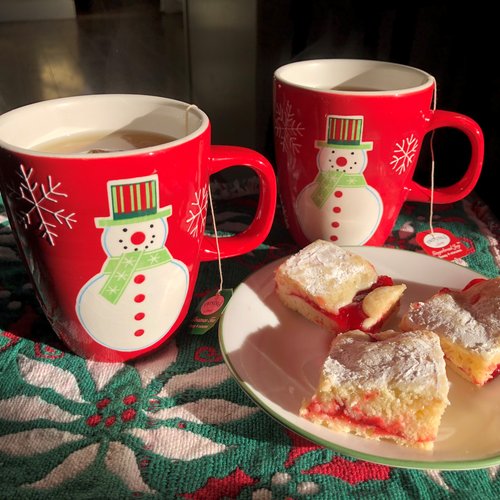
The recipe for cherry bars found here Cherry Bars Recipe: How to Make It (tasteofhome.com) is identical to the one we use every Christmas, except instead of the glaze we dust the cooled bars with powdered sugar.
Lazzuri writes from her home in Nova Scotia, where she lives with her husband, six children, and her mom. She can be reached at clarelazzuri@gmail.com.
Send us a letter to the editor about this or any other article.







