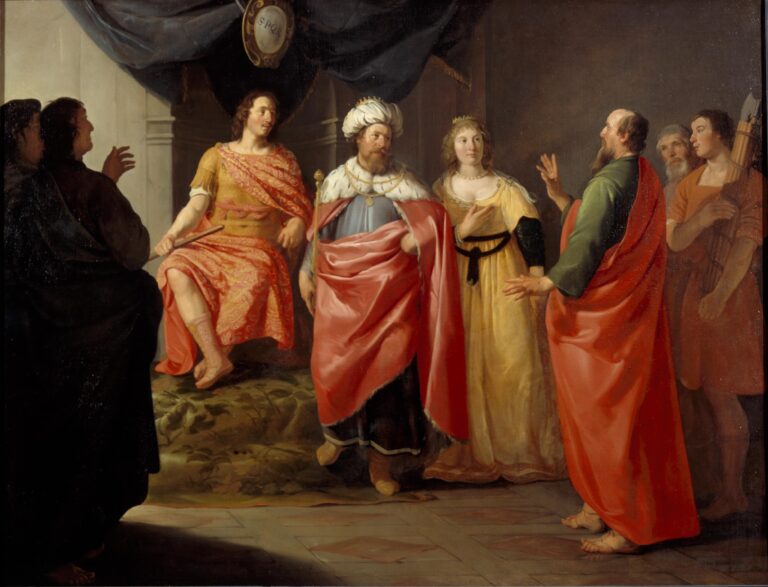

Scott has been leading Madalen and Elijah and a handful of other brave attendees through a Scripture study of the covenants. We’ve been focused on the Old Testament as God prepares the Israelites for the coming of the Messiah. Every story repeats the same message: God blesses man and makes a covenant with him. Man turns his back on God. A sacrifice is demanded, and God makes a covenant with man. Repeat until the ultimate sacrifice is made in Christ our Lord.
For some reason, after years of reading the story of Moses with my kids and hearing it at Mass, I was really hit by a particular detail this time around. The Israelites have been living in Egypt as slaves for 400 years before Moses is called to bring them to the land of promise. Four hundred years as slaves! Their infants have been murdered by the Egyptians only decades before Moses appears. They are miserable! And then this wondrous thing happens: God calls a prophecy to lead the people out of this darkness of enslavement and into their heritage. God proves himself by signs and wonders, plagues that attack the pagans, and finally he literally opens up the sea so the Israelites can walk across on dry ground. They witness not only the disdain that the Egyptians have for them, but the awesome power and might of the God of their people. He sets them free, and one of the first things they do is gripe and ask to go back.
With their own eyes they have seen the works of God on their behalf, yet they long to return to the slavery of Egypt. They are comfortable in their misery. So they whine and say that they were better off back home. Moses leaves them for, like, five minutes and they pull out the Egyptian gold they had held onto to make a pagan demon-god to worship. They are led into this false worship by Aaron, Moses’ brother and a priest of God!
Their lives have been so wrapped up in the paganism and culture of the Egyptians that their own faith is secondary to them. They may call themselves Israelites, but they are living as Egyptians, even when it can only make them slaves.
That is shocking. Or at least it should be shocking. But, of course, it led me to think about what it means to us, as Catholics in a very pagan world.
I really feel that there are a lot of lines being drawn in the sand in our times, a lot of seas being parted for us to either cross or forgo. Our post-Christian culture has no time for the morals of our faith. People around us mock and revile us, without shame or apology. Even natural law and logic are abandoned. How does that affect those of us meant to be in the world, but not of it?
It feels increasingly extreme to take a position of traditional values, and some people cannot withstand the pressure to conform. We are daily surrounded by a pagan culture that dominates media, music, entertainment, news sources, worship, politics, and education. Even some religious leaders, like Aaron, seem attracted by the invitation to blend the worldly and pagan with the worship of God.
So the question is, if a moment of revelation occurred, God calling Christians to exit, to leave behind the entanglements of pagan life, could we do it? Or are our hearts already too entwined? Are we already excusing (or voting for) pro-abortion, anti-human rights politicians? Do we hesitate to think of our religion as true, but instead condemn the zeal of missionaries and participate in subtle forms of pagan worship? Does the word “pagan” make us uncomfortable? Do we heed the direction of celebrities, replacing “outdated” views with more “tolerant” ideas of media gurus? Do we resent the teachings and laws of the Church, thinking that we can mould them to our more enlightened ways while remaining good Catholics? Are our choices for entertainment blush-worthy? Do we think of truth as something relative, using oxymorons like “your truth” instead of “the truth”? Do our friends even know that we profess a faith that is our hope and salvation?
I think that many of us (especially considering the surveys showing less than 30 per cent of Catholics even believe the ultimate teaching of the Eucharist) can admit to struggling with some of these contradictions. But the moment of revelation is now, as God has not stopped calling us to abandon the perverse ways of the world. It isn’t easy, but I believe that the only source of our happiness is the jealous love of God, who tolerates no rival. And that happiness is what will draw others to Christ when the world fails them. Only God will not fail us as he leads us out of slavery and across the Red Sea.