


It’s been said that the most difficult military manoeuvre to execute is the orderly retreat.
I thought of this last week after reading Brett Powell’s Sept. 26 article “As Christendom Falls, the Domestic Church Must Rise, about how Catholics might respond to the fact that Western society no longer manifests vital Christian values, particularly those surrounding family formation.
This fading of Christendom, Powell said, called for a renewed focus on the Christian family. In fact, he said there is a distinct possibility that vibrant Christian families will “be the primary institution by which Christianity remains strong in the West.”
Powell’s is a sound argument, and one that we should all take to heart.
But it also led me to picture Christians as a defeated army, retreating from a battleground, looking desperately to entrench, so as to be better able to regroup and march back into the fray.
This, in turn, led me to recall that one special ingredient is necessary for retreating troops to remain disciplined, accept new orders, and keep their spirits high so that they might gain ultimate victory. And that ingredient is “hope.”
Hope is, of course, one of the Church’s three great theological virtues, the others being faith and charity (aka love).
The New Advent website defines hope in its most general sense as being one’s desire of something together with the expectation of obtaining it. Hope is a theological virtue in the sense that it describes our desiring and expectation of eternal life with God.
And so, in the context of the situation Powell describes and of my thoughts about the importance of hope not only in retaining a Christian presence in society but also in reversing its decline, we might ask ourselves: Are there, in fact, signs Christendom’s fading might be reversed? Or, better yet, are events and attitudes showing any indication whatsoever that the tide might actually be turning? In other words, is there hope?
The answer is yes.
I assert this, not just because, as a Catholic journalist, I am hardwired to believe that the stories I tell make a difference and that ultimately, as Shakespeare wrote, “the truth will out.” No, it’s more than that.
For example, it’s seeing the little signs in public opinion polls like one published last May by ResearchCo.ca, which found that, while Canadians still held quite liberal views on a variety of subjects, the pendulum appeared to be swinging towards more traditional (Christian) views.
For example, while 73 per cent of those surveyed found divorce to be morally acceptable, that number was four percentage points lower than in the previous year. Similarly, acceptance of abortion declined two points, just as approval for prostitution dropped three points. You can access the full report here: https://researchco.ca/2022/05/17/morality-canada/
Not surprisingly, the news media completely ignored this apparent pendulum swing and, instead, concentrated solely on the still-high rate of liberality. It remains to be seen whether the pendulum actually is swinging but, for now, I’m hopeful that it is.
I also find hope in the knowledge that, while Christendom may be fading is the West, it is appears to be burgeoning elsewhere.
Consider, for example, the Dunamis International Gospel Centre in Nigeria, about which I learned last month. It’s been home to the world’s largest Christian church since 2018– the 100,000-seat “International Conference Centre and Glory Dome.” And now I hear that work is underway for an even larger Christian church in Nigeria, the Hand of God Cathedral, which will seat 120,000. Amazing!
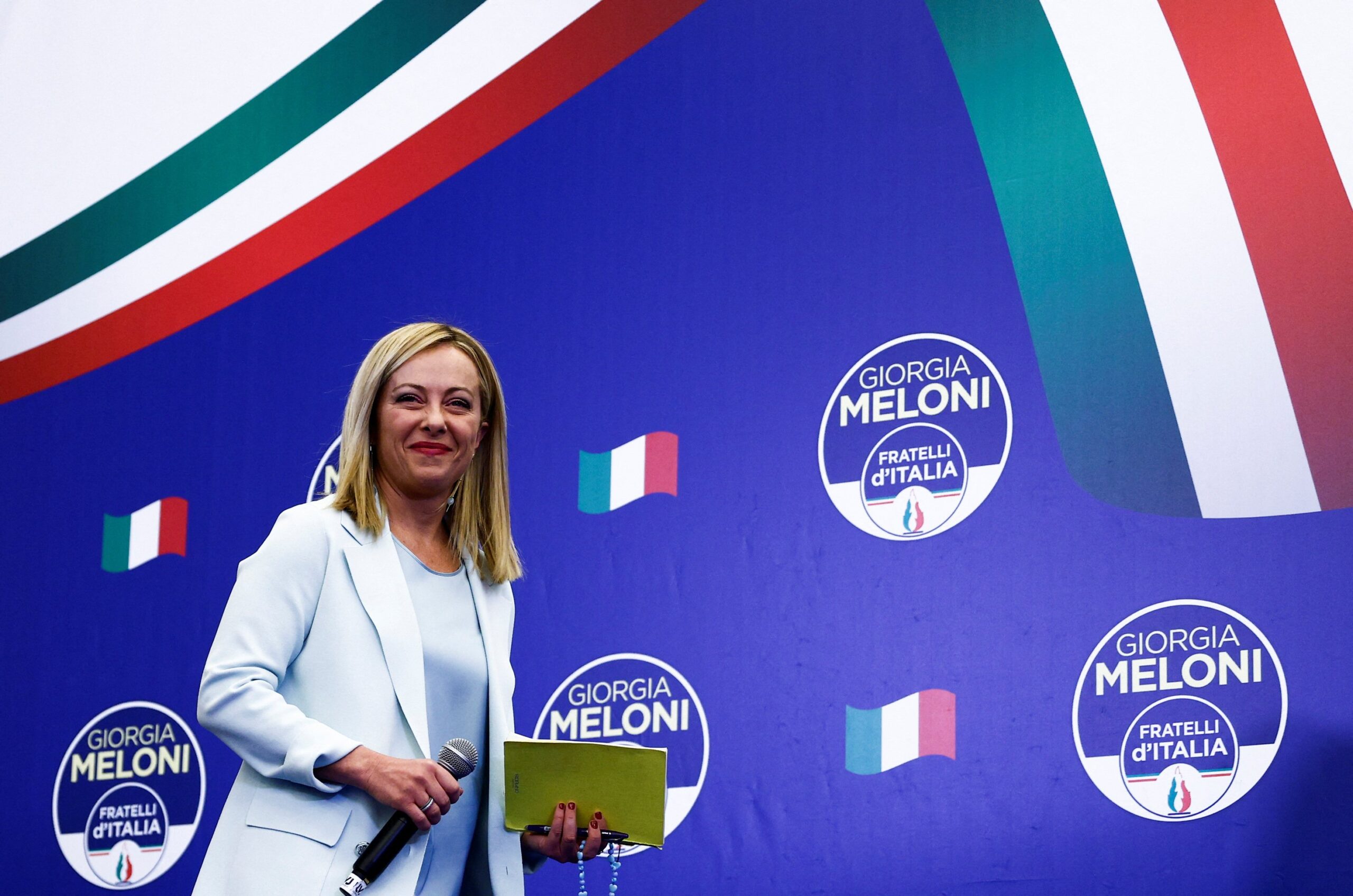
And, finally, what are we to make of Italy’s new prime minister, Giorgia Meloni, who describes herself as a Catholic Christian with conservative social views?
The mainstream media are painting her as a terrifying neo-fascist. But I found it heartening to learn that she recently gave a speech in which she proclaimed, “yes to the culture of life [and] no to the abyss of death,” and then quoted from the great Catholic apologist G.K. Chesterton’s 1905 work, “Heretics.”
“Chesterton wrote more than a century ago, ‘Fires will be kindled to testify that two and two make four. Swords will be drawn to prove that leaves are green in summer,’” Meloni said. “That time has arrived. We are ready.”
“Ready for what?” we might ask. Ready to fight relativism, is the obvious answer. Ready to proclaim that Truth really does exists.
And so, yes, there is reason to be hopeful amid the moral wreckage of modern times. This hope is not a chimera – a thing that is merely wished for but impossible to achieve – but is a realistic expectation based on the revealed truths of our faith.
It is a hope that is necessary to keep our Christian fires burning – fires that, as Powell so eloquently wrote, must be kept burning especially brightly in the hearths of Catholic homes.







