


As much of our world has gone into pause on the occasion of the passing of Queen Elizabeth II, it has doubtless been a time of reflection for millions – each according to the person’s own experience and concerns.
In no small way, for me as a person who has been aware of the power of modern media for much of my life, the events of the last week have resonated enormously as I became markedly aware that through the power of television the world marked the passing of a singularly successful monarch.
As I became aware of the massive media coverage of the events surrounding the death of Elizabeth II, I was particularly conscious of what a significant role the media have played in making those events so central to the lives of millions around the globe. This, of course was especially true in the United Kingdom, Canada, and the United States.
And as one who vividly remembers the time before Elizabeth came to the throne, I could not but reflect on how much more “real” her passing has been made to millions because of the impact of television.
Of course, prior to television, we had the radio, newspapers, books, magazines, and newsreels. So it was that when Princess Elizabeth married Prince Philip we were able avidly to follow details of the event through those forms of media which were then available to us. In the dreary days of post-war Britain, the event became a kind of shared symbol of rebirth, a promise of hope that things would improve. Later, when Elizabeth was crowned, the significance of the event was even more vividly presented.
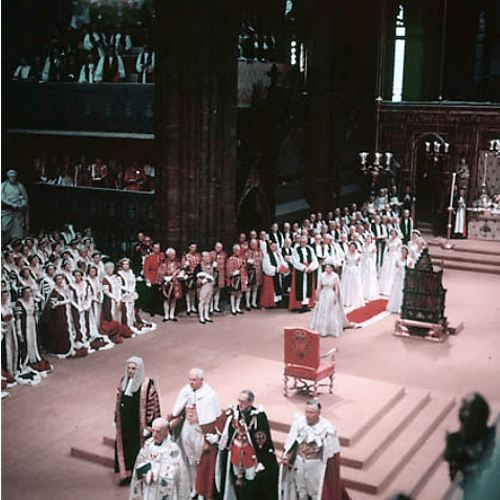
Elizabeth proceeding past the Coronation Chair. (Library and Archives Canada)
I fondly remember watching her coronation in 1953. My older brother having purchased a television for the family – one of the first television sets in our neighbourhood – close to 20 of our friends and relatives squeezed themselves into my parents’ small living room. For several hours, fortified with sausage rolls, sandwiches, and countless pots of tea, we watched, mesmerized, the events of Coronation Day unfold.
We did not complain that all of us were focused on a Pye console set with a 13-inch black and white screen. The pomp and pageantry, even in those grey tones, were for all of us not only interesting, but also a further fascinating reminder that we had survived the dark days of the Second World War and could now look forward to a new Elizabethan age.
Of course, all of us had been schooled to regard the age of the first Elizabeth as a golden time in Britain’s history: the time of Elizabeth, of Drake and Raleigh, of Shakespeare and Marlowe, of the defeat of the Spanish Armada, and the time of glorious British achievement. It little mattered that we were taking in an altogether simplistic, not to say inaccurate and misleading, view of history. We happily watched Elizabeth progress in the golden coach; we watched the parade of bands and military; we watched the visiting dignitaries (the most endearing of whom was the lively Queen of Tonga), and we were thrilled by the promise of it all.
Then, as the ceremony unfolded, again thanks to the “new” medium of television, we were able to follow with rapt attention every moment of that rich ceremony. It was a grandeur that we had never before experienced. And, of course, we all proudly congratulated each other as we asserted that the Brits really know how to do this sort of thing splendidly! It was, indeed, a unifying event for the country.
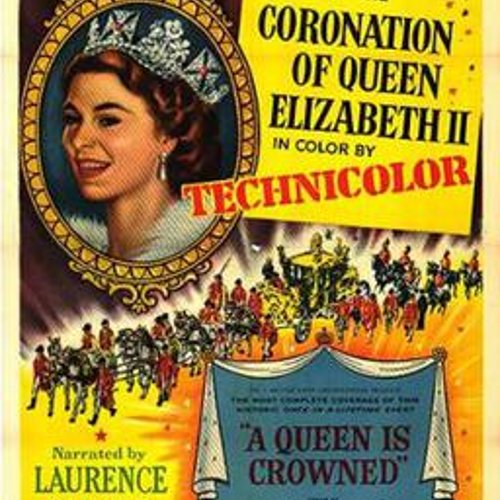
Afterwards, thanks to the wonders of cinematic achievement, a few days later, we were able to experience much of it again in the rapidly produced film A Queen is Crowned with commentary by no less a personage than Sir Laurence Olivier and script by famed playwright Christopher Fry – this time in “glorious technicolor”. It was a further reminder of promised and significant glory – one that could now be shared with the rest of the world. All of this was truly prologue to what followed.
Throughout her long reign, Queen Elizabeth certainly did all that she could to fulfill that early promise – and the world recognized it. Her passing did indeed become a world event, one which has been universally marked in a significant way
Whether the achievements of the second Elizabethan Age will be remembered with as much British pride as the first, time alone will tell. However, one thing has already been amply demonstrated. Clearly, in her historical reign, marked as it was by a multitude of great events, Elizabeth was a witness to many changes. Among them, she saw, as did many of us, the expansion of the media. This was most evidenced by the fact that for several days, every public moment of the events surrounding her death was given vivid television coverage. Millions of viewers were able to participate in those events in a manner which 70 years ago would have seemed impossible.
Ironically enough, however, the moment causes one to wonder if it will ever be repeated. Television audiences tend to be comprised of older adults. More and more, young people focus their attention on whichever of the many streaming services to which they currently subscribe. Instead of watching a television set, they focus on their hand-held devices. It’s almost as though things have gone full circle and we are back to those 13-inch screens, albeit in vivid colour.
Through the media that were then available, the young Elizabeth gave to the people of Britain (and, indeed, to some extent to the rest of the world) a promise of great expectations. Today, people are offered a bewildering array of choices. Young people no longer congregate around a television set. They have a myriad of choices for information and entertainment. The media are far more complex, offering an array of options that tends to divide rather than unite. The death of Elizabeth marks the introduction to a new reign and a new world. One wonders if in the future, that world will ever be quite as united in an experience as it has been in recent weeks. Perhaps the forthcoming coronation of King Charles III will be the last time that television viewers world-wide will tune in together and share in a common experience.







