

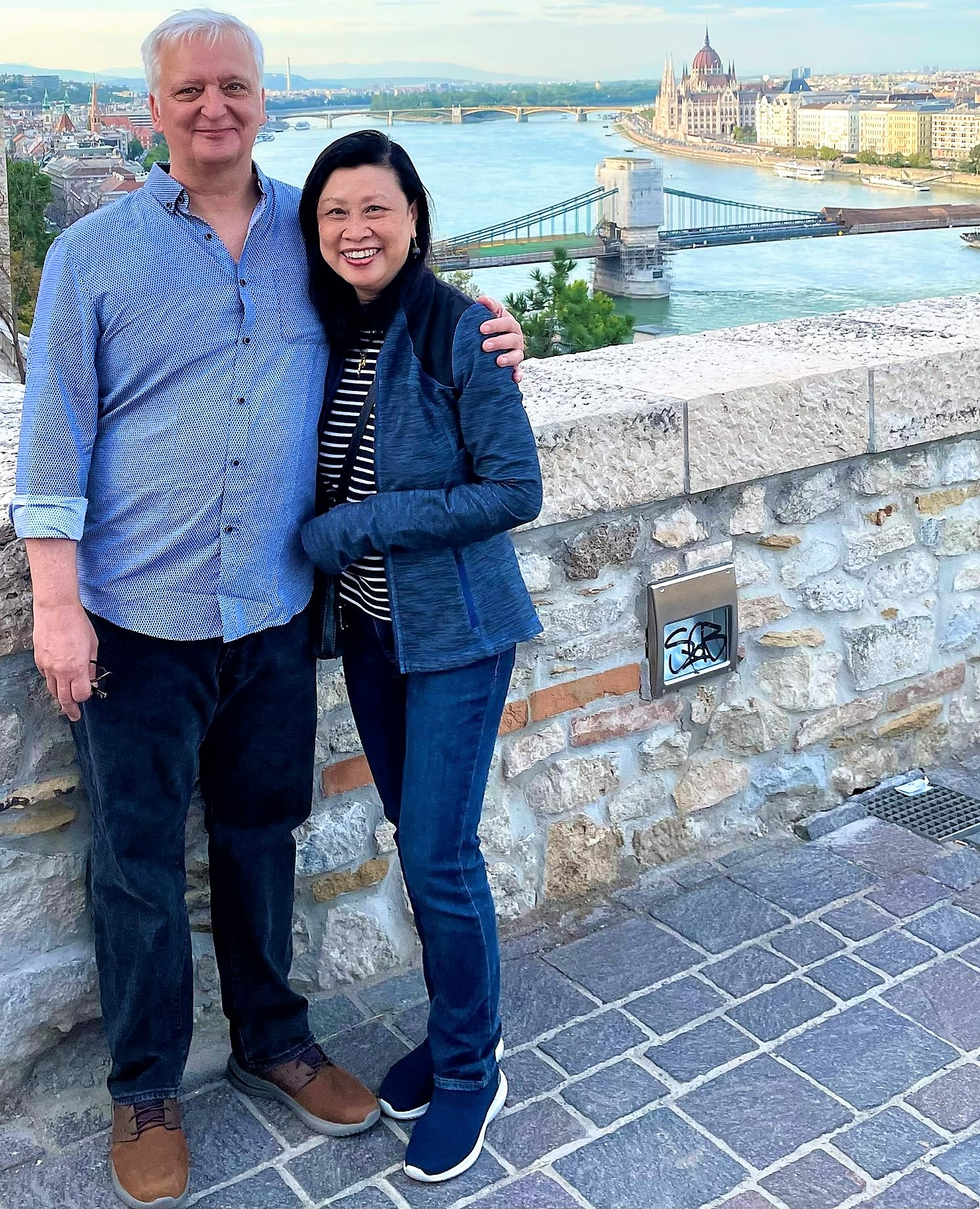

As I read about Terry O’Neill’s recent pilgrimage to Oberammergau (“Spiritual blessings from an earthly pilgrimage,” Sept. 12), I was inspired to share my own pilgrimage story.
My husband and I had been looking forward to our European pilgrimage for some time. Excited at the opportunity to commune with fellow Catholics to visit significant religious sites in Hungary, Poland, Austria, the Czech Republic, and Germany, it was to be no small event in our already busy life.
We eagerly looked forward to the break, albeit not a relaxing one, as the hectic schedule before us promised to fill 12 days with early morning starts, rapid-fire sightseeing, daily Masses, and long rides in a bus with 30 other pilgrims, mainly from Ontario.
It turned out that our trip was a spiritual awakening, but not the kind we had anticipated.
The pain kicked in around 4 a.m. on the day after we arrived in Budapest. Don tried to walk it off, thinking that it was just an upset stomach or trapped gas, but it didn’t go away. By 6:30 the pain was so bad that, armed with the address of a nearby hospital, we hopped into a cab in search of a doctor who could help give him some relief.
We arrived at the hospital, only to be sent by the sentry at the door to another part of the hospital a few doors down. There, the receptionist gave us an address to another place, saying we were in the wrong facility. It was an orthopedic trauma centre. We were sent back to the hospital entrance we had originally come from!
Don’s pain wasn’t subsiding, so we insisted on seeing a doctor. The sentry who had sent us away in the early hours of the morning reluctantly acquiesced and told us to go upstairs. There we waited another two hours before a doctor finally saw us.
After taking down our particulars, the doctor told us that he could not diagnose or treat Don because the hotel we were staying in was in the wrong district! It had to do with the Hungarian health system’s funding, he explained. After a cursory abdominal examination he sent us away to yet another facility – the Emergency Department of the Budapest University Hospital. At this third hospital Don was finally admitted at 10:30, four hours after we had left the hotel.
Wife or not, I was not allowed into the ER. I was to learn that they put Don through a battery of tests and scans revealing an inflamed and severely infected appendix. It was “a mess,” the doctor confided after she removed it in an emergency operation that night.
Letting go
Don told me later that his hospital stay was the most surreal experience in his life. Lying in a ward with four other men in a century-old building with faded pre-war art decor finishings and staff who only spoke Hungarian, he wondered whether he had stepped into another dimension and that this would be where he would say his final goodbyes. His mind wandered deliriously as they administered pain meds through a steady IV drip in his arm and he stared up at the cavernous ceilings searching for some heavenly assistance. After several hours, he began to grasp how little control he had over what was happening or what was to happen to him.

I had read somewhere that the correct translation of the oft-quoted adage “Be still and know that I am God” is “Let go and know that I am God.” I cannot help but believe that this was the message we were prompted to comprehend during this chaotic day and the following days of recovery in Budapest.
I used to organize conferences and plan events for a living. That makes me a planner, someone who likes to control the flow of things to a T. I do not consider myself necessarily OCD, but at work I tend to lean that way. My husband believes I am programmed to plan and go into this mode constantly. I have lists with sub-lists that blossom into bouquets. Blame my early days as a Brownie for wanting to be prepared.
In my defence, I am of the belief that we all wish to be in control to a certain degree. It’s a human trait. So I thought that to “Let go and let God” in the face of this sudden emergency was going to be a tough cookie that I had to be forced take a bite of. I have been happily surprised. Having no plans for our days in Budapest has been an unexpected release, a sweet surrender.
As part of Don’s exercise routine, we take long slow walks. We wander the sleepy railway station near our hotel at a snail’s pace, heading to nowhere in particular. Should we hop on a train and ride to the next stop? Maybe, or maybe not. We booked ourselves an apartment for a week in a city we know nothing about. We have plans to do … nothing. As we wander aimlessly, we wonder at the stunning beauty of the city and its people in the gorgeous dusk light. “Let go and let God” is our agenda. We feel his gentle parental embrace as we surrender gratefully to his Divine Timing, the concerns of the normal busy day taking a back seat as Don recovers.
We have likely burnt a huge hole in our pocket (unfortunately, the travel agent will not reimburse us for our missed tour), but we have more importantly encountered kindnesses and blessings along the way that prove priceless: a hotel manager who provided us dinner (when the travel agency declined to pay for our hotel); a nurse friend from home who texted dietary advice in the middle of the night to ensure our patient was doing okay; fellow pilgrims who include Don in their daily Mass and prayers; and much more.
We have opened our eyes to possibilities we would probably have ignored in that rush to take the next photo and scramble back on the bus. We have wandered down lanes only locals take to visit tiny churches and cafes we would have never seen. We’re even becoming amusingly fluent in Hungarian thanks to a lovely translation app on our phones! All due to embracing his Divine Timing with gratitude.
Maybe we were forced to slow down and take that real spiritual break we needed in order to fully experience his presence and grace in our lives. So if someone was to ask me if we plan to go back for that pilgrimage we missed, I’d have to reply, “That’s really up to Him isn’t it?”
At press time, Christine and Don were still wandering down lanes and visiting churches and cafes in Budapest. They are parishioners of St. Clare of Assisi in Coquitlam.







