

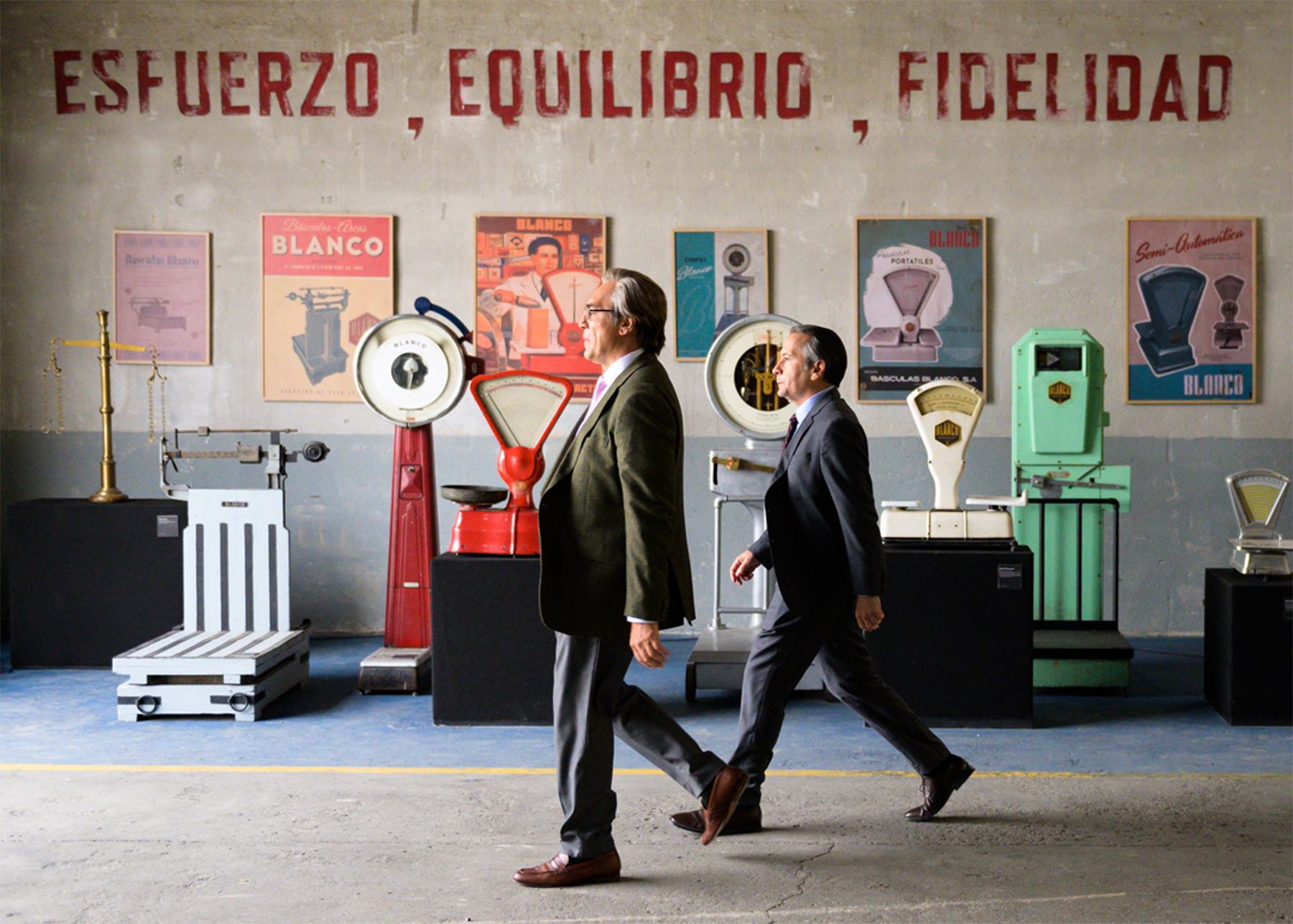

So-called “foreign films,” i.e. those in which the script is not in English, generally do not become big box office hits in the English-speaking world. With the passage of small “art theatres” and the demise of DVDs, access to these foreign films, sometimes labelled “art films,” can be difficult. Fortunately one “foreign film” which might be regarded as an “art film,” The Good Boss, has been showing at the Vancouver International Film Festival and is scheduled for another showing on Sept. 14.
The Good Boss, a Spanish film with English subtitles, is ostensibly a satire on big business. It tells the story of the head of a company which manufactures scales – scales to weigh everything from cakes to cattle. The boss of the company is, at the time of the narrative, in a state of anxiety as the factory is about to be inspected to see if it qualifies for a major award for distinction in manufacturing.
Touting his factory as a model of happy business and hoping that everything will be in a state of balanced perfection, he has to cope with a number of disasters: an employee is failing to do his job as he attempts to deal with marriage conflicts, another fired employee sets up a protest opposite the gates to the factory, and several other concerns of this sort. Clearly, none of them reflect well on him or his company which the boss proudly proclaims to be a close-knit family, a model of happiness for all.
As the award inspection looms closer, the boss finds himself involved in a series of conflicts as he tries to preserve his own fatherly-family image and that of the company while dealing with the negative business and personal realities that beset him. It is a challenging balancing act.
In many ways, The Good Boss is similar to that other great “foreign film,” Parasite, not only because it is getting widespread availability , but because Parasite is clearly intended to be seen as political allegory and satire. So too, The Good Boss is clearly intended to be a commentary on more than the negotiations and compromises that take place because of the conflicts between ethical marketing principles and pragmatic business demands. It is apparent that writer/director Fernando Leon de Aranca has more in mind than showing how these business concerns are weighed against each other.
One must remember that for much of the 20th century Spain was ruled by a dictator, General Francisco Franco. Regardless of how one views his rule, it is apparent that though the head of state wished to project a view of his reign as being one of great benefit to all of Spain, there were a number of negative realities to the reign. Moreover, it is true that today there has been a marked drift towards totalitarianism in a number of countries. The heads of such states are condemned by many because they are seen as a threat to the virtues of democracy. Furthermore, they themselves are often perceived as paying only lip service to the political and ethical ideals they profess, while often being seen as personally corrupt and opportunistic.
Clearly, The Good Boss is intended to be an allegory of such a political reality and a satire of the heads of those countries subject to such dictatorial rule. It is a clever and meaningful film. It moves at a gentle pace, but never lapses into dullness. It maintains its focus on the several subplots, without once losing its major dramatic thrust. It is indeed an engaging and ultimately challenging film. And, despite the comedy of its narration, ultimately it leads to a cynical and arresting conclusion – and it is apparent that it is this cynicism which the makers intended to be their final comment on the current political scene. It is a powerful moment.
A warning is also necessary in that there are some brief scenes with sexual content and considerable use of objectionable language.
Despite that, The Good Boss has much to offer adult and discerning audiences. Thanks to a series of beautifully staged scenes and, above all, a stunningly subtle portrait by Xavier Bardem as the boss, backed up by the work of a talented supporting cast, this is a film which is both richly comical and bitingly relevant. This is one time when an “art film” is not only well worth watching, but actually fairly easily accessible. Do we dare to hope for more such productions?
Click here to send a letter to the editor.







