

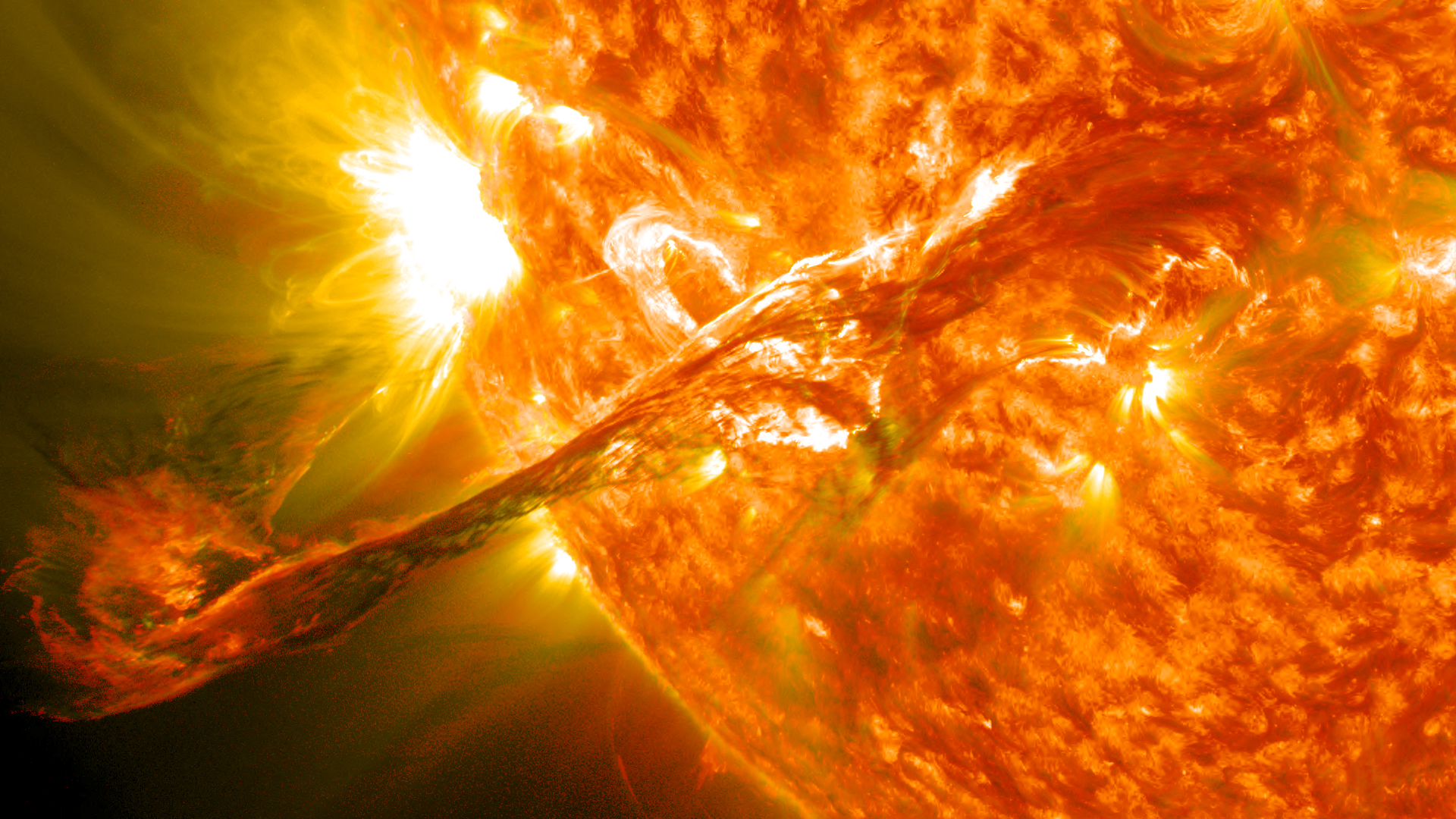

CME: an abbreviation that has become known to those who long to see auroral activity – the northern lights, aurora borealis (or its southern equivalent, aurora australis). A CME, or coronal mass ejection, is basically a solar hiccough that hurls mass from the sun in unpredictable directions.
When a given CME occurs in the direction of Earth, various websites go into overdrive and observers get ready, hoping to see one of the marvels of nature, a light show like no other. Vancouver puts on some spectacular fireworks events with the summertime Celebration of Light, but these have nothing on an auroral light show.
However, there is more to CME events than mere spectacle. A large enough CME could wreak havoc in worldwide communications networks, particular those involving satellites. Even worse, it could bring down electrical energy distribution systems.
For decades now there have been calls to “harden” such electrical systems, to limit the negative effects of a CME event, if not outright prevent them. We’ve had some experience with big CMEs. In 1859, the so-called Carrington event, admittedly before the age of widespread electrification, caused widespread damage. During this event telegraph key operators reported long sparks leaping from their keys, and some telegraph stations burned down.
The Carrington event is considered to be the strongest geomagnetic storm ever recorded. It occurred over two days, from Sept. 1 into 2, just as solar activity was approaching a peak in Solar Cycle 10. It is named after British amateur astronomer Richard Carrington, who happened to see the actual coronal mass ejection event while sketching sunspot patterns.
In March 1989 there was another Carrington-type event. A huge solar outburst on Friday, March 10, was observed by astronomers. On Sunday March 12, in the evening, the plasma cloud from this CME began striking the earth, and just before 3 a.m., the Quebec electrical grid failed. The province was without electricity for some 12 hours. Ripple effects caused grids elsewhere, deep into the United States, to go down as well.
Meanwhile, the northern lights put on a spectacular show, only enhanced by the darkness in cities. Auroral activity appeared as far south as Cuba and Florida, another indication that this was a particularly big solar event.
Try to imagine all of Metro Vancouver, or even the entire province, plunged into darkness, nothing electrical working. Transportation would grind to a halt. Communications would rapidly begin to fail as backup power sources begin to diminish in capacity.
Today, in 2022, we are in Solar Cycle 25, that is to say the 25th such cycle since records, particularly of sunspot numbers and solar activity, began to be kept in 1755. Cycles are around 11 years in duration and Cycle 25 began in December 2019.
For the current cycle then we are still a few years away from a peak in solar activity, but an increase in CMEs is already noticeable through enhanced auroral activity that reaches down to and even beyond the 49th parallel.
Pretty much every week or two I’m asked through my social media channels about a possibility for northern lights being visible from Vancouver. Up until this point my replies have always been laced with doubt. Northern lights sightings in Metro Vancouver are relatively rare. The odds are better in very dark spots such as near Pitt Lake, or, outside the Metro area in, say, Porteau Cove off the Sea to Sky Highway.
Northern lights and beautiful auroral activity aside, a real concern is a repeat of a Carrington-class event. There have indeed been some but, fortunately, they weren’t directed towards earth. Such an event today could cause damage that might take months or even years to repair. Damage estimates ranging into the trillions of dollars for North America alone have been bandied about.
We have a much better understanding of the sun today than we did when Richard Carrington saw the solar flare that hit the earth a day or two later. We can even issue warnings, and certain sensitive spacecraft can be directed away from greatest impact orientations.
But not much has actually been done to harden our terrestrial electrical and communications systems. Governments and regulatory agencies have been slow to take up this file. In the current geopolitical instability we may have another reason to take action: the deployment of a terrestrial equivalent of a CME, an EMP device. Electromagnetic pulse weapons, whether nuclear or otherwise, are designed to disable communications and electrical distribution systems over a wide area.
We know rather little about EMP weapons, which is perhaps a topic for another day. For now, I will keep tabs on solar events, consult my favourite space weather sites, and hope for a non-damaging CME that lights up Metro Vancouver skies with dancing auroral displays.
Follow me on Facebook (facebook.com/PeterVogelCA) or on Twitter (@PeterVogel).







