

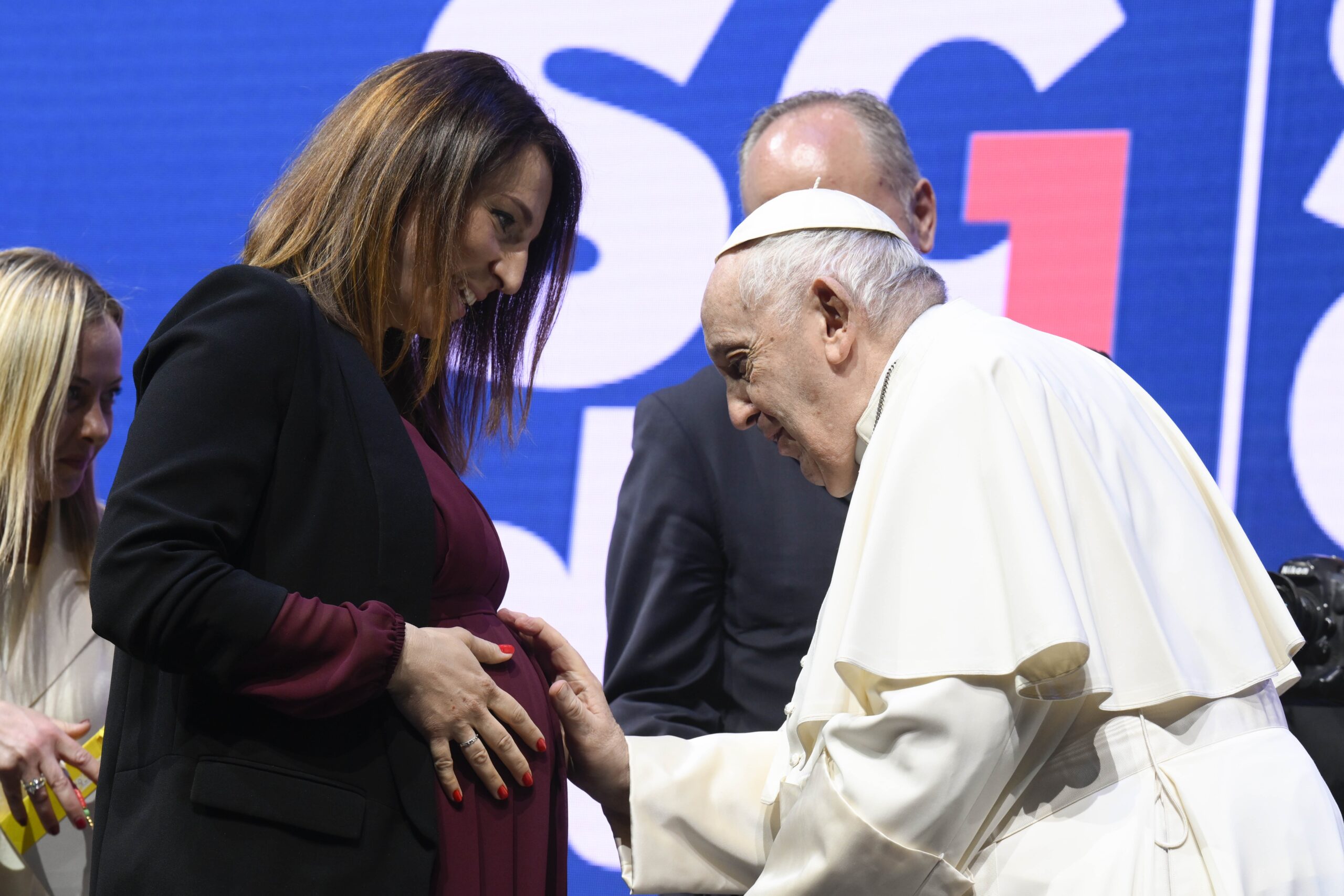

The Vatican’s document on blessings, Fiducia Supplicans, has stirred up many opinions about what it said, what it didn’t say, and what it should have said. Below, our own writers offer their views about the document, and although they have different thoughts about it, they’re in agreement that with Fiducia Supplicans, the Church is responding to a real need in the world.
Fiducia Supplicans offers hope for those living ‘immorally’
By Father Vincent Hawkswell
“Perhaps the bitterest commentary on the way in which Christian doctrine has been taught in the last few centuries is the fact that to the majority of people, the word ‘immorality’ has come to mean one thing and one thing only,” writer Dorothy L. Sayers said in 1941.
“A man may be greedy and selfish; spiteful, cruel, jealous, and unjust; violent and brutal; grasping, unscrupulous, and a liar; stubborn and arrogant; stupid, morose, and dead to every noble instinct – and still we are ready to say of him that he is not an immoral man. I am reminded of a young man who once said to me with perfect simplicity: ‘I did not know there were seven capital sins; please tell me the names of the other six.’”
If, today, you ask the average person what the Catholic Church considers sinful, the answer will probably be sex.
But it is lust – not sex – that is a sin, Sayers said, and “it ought to be called by its own name, and neither huddled away under a generic term like ‘immorality’ nor confused with love.”
The sins of lust are of two kinds. There are what we might call “short-term” sins, like masturbation, enjoyment of pornography, or “casual” sex, whether heterosexual or homosexual.
There are also what we might call “long-term” sins, like contraception, cohabitation without marriage, divorce followed by “remarriage,” and homosexual unions.
We can repent “short-term” sins of lust immediately. Indeed, William Shakespeare described such lust perfectly in Sonnet 129: “Enjoy’d no sooner, but despisèd straight; past reason hunted, and no sooner had, past reason hated.”
However, the “long-term” sins of lust make no sense in the short term; they necessarily mean a “long term” of sin. Accordingly, people who commit them are led to think that there is no salvation for them: that the Catholic Church has no sympathy for them, that she denies them God’s mercy, and that God himself has cast them off.
Yet even long-term lust can be repented and forgiven. Let me tell you of two examples.
The first is a man who had been living for some decades with a woman to whom he was not married (who was in fact someone else’s wife). He could not leave her because neither she nor he could afford to live alone. However, every day, he told me, he asked God to preserve him from the sin of asserting his right to live in sin, and never to let him think, or even try to convince himself, that his way of life was not sinful.
When he entered hospital in his last illness, I offered to bring him Holy Communion, and he replied, “I don’t think I can receive Communion, Father.” Then and there I heard his confession and gave him absolution and the sacrament of the sick, and he prepared to enter into “peace with God and his mother,” as he delightedly told everyone who visited him in the few weeks before he died.
The second example is a man who had had three children with a woman he was not married to. The couple continued to live together, unable to separate because of their responsibilities and duties to the children. Occasionally they found themselves “in each others’ arms,” as they put it, but they always repented, confessed their sins in the sacrament of reconciliation, and tried again to live in continence.
In today’s society, many people, seduced by the world’s view of sex, find themselves “trapped” in similar situations. Overcome by the prevailing misunderstanding of the Church’s teaching about sex, they despair of salvation, convinced that there is no hope for them.
Thanks to Fiducia Supplicans, published Dec. 18 by the Vatican’s Dicastery for the Doctrine of the Faith, they can take fresh heart.
Fiducia Supplicans mentions the “numerous and varied reactions” that followed the Vatican’s Responsum Ad Dubium of Feb. 22 2021. As usual, many people did not read that document for themselves, but relied on the secular media to interpret it for them.
Of those who did read the Responsum, Fiducia Supplicans says that some welcomed its “clarity and its consistency with the Church’s perennial teaching,” while others “did not consider the formulation of its answer and the reasons provided in the attached Explanatory Note to be sufficiently clear.”
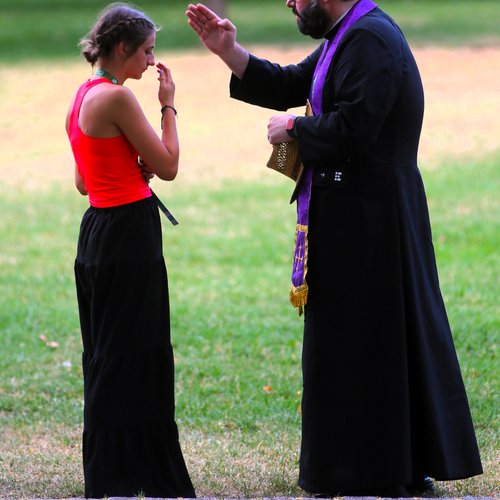
A priest blesses a pilgrim after hearing her confession at World Youth Day in Lisbon, Portugal, Aug. 2, 2023. (OSV News photo/Bob Roller)
Fiducia Supplicans has been written, the Dicastery says, “to meet the latter reaction with fraternal charity” by drawing together coherently the “doctrinal” and the “pastoral.”
The document should assure not only “couples in irregular situations and couples of the same sex,” but all of us who “though sinners, hope in [God’s] abundant mercies” (see Eucharistic Prayer I) – that the Church calls down God’s blessing on us all, whether our sin be “immorality” or any of the other six capital sins: pride, covetousness, anger, gluttony, envy, and sloth.
Blessèd vs. blest: distinguishing between holy and favoured in the Vatican’s document on blessings
By Maureen Creelman
The value of Fiducia Supplicans (“On the Pastoral Meaning of Blessings”), published Dec. 18 by the Vatican’s Dicastery for the Doctrine of the Faith, is that, as the document itself says, “it offers a specific and innovative contribution to the pastoral meaning of blessings, permitting a broadening and enrichment of the classical understanding.”
Before we can understand the document, we should consider – in full docility to the Holy Spirit – our own understanding of “bless.” Confusingly, we use it (as we use “grace”) in various ways.
1) When we say, “Bless the Lord, O my soul, and all my being, bless His holy name” (Ps 103:1), we mean “praise,” “extol,” “adore.”
2) When we say, “May God have pity on us and bless us” (Ps 67:2) or “Bless us, O Lord, and these, Thy gifts” (Grace Before Meals), we ask God to “favour” us or our goods.
3) When we ask a priest to bless us or a sacramental (like a crucifix or a rosary), we ask him to “invoke God’s favour” upon us or our goods.
Fiducia Supplicans describes the sense of “bless” as “ascending” in 1) and “descending” in 2) and 3). In each sense, the past participle of “bless” is spelled “b-l-e-s-s-e-d”:
1) “Blessed be the name of the Lord” (Ps 113:2), or “Blessed are You, Lord God of all creation,” or “Blessed be God forever” (Offertory of the Mass).
2) “You will be blessed above all peoples” (as Moses told the Israelites; Dt 7:14).
3) “Father has blessed” my house or my marriage.
The meaning of “blessed” is complicated, in English, by its pronunciation.

Like all other English past participles that end in “ed,” “blessed” used to have two syllables: blessèd. However, starting in the 16th century, its pronunciation gradually changed. Accordingly, in the plays of Shakespeare (1564-1616) Romeo says, “O blessèd, blessèd night!” (Romeo and Juliet, Act II, Scene 2), but Portia says, “The quality of mercy is not strain’d…. It is twice blest” (The Merchant of Venice, Act IV, Scene 1).
The two-syllable pronunciation has largely died out in everyday English, but it is still common in religious language, like the old forms of “you,” “your,” and “yours” – “thou,” “thee,” “thy,” and “thine.” However, even in religious language, pronunciation varies: the usual pronunciation in 1), above, is “blessèd,” while in 2) and 3), it is “blest.”
The pronunciation is important, for “blessèd,” it seems, no longer means the same as “blest.” (Similarly, the meanings of “agèd” and “aged” have diverged; we speak of “well-aged” beef or wine, but an “agèd” gentleman.)
Today, “blessèd” tends to mean “holy, revered, consecrated,” as when we speak of “the blessèd Virgin Mary” or give the title “Blessèd” to someone the Church has beatified (before canonization). That is what the hymn Blest are They (in Gather, 659) implies by its refrain, “Blessèd are you, holy are you,” as though “blessèd” and “holy” are synonymous.
We can see that they are not synonymous in Mary’s Magnificat. When she said, “All ages to come shall call me blessed,” she must have meant “blest,” not “holy,” for she immediately added, “God, Who is mighty, has done great things for me” (Lk 1:48-49). Accordingly, Elizabeth said to her, “Blest are you among women and blest is the fruit of your womb” (Lk 1:42) – “blest,” not “holy.”
Similarly, when Jesus said, “Blest are they who mourn” (Mt 5:4), he was saying not that unhappy people are holy, but that they are “favoured.” When he said, “Blest are the poor in spirit,” he was saying not that poor people are holy (they may be envious and covetous), but that they have an advantage over the rich – “it is easier for a camel to pass through a needle’s eye than for a rich man to enter the Kingdom of God.” And he was not commanding the rich to get rid of their wealth, for when the disciples asked, “Then who can be saved?” he explained that “for God, all things are possible” (Mt 19:23-26; Mk 10:24-27; Lk 18:24-27). The first word in each of the beatitudes, then, is “blest,” meaning “favoured” – not “blessèd,” meaning “holy.”
The semantic pressure behind the change from blest to holy may come from our deep-seated reluctance to believe that all we have and are is a pure blessing from God; surely, we think, at least part of his willingness to bless us must be due to something in us that is holy! Under the same pressure, the use of the word gifted about oneself (“I’m gifted”) is now understood as bragging.
Perhaps, too, the same misunderstanding helps to explain the public’s mistaken reaction to Fiducia Supplicans: the reluctance of good people to see sinners “blessed” by the Church and the jubilation of bad people when the Church does “bless” sinners.
Hence the insistence of Fiducia Supplicans on the difference between a “liturgical” blessing and a “simple” blessing.

Certainly, “when a blessing is invoked on certain human relationships by a special liturgical rite, it is necessary that what is blessed correspond with God’s designs,” the document explains. However, to require “the same moral conditions” for a simple blessing would “overshadow the unconditional power of God’s love.”







