
3rd Sunday of Advent, Year B
First Reading: Is 61:1 – 2a, 10 – 11
Second Reading: 1 Thes 5:16 – 24
Gospel Reading: Jn 1:6 – 8, 19 – 28
The passage from Isaiah in this Sunday’s First Reading is the one Jesus read in the Nazareth synagogue at the beginning of his public ministry. He read it standing, and he would have read it from the front, but when he had finished, he sat down, and “all in the synagogue had their eyes fixed on him.” Why?
The International Standard Bible Encyclopedia says that in a synagogue, there was a stone seat on a raised platform next to the ark containing the Old Testament scrolls. It was from here that teachers expounded the Law of Moses. The seat symbolized their authority as interpreters of the law. In fact, it came to be known as the “chair of Moses,” and it may have been what Jesus was referring to in Matthew 23:2.
This is the chair from which Jesus said, “Today this Scripture passage is fulfilled in your hearing.” He spoke from the chair of Moses, but he spoke on his own authority, claiming to be, himself, the one anointed by God to bring good news to the oppressed and release to prisoners.
Our reaction should be, as Isaiah says, “I will greatly rejoice in the Lord; my soul shall exult in my God, for he has clothed me with the garments of salvation, he has covered me with the robe of righteousness.”
However, we will not welcome this good news unless we recognize that, otherwise, we remain oppressed, brokenhearted captives and prisoners. It is not the healthy who need a doctor, Jesus said, but the sick; he came “to call sinners, not the self – righteous.”
Accordingly, before Jesus began his public life, John the Baptist preached a “baptism of repentance for the forgiveness of sins,” as we hear in the Gospel Reading.
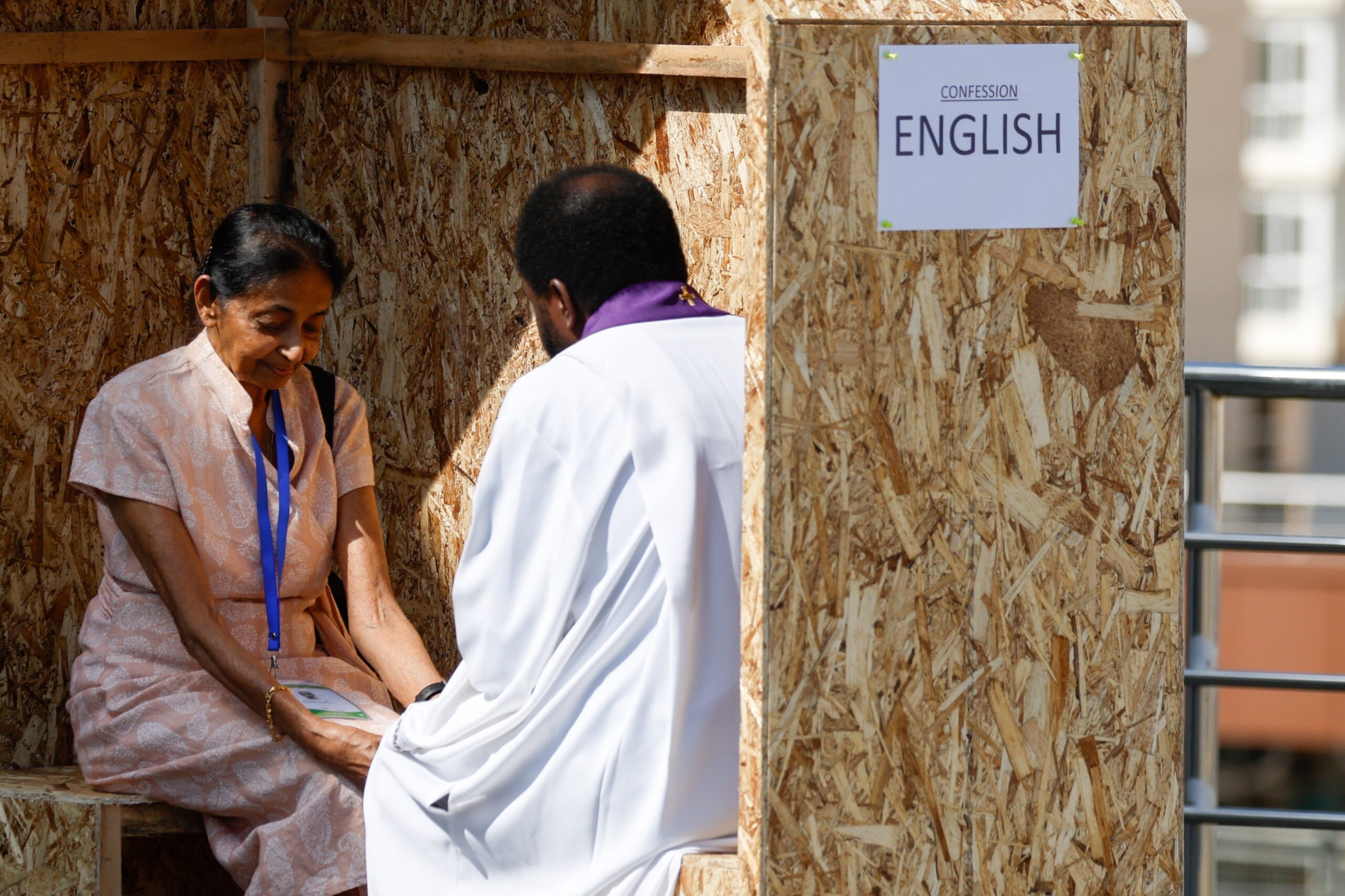
We must allow John to arouse in us a sense of sin. This is neither negativity, as New Age devotees declare, nor a purposeless wallowing in guilt. Rather, it is the prerequisite to God’s forgiveness and his gift of divine life.
Before he left us, Jesus promised to send us his Holy Spirit, who, he said, would “prove the world wrong about sin, about justice, about condemnation.” He also warned that people who sin “against the Holy Spirit” will not be forgiven but will carry the guilt of their sin “without end.”
Pope St. John Paul II explained. To sin against the Holy Spirit, he said, is to refuse to accept the salvation he offers, which “presupposes the genuine conversion which he brings about in the conscience.” The “non – forgiveness” of this sin is caused by our “non – repentance.”
This is the sin committed by a person “who claims to have a right to persist in evil, in any sin at all, and who thus rejects redemption,” the Pope said. “One closes oneself up in sin, thus making impossible one’s conversion, and consequently the remission of sins, which one considers not essential or not important for one’s life.”
“This is a state of spiritual ruin,” he said. In such a person, the Holy Spirit encounters “an interior resistance” or “an impenetrability of conscience,” which Scripture describes as “hardness of heart.”
This attitude of mind and heart, the Pope said, is reflected in our loss of the sense of sin, which Pope Pius XII called “the sin of the century,” a loss which “goes hand in hand” with our “loss of the sense of God.” Since God is our origin and our end, we are wasting our time trying to eradicate sins against human beings and human values if we have “no sense of offence against God.”
In this last week before Christmas, let us pray “that integrity of human consciences will not be lost, that their healthy sensitivity with regard to good and evil will not be blunted,” as the Pope said.
“Do not quench the Spirit,” as St. Paul says in this Sunday’s Second Reading.
Father Hawkswell is again teaching The Catholic Faith in Plain English with new insights, in both print and YouTube form, at beholdvancouver.org/catholic-faith-course. He is also teaching the course in person on Sundays from 2 to 4 p.m. at the John Paul II Pastoral Centre, 4885 Saint John Paul II Way, 33rd Avenue and Willow Street, Vancouver, and Mondays from 10 a.m. to noon in St. Anthony’s Church Hall, 2347 Inglewood Avenue, West Vancouver. Next week’s topic is Mary and Joseph. The course is entirely free of charge and no pre-registration is necessary.