


32nd Sunday of Ordinary Time, Year A
First Reading: Wis 6:13-17
Second Reading: 1 Thes 4:13-18
Gospel Reading: Mt 25:1-13
When the bridegroom comes, Jesus said, those who are ready go into the banquet with him, and the door is shut. To the others, he says, briefly and finally, “I do not know you.”
God intends our welfare, not our woe, says Jeremiah. Essential to his plan is our freedom to seek the happiness he offers us and thus co-operate with him in achieving our own perfection.
Confronted with this freedom, God makes himself powerless, said Pope St. John Paul II. If we let him, he makes us perfect, like himself, and so capable of enjoying his happiness. If we do not, he speaks those most terrible words: “Have it your way – thy will be done.”
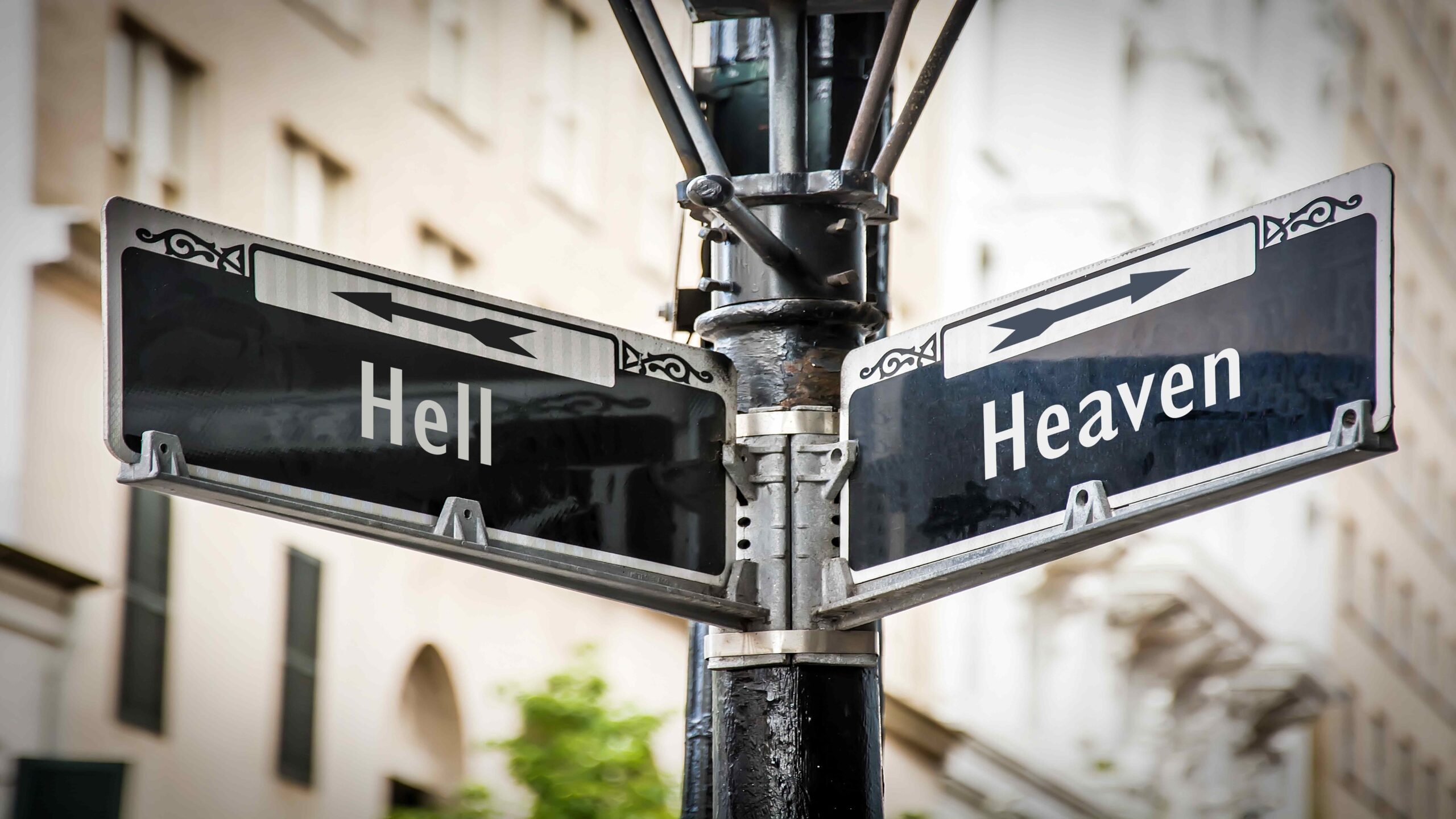
This is the “tragic situation that Christian doctrine explains when it speaks of eternal damnation or hell,” the Pope said. “It is not a punishment imposed externally by God, but a development of premises already set by people in this life.”
Hell is the state of “self-exclusion from communion with God and the blessed,” he explained. It “cannot be attributed to God’s initiative, because in his merciful love he can only desire the salvation of the beings he created.” Rather, damnation is “freely chosen” by the damned and “confirmed with death,” which seals their choice forever. God’s judgement simply ratifies it.
In their God-given freedom, “some have already said no” to God, the Pope noted: namely “the spiritual creatures” called demons, “who rebelled against God’s love.”
Their fate is a warning to us, he said: a call to avoid the tragedy of sin and conform our life to that of Jesus, “who lived his life” saying “yes to God.”
The thought of hell “must not create anxiety or despair,” the Pope cautioned, for Jesus has conquered Satan. Nevertheless, it is a “necessary and healthy reminder” of our freedom; “eternal damnation remains a real possibility.”
New Age holds – mistakenly – that “there is no distinction between good and evil”; that the thought of evil can create “only negativity and fear,” says the Vatican’s 2003 document on the subject. Along the same lines, William Blake wrote The Marriage of Heaven and Hell, in which, as the title suggests, he asserts that both are essential to human wisdom.
This “perennial” attempt to “marry” heaven and hell is based on the erroneous belief “that reality never presents us with an absolutely unavoidable either-or,” says C.S. Lewis. We vaguely hope that, with “skill and patience and (above all) time enough,” we can find “some way of embracing both alternatives.” We think “that mere development or adjustment or refinement will somehow turn evil into good” without “a final and total rejection of anything we should like to retain.”
The truth, he says, is that every path forks into two, and at each fork we must choose or reject God. The wisdom to make the right choice is always there for the asking, for wisdom “hastens to make herself known to those who desire her.” As it’s been said, “No one wakes up in hell surprised.”
We can correct our wrong decisions, but only by going back, never by simply going on. If we steal $20, no amount of time or forgetfulness will make it ours. “If we insist on keeping hell (or even earth), we shall not see heaven,” Lewis says; “if we accept heaven we shall not be able to retain even the smallest and most intimate souvenirs of hell.”
If we habitually say yes to God, swiftly repenting whenever we say no, we will be ready, when Jesus comes for us, to say our final, definitive, yes to him and enter into infinite, untiring, unending bliss with him in heaven. If we do not, our own no will shut the door to all happiness and there will be no opening it.
We must keep awake, therefore, for we know neither the day nor the hour.
Father Hawkswell is again teaching The Catholic Faith in Plain English with new insights, in both print and YouTube form, at beholdvancouver.org/catholic-faith-course. He is also teaching the course in person on Sundays from 2 to 4 p.m. at the John Paul II Pastoral Centre, 4885 Saint John Paul II Way, 33rd Avenue and Willow Street, Vancouver, and Mondays from 10 a.m. to noon in St. Anthony’s Church Hall, 2347 Inglewood Avenue, West Vancouver. Next week’s topic is A Place for Science in the Catholic Faith. The course is entirely free of charge and no pre-registration is necessary.







