

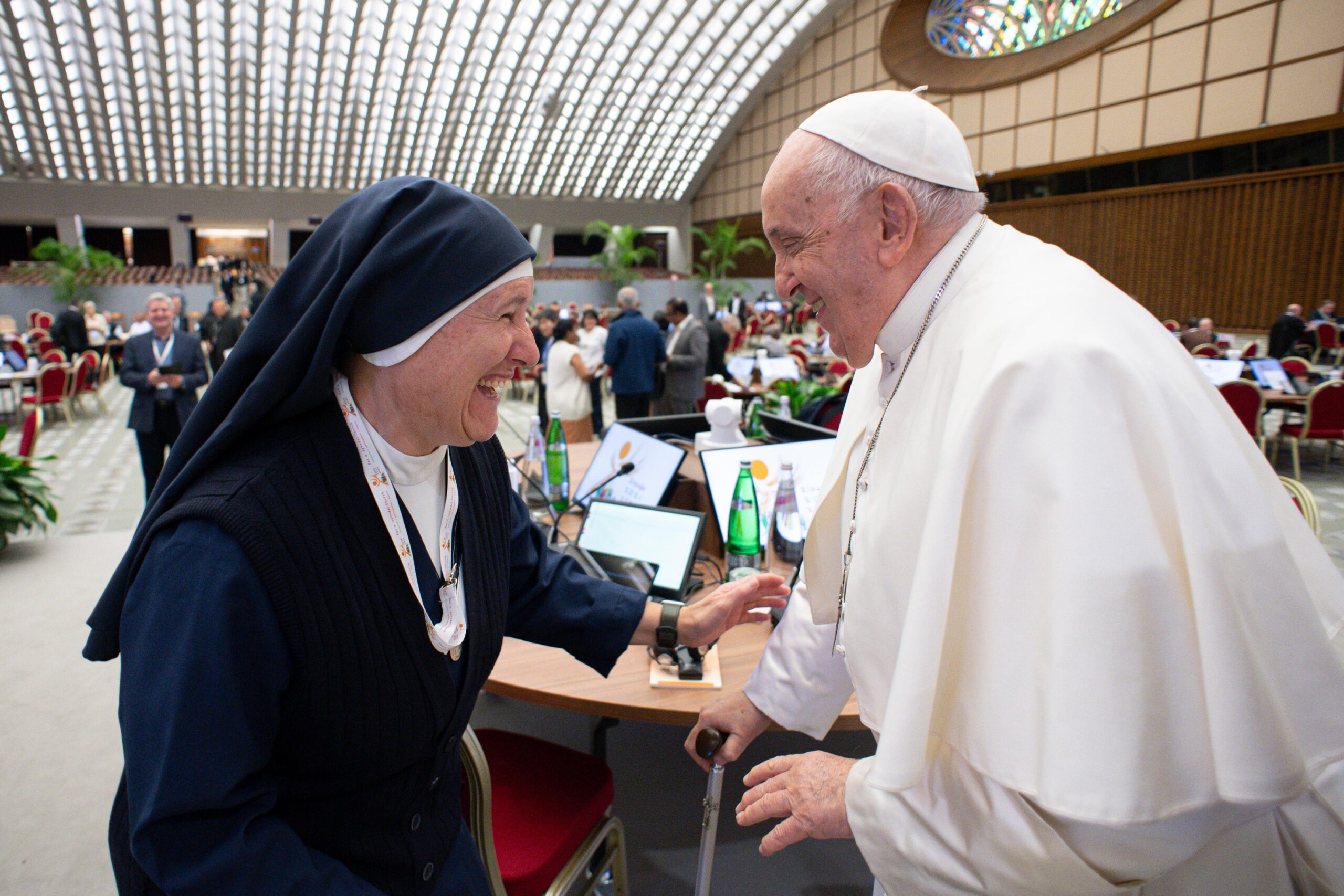

There is a debate going on in the Church and the parties involved are largely unaware of their participation.
On one side is the institutional approach – a rules-based, legalistic mindset. On the other hand is the pastoral style which emphasizes calling others to a deep, personal relationship with Jesus.
Pope Francis, being pastoral, finds himself caught in the middle. Both approaches are necessary, and a better understanding of their differences is badly needed.
In his recent apostolic exhortation, “C’est La Confiance,” Pope Francis outlines how St. Therese, who died in 1897, serves as a timely witness to the problems we face today. And in it, the Pope reveals his genuine pastoral love.
The issue predates Therese, stretching back to the mid-1500s amid the Protestant Reformation, growing secularism, and political unrest in Europe. The Council of Trent was convened, providing clarity on contentious dogmatic issues and reinforcing the Church’s ecclesiastical structure, in the process giving birth to Roman Catholicism as an institution. The Tridentine Council established boundaries, definitions, and rules designed to clarify and correct. It allowed Catholics of the next three centuries to breathe a sigh of relief amidst a growing and confusing secular age.
The institutionalization of the Church was a critical and necessary solution, guarding against the ideological complexities of those centuries. It gave abundant fruits of sanctity, deep piety, religious vocations and plenty of charitable movements . However, it also fostered the perception of the Church as primarily the prerogative of bishops, priests, and religious orders, relegating lay people to a mere “long hand” of the hierarchy.
Into this milieu was born the saint of the famous “little way.” St. Therese’s Little Way, writes Pope Francis in the exhortation, focuses on the little things of daily life that can lead us to God. Therese wrote that God “does not demand great actions,” but simply “surrender and gratitude.”
It was through Therese that God brought the Church’s focus back to love.
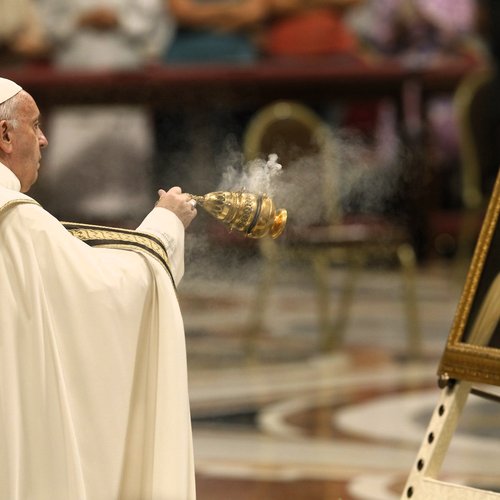
Pope Francis uses incense to venerate an image of St. Therese of Lisieux in 2019. The Pope is trying to return the Church’s focus to love, just as Therese did, writes Ida Gazzola. (CNS Photo/Paul Haring)
Some critics with their own agenda are trying to turn our attention away from love and toward some allegedly improper actions of the Pope, such as the blessing of same-sex unions. In response to the dubia presented by five Cardinals, Pope Francis offers an illuminating pastoral approach, rooted in sound doctrine.
He clarifies the Church’s conception of marriage as “an exclusive, stable, and indissoluble union between a man and a woman, naturally open to the begetting of children.”
However, in dealing with people, he emphasizes a pastoral discernment. In dealing with people, he says, “we cannot become judges who only deny, reject, exclude.”
A pastoral approach means being ready to discern prudently whether a blessing transmits a mistaken conception of marriage or a request for help from God – a plea for a better life, a trust in a Father who can help us to live better.” A blessing is not a sacrament.
The Synod on Synodality provides a platform for pushing private agendas. In dealing with situations like the one in Germany, the Pope is navigating a pastoral path. He does not condone what seems to be an attempt to institutionalize a situation, but he is trying to prevent schism.
Others question why Pope Francis talks so much about the environment instead of issues like abortion. But the Pope understands that addressing the environment prepares the ground for these tough issues.
A pastoral approach means being ready to roll up one’s sleeves and get dirty, or as I recently heard priest say, “To be pastoral is to get into trouble – a fantastic trouble indeed!”
He offered an example: a man who after being away from the Church for 20 years goes to confession and confesses a couple of banal things. The institutional approach would have the priest question him on a host of subjects: “How many acts of impurity did you commit? How many acts of dishonesty?”
The man, probably not prepared for such a barrage of questions, becomes frustrated and does not return to confession for another 20 years.
The goal of the pastoral approach is to bring people to Christ. The priest must be wise and supernatural enough to discern if these banalities in confession result from factual dishonesty or, as is usually the case, from lack of due formation in the man’s conscience.
A pastoral approach to spiritual growth gently encourages him to keep coming to the sacrament, gradually teaching him and offering his priestly time so the Holy Spirit can work in his soul. The pastoral approach is the way of Our Lord who found himself at home with the imperfect and sinful around him, troubling his contemporaries who were not ready to understand.
Pope Francis does not contradict Church teaching, but he is more concerned with bringing people to Christ than he is with rules. In “C’est La Confiance,” he urges us to focus on love and to be missionaries right where we are. He asks us to “move beyond a legalistic or moralistic mindset” that might “cause the joy of the Gospel to grow cold.”
As St. Josemaria said, “To save a sinner, I would go to the gates of hell but no further.”
The Church needed to be institutionalized in the 16th century, and now is the time to move past institutionalization and embrace a pastoral approach. There are many divisive videos and articles being circulated about Pope Francis and the Synod. Here’s a safe rule of thumb: if it takes a divisive approach, reject it. If we believe the Holy Spirit is guiding the Church, what reason have we to be anxious?
Ida Gazzola is a freelance writer, author of Team Baby: Creating a Happy and Rested Family, and mother of seven who lives in Burnaby.







