


The Whodunnit? as it is popularly called has long been a popular literary form, one which has been transposed to both stage and screen. We all have our favourite authors, and for many Agatha Christie takes pride of place.
I was first introduced to Christie when I was about 12 years old. The cleverness of The Murder of Roger Ackroyd led me to read many of the author’s other novels, though gradually I found myself agreeing with what P.D. James once said in a CBC interview: that at the end of each Christie mystery, one finds oneself saying that could not possibly happen.
I soon found myself savouring the delights of other mystery writers: the brilliant P.D. James was indeed one of them, though I welcomed a multitude of other authors – Blake, Innes, Sayers, Dexter. I found that there was a huge range in the Whodunnit? genre – from the hilariously satirical Brahms and Simon’s A Bullet in the Ballet to the challengingly philosophical Umberto Eco’s The Name of the Rose.
However, while I stayed decidedly less enthusiastic, Christie continued to churn out mystery after mystery, including 75 novels and several plays, proving to be the world’s most successful writer after Shakespeare. Her play The Mousetrap holds the world record for the longest theatrical run.
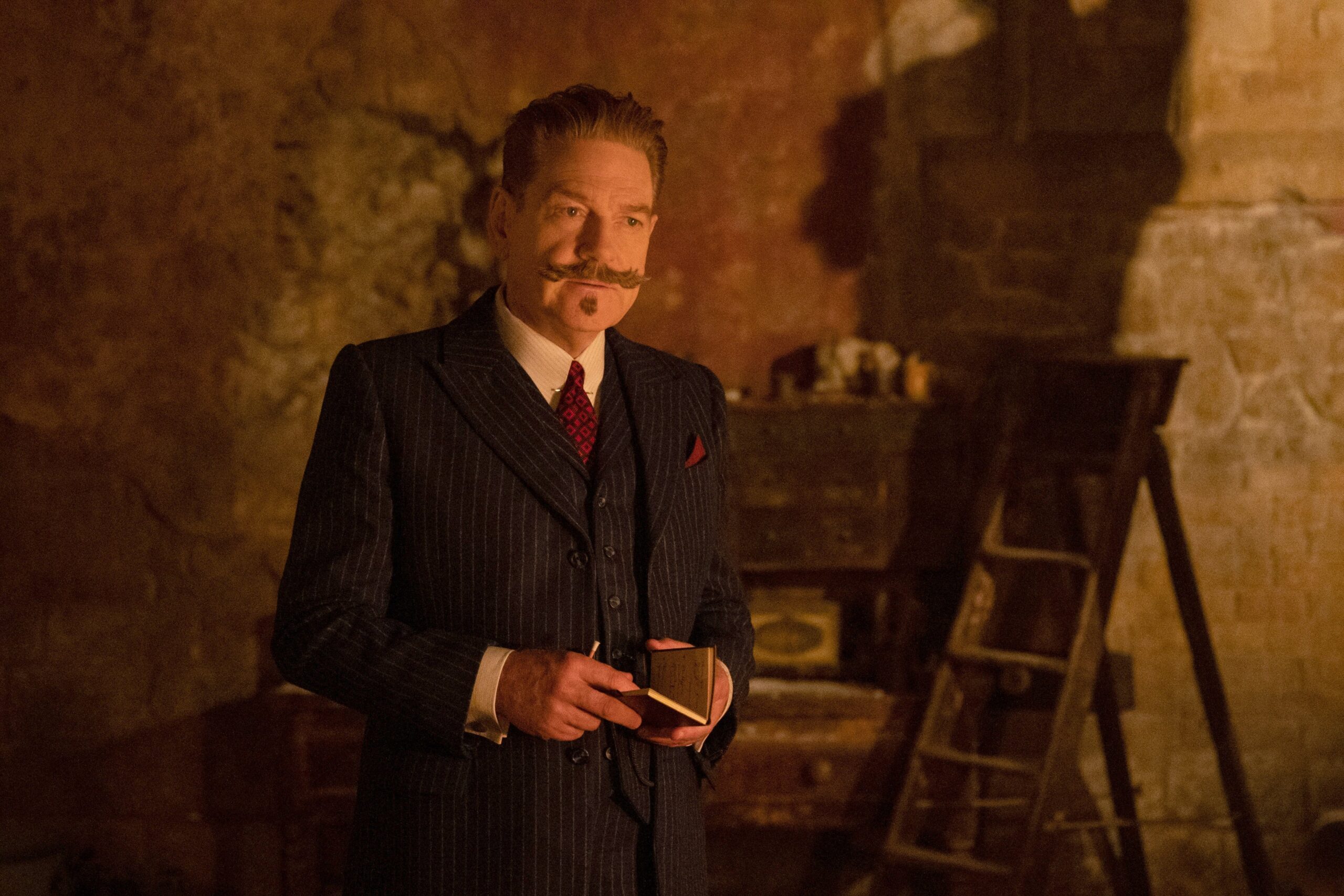
Christie’s success has, of course, been translated to the screen, most notably with Murder on the Orient Express, with productions in 1974 and 2010. The latter, starring Kenneth Branagh as the Belgian detective Hercule Poirot – he of the carefully shaped moustache and “the little grey cells” – was a great success. In fact, it proved to be so successful that Branagh seems to be determined to turn the concept into a franchise, now reprising his appearance as Poirot.
On the surface, the film holds out great promise. Alas, it fails to deliver.
It is, of course, often true that sequels prove to be disappointing, but nothing that has gone before can prepare viewers for the mess that is A Haunting in Venice, despite the fact that the opening minutes of the film should act as a warning.
Branagh has moved the setting of the original novel, Hallowe’en Party, from the cozy comforts of an English village to the city of Venice. While one might expect that this will result in some spectacular scenic exploration, the film quickly moves to a purportedly haunted villa. Although the setting is 1947, the background music is accountably Vera Lynn singing When the Lights Go On Again. The lights don’t seem to include Venice, however, as most of the movie takes place in eternal darkness, so no matter how many lamps and chandeliers may be lit, every scene takes place in utter gloom. One can only assume that the Venice setting was an excuse for cast and crew to have a holiday in one of the loveliest cities in the world at the expense of the producers.
Once the plot gets under way there is a multitude of sudden bangs, gratings, and thuds. Lights flash. Weird things happen. There is the cliche of a melodramatic seance. There is even a screaming parakeet, which seems to have wandered in from the set of Citizen Kane. Most of the unexpected and often unexplained bangs, creaks, clangs, and flashes seem to have little purpose other than to wake up the audience as the story unfolds in unlikely and mind-numbing fashion. The result of all this is that the film resembles less an escapist detective story and more a cheesy and unsuccessful non-frightening horror movie.
All this is at the expense of a cast who try to give it their best shot: So it is that Tina Fey as an authoress who has become a bestseller by writing books based on Poirot (shades of Christie herself!) inveigles the detective to attend the seance, which gets the inevitable murders unrolling.
None other than Oscar-winner Michelle Yeoh throws herself into the role of the medium. And the rest of the cast gamely participate in what follows.
What follows seems at times to be a bizarre and outrageous attempt to create a bad version of The Exorcist.
Overseeing it all is Branagh, who, understandably, tries to hide behind a bushy and unlikely version of Poirot’s moustache. Unfortunately, the disguise fails. Although he has shown himself in the past to be a fine director, here Branagh cannot avoid being blamed for a film which simply fails to live up to its promise.







