


As we make our way from summer, into fall, and on to winter, friendly banter about the weather picks up steam. Many of us have favourite weather apps on our mobiles, and perhaps our favourite weather resource sites on our desktops and tablets.
Some readers may even be so fascinated by weather that they have their own weather station, ranging from the inexpensive to some costing hundreds of dollars. I go a step further and pull in my own weather satellite images via radio signals.
In short, we can always talk about the weather without getting into conflicts and arguments. Not that we can do anything about it mind you.
Mobile communication has enabled us to have instant access to current and projected weather. The simple weather display on your mobile’s lock screen typically provides the present temperature, perhaps a graphic representing current sky conditions, and, if access to positional data is permitted, a location identifier. Clicking on that simple display typically launches a comprehensive weather application.
B.C. Catholic reader Chris Scolefield says his favourite weather app is YR on Android (more than five million downloads in the Google Play Store). He reports he was provided the app by a ship’s captain while visiting Norway. It is produced by NRK, the Norwegian Meteorological Institute. Scrolling leftwards across the screen moves the dynamic display through the next four days, graphically and dynamically depicting the weather, as well as the sun and the moon positions.
Scolefield particularly likes using the app while travelling. He stores a number of locations for the travel itinerary in the app, making it convenient to quickly gauge the upcoming weather at the stops ahead. He also says he keeps the app in table view, giving a quick snapshot forward for the next 10 days and hourly views of the next four days.
Recently he discovered the “Other conditions” option in YR. This opens up additional features such as nearby webcams, and even space weather metrics for auroral activity fans. YR is also available for iPhone users.
My phone has at least a dozen weather apps. One I use frequently is Weerplaza from the Netherlands. I particularly make use of its rain “radar” feature and its lightning mapping. This app was suggested to me by a Dutch user, and in short order I had it on my main mobile screen.
I frequently post screenshots from Weerplaza to my Twitter stream which has a large number of weather aficionado followers. In particular I post shots showing cold fronts moving ashore, and also shots capturing active weather (lightning strikes) within about 300 kilometres of Metro Vancouver.
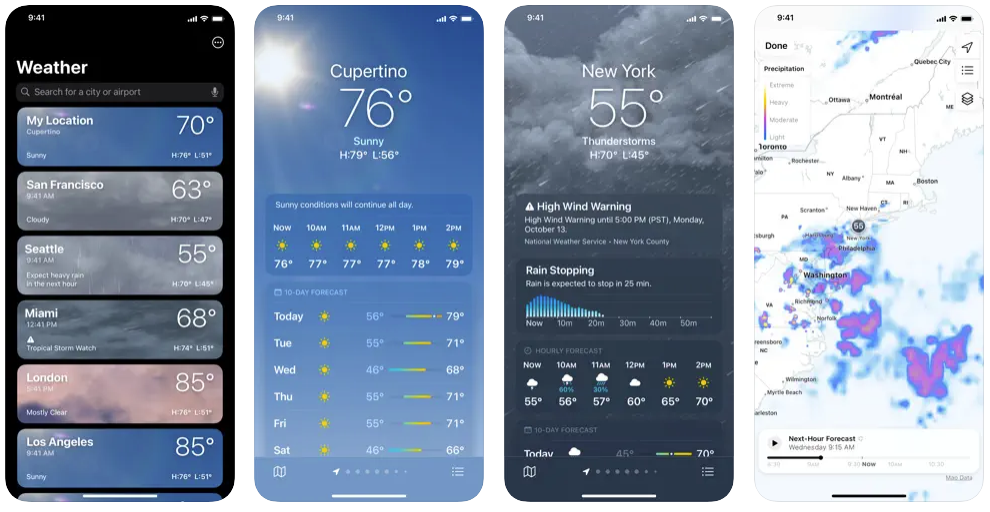
Most mobile users find that their phones come with a native weather app. Samsung Android devices have an app powered by the Weather Channel. For iPhone users this has been Apple Weather for many years, going back to 2007. Recently that app underwent a major revamp and certain parts were actually removed. It is now more generically simply known as Weather.
Here’s part of Apple’s description for its popular app: “View the hourly forecast for the next 10 days. Forecasted weather conditions include temperature, precipitation amounts, humidity, dew point, wind speed, barometric pressure, Feels Like temperature, and visibility. To view hourly forecasts, tap a condition in the location view or tap a day and select the condition you want to view.”
B.C. Catholic reader Eric Whalley likes to use Apple’s Weather app when he travels, finding it reliable and particularly easy to switch between locations.
Of course Apple Weather is available for all components of the Apple ecosystem, iPhone, iPad, Macbook laptops. That isn’t always the case for Android applications, which may be fine on a mobile but may not adapt properly to say a Chromebook billed as Android-compatible.
Most weather apps have options to upgrade, be it to remove ads or to unlock so-called pro features. The field is competitive, and behind the scenes there is big money at play, with the likes of the Weather Channel and the Weather Network. The former is actually owned by IBM but has been sold in a deal set to close in Q2 2024.
In August 2022 IBM announced it was selling various assets under the Weather Channel umbrella. Included were properties such as Storm Radar, Weather Underground, and website weather.com. In a filing announcing the sale IBM noted that its weather properties served more than 400 million people monthly.
Perhaps most telling about this deal is that IBM will retain rights to the underlying weather data. Such data can be used with artificial intelligence to power new insights that can be sold to major corporations, or in business parlance, enterprise clients. This type of data can only become more valuable with time as climate change and natural disaster modelling become increasingly important.
We’ve only touched the surface when it comes to weather apps in common use. We will look at some more, as well as web-based resources, in a subsequent column. Perhaps you have a favourite app or weather resource site you’d like to see mentioned. Send me a note through the email address below.
Follow me on Facebook (facebook.com/PeterVogelCA), or on Twitter (@PeterVogel)







