

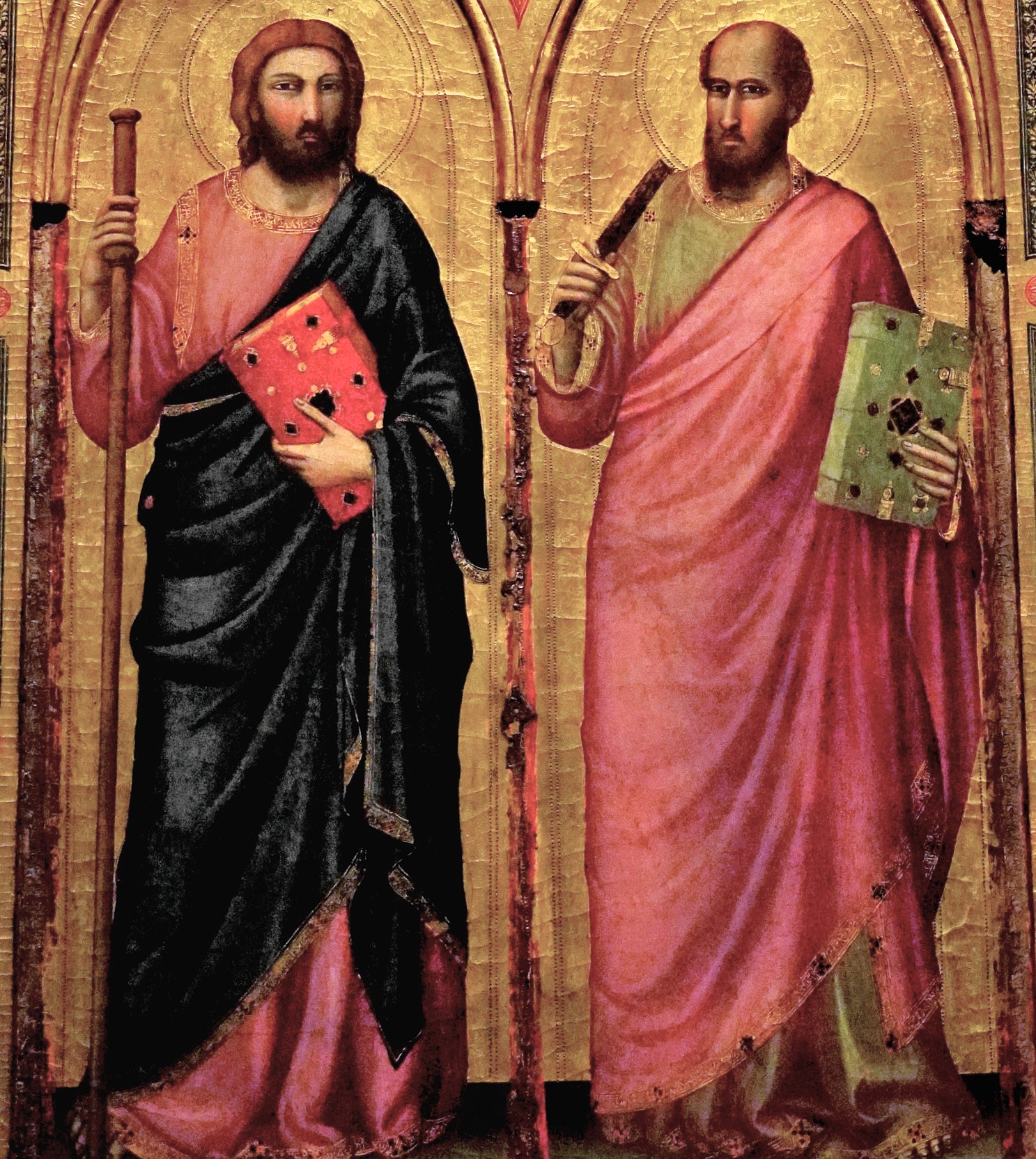

One of the key themes of the Letter of St. James is that faith without works in dead. St. John Chrysostom said, “Even if somebody believes rightly in the Father and the Son, as well as in the Holy Spirit, if he does not lead the right kind of life, his faith will not benefit him at all as far as his salvation is concerned.”
St. Paul wrote, “For we hold that one is justified by faith apart from works of the law.” (Rom 3:28)
Whereas St. James wrote, “You see that a person is justified by works and not by faith alone.” (Jas 2:24)
To see how the teaching of St. James is complementary to that of St. Paul, we must understand two important distinctions regarding faith and works.
Regarding faith, the Church Fathers made the distinction between faith before baptism (pre-baptismal faith) and faith after baptism (post-baptismal faith). In his letter, St. James talked about post-baptismal faith which is conjoined with works. Pre-baptismal faith in itself does not require works but only confession and word of salvation.
Andreas, a seventh-century monk wrote, “Now someone might object to this and say: ‘Did Paul not use Abraham as an example of someone who was justified by faith, without works? And here James is using the very same Abraham as an example of someone who was justified, not by faith alone, but also by works which confirm that faith.’ How can we answer this? And how can Abraham be an example of faith without works, as well as of faith with works, at the same time? But the solution is ready to hand from the Scriptures. For the same Abraham is at different times an example of both kinds of faith. The first is pre-baptismal faith, which does not require works but only confession and the word of salvation, by which those who believe in Christ are justified. The second is postbaptismal faith, which is combined with works. Understood in this way, the two apostles do not contradict one another, but one and the same Spirit is speaking through both of them.”
Another important distinction is in regard to works. St. Augustine commented: “Holy Scripture should be interpreted in a way which is in complete agreement with those who understood it and not in a way which seems to be inconsistent to those who are least familiar with it. Paul said that a man is justified through faith without the works of the law, but not without those works of which James speaks.”
When St. Paul talked about “works of the law” he was referring to the ceremonial and ritual laws (such as circumcision), and when St. James talked about “works” he had in mind the deeds of love that incarnate the faith, such as feeding the hungry and clothing the naked.
Both St. Paul and St. James made note of Genesis 15:6 regarding Abraham: “And he believed the Lord, and He counted it to him as righteousness.” But Paul connected this passage to Genesis 17 whereas James connected it to Genesis 22.
In Genesis 17 Abraham received circumcision. St. Paul pointed out that Abraham was justified by faith (Gen 15) before being circumcised (Gen 17), hence uncircumcised Gentiles can also be justified by faith without observing the Jewish ceremonial and ritual laws.
Genesis 22 is about the sacrifice of Isaac. By connecting Genesis 15:6 and Genesis 22, St. James emphasized that faith cannot be divorced from obedience to God. Regarding the need to put faith into practice by deeds of love, St. Paul was in perfect agreement with St. James.
St. Paul wrote, “For in Christ Jesus neither circumcision nor uncircumcision counts for anything, but only faith working through love.” (Gal 5:6) “[I]f I have all faith, so as to remove mountains, but have not love, I am nothing.” (1 Cor 13:2) St. Paul never spoke of “justification by faith alone.” The phrase “faith alone” appears only once in the New Testament in James 2:24. “You see that a person is justified by works and not by faith alone.”
Pope Benedict XVI said, “Saint Paul is opposed to the pride of man who thinks he does not need the love of God that precedes us; he is opposed to the pride of self-justification without grace, simply given and undeserved. Saint James, instead, talks about works as the normal fruit of faith: ‘Every sound tree bears good fruit, but the bad tree bears evil fruit,’ the Lord says (Mt 7: 17). And St. James repeats it and says it to us.”
Click here to send us a letter to the editor.
雅各伯和保祿相輔相成
聖雅各伯書的一個關鍵主題是,沒有行為的信仰是死的。金口若望說:『即使有人正確地相信聖父和聖子,以及聖神,如果他沒有過正確的生活,就他的救恩而言,他的信仰根本不會使他受益。』
聖保祿寫道:『因為我們認為人的成義,是藉信德, 而不在於遵行法律。』(羅3:28)而聖雅各寫道:『你們看,人成義是由於行為,不僅是由於信德。 』(雅2:24)要瞭解聖雅各伯的教導如何與聖保祿的教導相輔相成,我們必須了解關於信德和行為的兩個重要區別。
關於信仰,教父們區分了洗禮前的信仰和洗禮後的信仰。在他的書信中,聖雅各伯談到了洗禮後的信仰,它與行為是聯繫在一起的。洗禮前的信仰本身不需要行為,只需要懺悔和救恩的話語。
安德列亞斯,一位7世紀的隱修士寫道:『現在有人可能會反對這一點並說:「保祿難道沒有用亞巴郎作為因信成義的人的榜樣,而不需要行為嗎?雅各伯在這裡用同一個亞巴郎作為成義的例子,他不是單單因信成義,而是因為他的行為,且更肯定了這似信仰。」我們該如何回答這個問題?亞巴郎怎麼能同時成為不需要行為的信仰和需要行為的信仰的榜樣呢?但解決方案已經準備好從聖經中拿出來。因為同一個亞巴郎在不同的時代是兩種信仰的榜樣。第一種是洗禮前的信仰,它不需要行為,只需要懺悔和救恩的話語,相信基督的人就是成義的。第二種是洗禮後的信仰,它與行為相結合。以這種方式理解,兩個宗徒並不相互矛盾,但同一個聖神通過他們兩個說話。』
另一個重要的區別是關於『行為』。聖奧斯定評論道:『聖經應該以一種與理解它的人完全一致的方式解釋,而不是以一種似乎與那些最不熟悉它的人不一致的方式解釋。保祿說,一個人藉著沒律法的行為,因信成義;但不是雅各伯所說的那些行為。』
當聖保祿談到『律法的行為』時,他指的是禮儀律法(如割禮),當聖雅各伯談到『行為』時,他想到的是體現信仰的愛的行為,例如餵養饑餓的人和赤身裸體的人。
聖保祿和聖雅各伯都注意到創世記15:6關於亞巴郎:『亞巴郎相信了上主,上主就以此算為他的正義。』但是保祿將這段經文與創世記17章聯繫起來,而雅各伯將它與創世記22章聯繫起來。
在創世記17中,亞巴郎接受了割禮。聖保祿指出,亞伯郎在受割禮(創世記17)之前因信成義(創世記15),因此未受割禮的外邦人也可以在不遵守猶太禮儀律法的情況下因信成義。
創世記22章是關於依撒格的犧牲。通過將創世記15:6和創世記22聯繫起來,聖雅各伯強調信仰不能與服從天主分開。關於通過愛的行為將信仰付諸實踐的必要性,聖保祿與聖雅各伯完全一致。聖保祿寫道:『因為在基督耶穌內,割損或不割損都算不得什麼,唯有以愛德行事的信德,纔算什麼。』(加5:6)『我若有全備的信心,甚至能移山,但我若沒有愛,我什麼也不算。』格前(13:2)聖保祿從未說過『唯獨因信成義』。『唯獨信』在新約中只出現了一次——『你們看,人成義是由於行為,不僅是由於信德。』(雅2:24)
教宗本篤十六世說:『聖保祿反對人的驕傲,這驕傲認為人不需要天主之愛在我們之前;他反對不靠恩寵而自以為義的人。恩寵是簡單地給與並不是應得的。相反,聖雅各伯談到行為是信德的正常果實:「這樣,凡是好樹都結好果子; 而壞樹都結壞果子」(瑪竇7:17)聖雅各的重複向我們說了一遍。』







