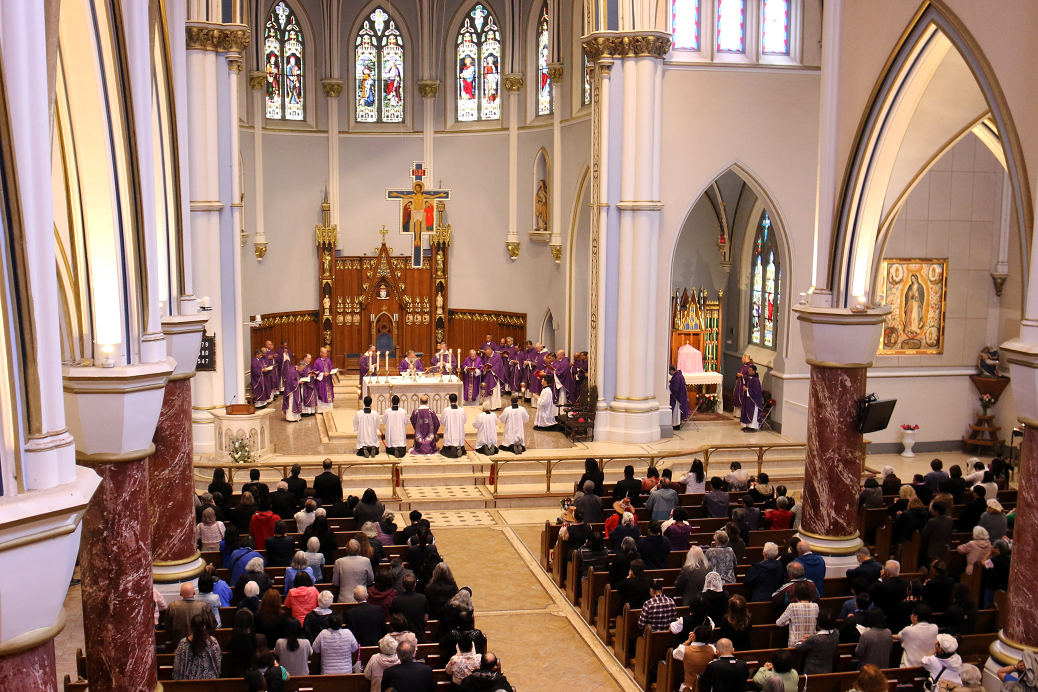

Archbishop Miller received the following messages following the death of Archbishop Adam Exner.
His Holiness Pope Francis was saddened to learn of the death of Archbishop Emeritus Adam Exner, and he sends heartfelt condolences to you, the clergy, religious, and lay faithful of the archdiocese. Recalling with gratitude the example of faith and dedication that marked the late Archbishop’s ministry to the Church in Vancouver, together with his service to the Canadian Conference of Catholic Bishops and to the Holy See, His Holiness joins you in commending his soul to the merciful love of God our heavenly father. To his family and to all who mourn Archbishop Exner in the sure hope of the resurrection, the Holy Father cordially imparts his blessing as a pledge of consolation and peace in the Lord Jesus.
Cardinal Pietro Parolin
Secretary of State
The Pope’s message was conveyed by Archbishop Ivan Jurkovic, the Vatican’s nuncio to Canada, who sent his own condolences.
Joining my own expressions of sorrow and condolence to those of his holiness, I assure Your Grace of my heartfelt prayers for the late Archbishop, as well as for Your Grace and all the faithful of Vancouver who mourn his passing.
Archbishop Ivan Jurkovic
Apostolic Nuncio
Ottawa
It is with deep sadness that I am sending you my most sincere condolences for the departure of our beloved Emeritus Archbishop Adam Exner. He has surely left us with a profound legacy of humble servant leadership throughout his life.
It was thanks to him that I was invited to serve with joy at Catholic Family Services from 1995 to 2013. I cherish his wisdom and inspiring homilies, his compassionate and loving presence to all the faithful of the Archdiocese.
May he now be blessed eternally and watch over his beloved Archdiocese of Vancouver from heaven above.
Sister Cecilia Hong, MIC
Laval, Que.
Must everything die through injection, be it cat, dog, or human?
In the past, our animals were always put to sleep by veterinarians. We didn’t think about it. It was the norm.
Until I got a cat.
One day she got up and had the face of an “old person.” Another day her back legs were rickety. Another she just stared at her food. And another she just stared at her water. Then one day she woke up, screeching and having a seizure. I wrapped her up and she lay there. In the middle of the night her heart stopped.
I had her cremated and got her ashes.
To sum it up: She died naturally and at home.
If a cat can die naturally, why can’t a human too?
John Payzant
Vancouver
I was disappointed to read Bishop Fred Henry’s comments in the Aug. 28 B.C. Catholic (“Retired Calgary bishop wants to break the silence”):
Such rear-guard comments from a senior level clergy member only make reconciliation attempts more difficult, if not impossible, for us at the local parish level who are trying to work on reconciliation with the local First Nations.
I have not heard one First Nation who have possible unmarked graves at residential schools allege that “missing children were murdered by Catholic priests and nuns and clandestinely buried in unmarked graves.” They are following a forensic process to determine what the evidence is and come to conclusions at a future date.
More importantly, the affected First Nations are trying to heal from the historic loss of their children because some did not come home from residential school. For Bishop Henry to call on his colleagues to challenge the media reports as false or inaccurate is premature and insensitive to the real loss and suffering of the affected First Nations.
The facts are clear: terrible harm and abuse occurred to First Nations families at the hands of the Canadian government and participating churches. Pope Francis has apologized for the residential schools and the abuses that occurred. The Canadian bishops have apologized. The Canadian government under Prime Minister Stephen Harper did as well, and Justin Trudeau has stated how unacceptable the residential schools were.
The Truth and Reconciliation Commission had numerous witnesses testify about their horrific experiences in residential school, but Bishop Henry chooses to focus on one aspect of the ongoing trauma around residential schools, that being the possibility that criminal acts were involved. This serves to cloud the real issues and only serves to qualify the apology offered by the Church.
It is paramount that the Catholic Church does not develop an image of “deniers and dog whistlers.” Maybe that is why the mainstream media chose not to respond to Bishop Henry’s comments. If the Canadian bishops issue a statement that supports his viewpoint the conclusion will be that there is a degree of denial already starting in the ranks of the Catholic Church.
I await the response of the Canadian bishops to Bishop Henry’s comments as well as the outcomes of the forensic analyses by the affected First Nations.
Dale McGregor
Chilliwack
I agree with Bishop Henry’s views regarding the missing children claims. It’s one thing to accuse someone of evil deeds, and another to prove it with the preponderance of evidence. In this case we have waived this principle for political expediency’s sake.
As in many other countries, First Nations in Canada may not have been fairly treated in early colonial days. What countries have not suffered invasions, occupations, and mistreatment from invading countries throughout their history? They moved forward and eventually were able to rebuild their lives and societies.
Trying to give First Nations children in the 19th century the tools they would need to be integrated in a changing frontier and world is now considered “genocide.” Yet many have received university degrees and become successful people. They do not call it genocide.
John Bueno
Vancouver
After reading the two letters that appeared in the print edition of the Sept. 4 B.C. Catholic, I don’t even want to look at what might be in the online paper!
Both letters display an unacceptable amount of denialism, first towards what MUST be referred to as the climate crisis, and next, in an equally unacceptable sense of colonialism, denial of what Indigenous elders need.
The writers use some sketchy justification for their claims, which only contribute to slowing efforts toward reducing fossil fuel extraction and use, as well as the paradigm shifts that are needed in order to carry out true reconciliation.
Penny Oyama
Burnaby
I read with amazement Norman Reilly’s Sept. 4 letter “Is climate change a crisis?”
Mr. Reilly’s views are at odds with those of every level of government in Canada. They are also at odds with those of the United Nations and most governments around the world.
His climate change denial stance is very much at odds with that of Pope Francis. Mr. Reilly is surely one of those that the Pope refers to in Paragraph 14 of Laudato Si’: “Obstructionist attitudes, even on the part of believers, can range from denial of the problem to indifference.”
Mark Norbury
Port Moody
I am disturbed by the promotion of replacing the cross with an anchor in the Aug. 28 article “Vancouver rosaries made from ocean plastic shine at World Youth Day.”
The argument is that the anchor was an ancient symbol of hope. The article suggests that in reducing ocean wastes, the recycling of plastics and reusing them to replace the cross is a noble act.
We have seen our Lord’s body removed from crucifixes for other absurd arguments. How far can we go?
Anthony Chung
Vancouver
May I request a clearer photo of the Anchored Cross on the rosary? The other metal images attached to the Anchored Cross are not clear. I hope these extra images did not distract from the most important symbol of Jesus Christ.
In addition, the article should have said “the Anchored Cross” on the rosaries was an ancient Christian symbol for Christ, not “the anchor.”
Bernadette Geronimo
Vancouver
(As requested, here is a closeup of the Anchored Cross – Editor)

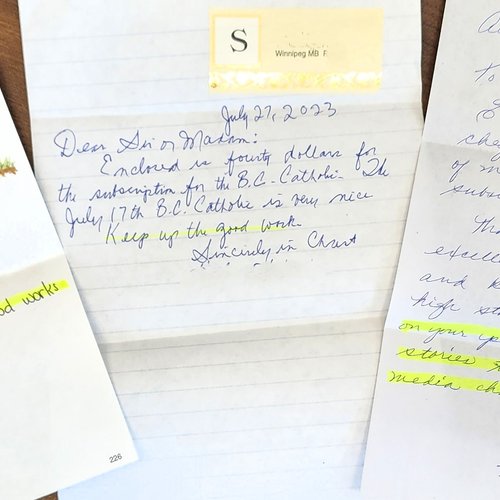
We receive all sorts of letters, including thank you notes and messages sharing how important The B.C. Catholic is to readers. Below is a sample.
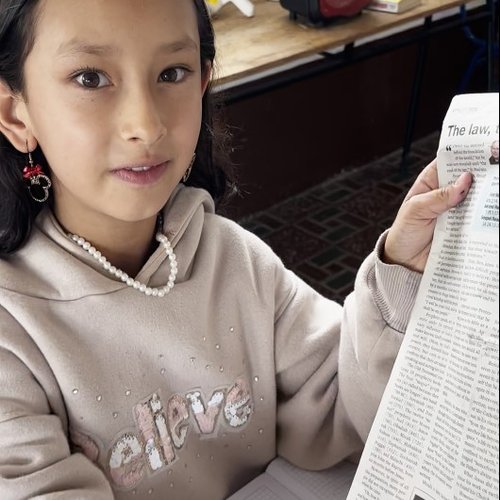
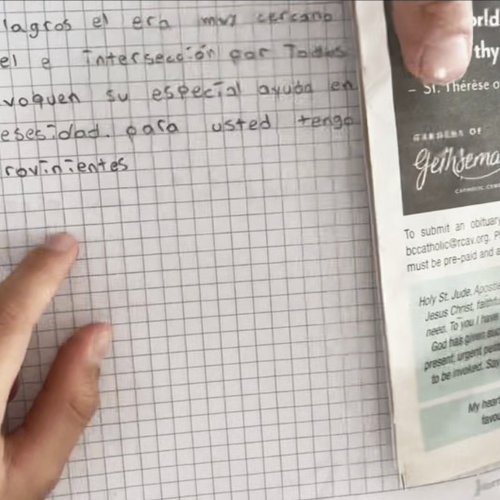
How useful is The B.C. Catholic? I recently wrapped vitamins in pages of The B.C. Catholic to send to a friend recovering from cancer in Colombia. In his spare time, he teaches refugee children. These young, bright children are eager to learn English, and they sent me a short video for sending the newspaper. They even welcomed an article on death and dying and an ad for a funeral home.
How little effort it takes to make a difference.
Marianne Werner
Vancouver