

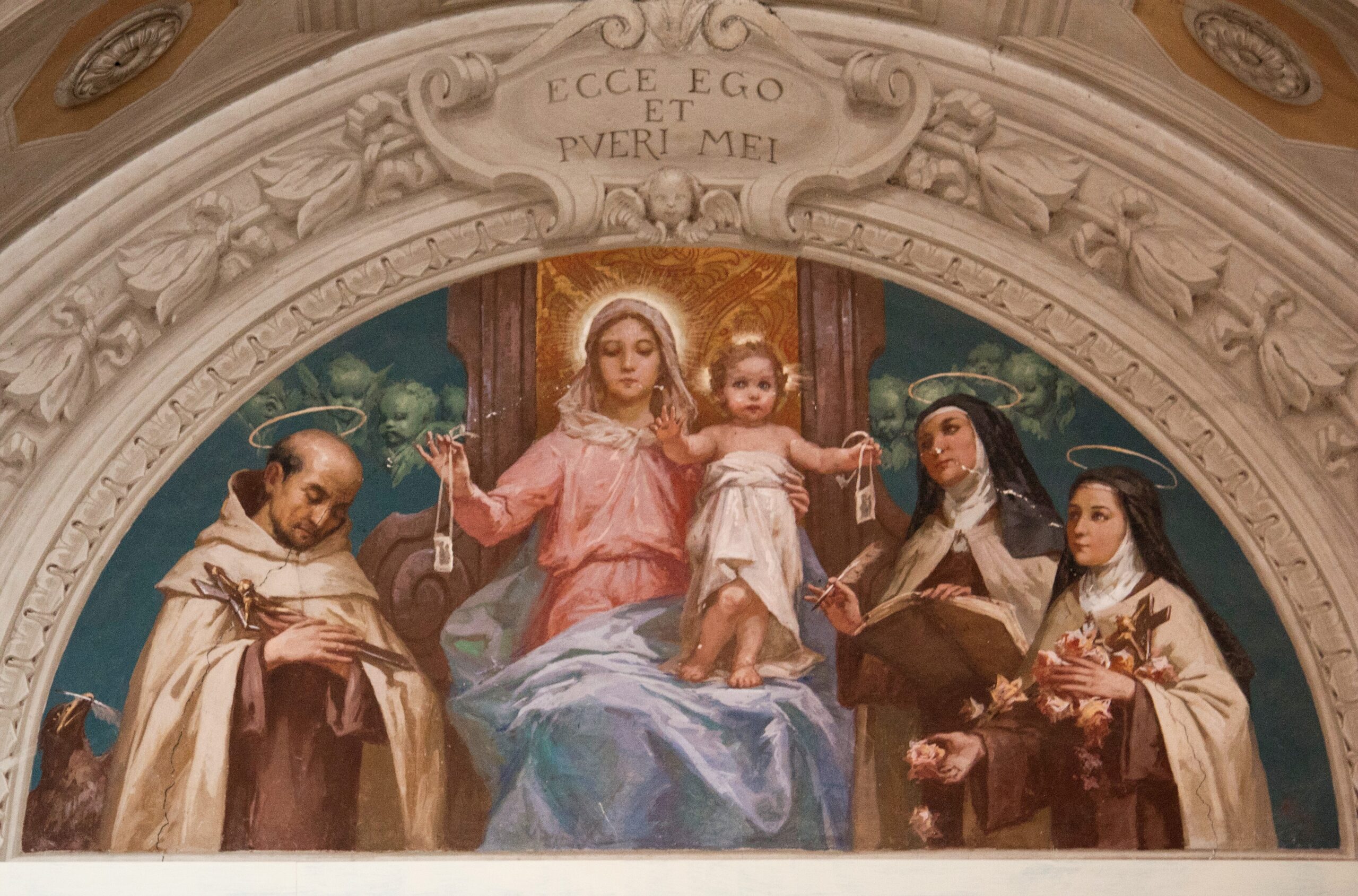

St. Teresa of Avila was born in Avila, Spain, in 1515. She had three sisters and nine brothers. While still a child she read the lives of several martyrs which inspired in her a longing for martyrdom. She ran away from home in the hope of being martyred by the Moors. After being returned and asked the reason for her flight, Teresa replied, “I want to see God, and I must die before I can see him.”
Teresa built a hermitage in the garden with her brother and was often heard repeating “Forever, forever.” She was about 12 years old when her mother died and she implored the Blessed Virgin to be her mother.
When Teresa was 16, her father sent her to a convent school run by Augustinian nuns. Years later, reflecting on her own experience, Teresa said, “If I should have to give advice, I would tell parents that when their children are this age they ought to be very careful about whom their children associate with. For here lies the root of great evil since our natural bent is toward the worst rather than toward the best.”
Teresa entered the Carmelite Convent of the Incarnation in Avila in 1536 at the age of 21. This convent was large and had a somewhat relaxed lifestyle. After a few years, Teresa became lukewarm. Only around the age of 40 did she become fervent again.
Later on, she identified a number of things which had caused her lukewarmness: first, paying little attention to venial sin; second, failing to avoid the people who caused her to sin; third, relying too much on herself rather than on God; fourth, neglecting the holy inspirations and light given by God.
Ralph Martin, author of The Fulfillment of All Desires, wrote: “The means that God used to call her to himself again was a small statue that showed his sufferings as he approached crucifixion. As she meditated on what Christ had suffered for her, she fervently asked for and experienced the grace of deeper conversion, which relaunched her on the spiritual journey. Shortly afterwards she read Augustine’s Confessions, which had just recently been translated into Spanish. God used Augustine’s testimony to consolidate the awakening that was occurring in Teresa.”
This awakening helped Teresa to overcome her desire to be appreciated and thought well of.
In 1562 Teresa founded the first reformed Carmelite convent in Avila. During her lifetime, Teresa founded 17 Carmelite convents. She also launched the Carmelite reform for the friars with St. John of the Cross.
Teresa died on the night of 15 October 1582. Her last words were: “After all I die as a child of the Church,” and “O my Lord and my Spouse, the hour that I have longed for has come. It is time to meet one another.”
St. Teresa wrote, “Mental prayer in my opinion is nothing else than an intimate sharing between friends; it means taking time frequently to be alone with him who we know loves us.”
Pope Benedict XVI commented: “Prayer is life and develops gradually, in pace with the growth of Christian life: it begins with vocal prayer, passes through interiorization by means of meditation and recollection, until it attains the union of love with Christ and with the Holy Trinity. Obviously, in the development of prayer climbing to the highest steps does not mean abandoning the previous type of prayer. Rather, it is a gradual deepening of the relationship with God that envelops the whole of life … Therefore time devoted to prayer is not time wasted, it is time in which the path of life unfolds, the path unfolds to learning from God an ardent love for him, for his Church, and practical charity for our brothers and sisters.”
We welcome letters to the editor about articles in The B.C. Catholic.
德肋撒解釋心禱
阿維拉的聖德肋撒於1515年出生於西班牙的阿維拉。她有三個姐姐和九個兄弟。當她還是個孩子的時候,她讀過幾位殉道者的生活,這激發了她對殉道的渴望。她離家出走,希望成為被摩爾人殺害的殉道者。被帶回來後被問及她出走的原因,德肋撒回答說『我想見到天主,我必須死才能見到祂。』
德肋撒和她的兄弟在花園裡建造了一個隱居所,經常聽到重複的話『永遠,永遠。』當她的母親去世時,她大約12歲,她懇求童貞聖母做她的母親。
德肋撒16歲時,她的父親把她送到了奧斯定修女開辦的修院學校。多年後,德肋撒回顧自己的經歷,說:『如果我必須給出建議,我會告訴父母,當他們的孩子到了這個年齡時,他們應該非常小心他們的孩子與誰交往。因為這就是大惡的根源,因為我們的自然傾向是朝著最壞的而不是最好的。』
德肋撒於1536年21歲時進入阿維拉的加爾默羅降孕修院。這個修道院很大,生活方式有所輕鬆。幾年後,德肋撒變得冷淡。直到40歲左右,她才再次變得狂熱起來。後來,她發現了一些導致她冷淡的原因:第一,很少注意小罪;第二,未能避開使她犯罪的人;第三,過分依賴自己而不是天主;第四,忽略天主賜予的聖靈感和光。
拉爾夫·馬定(Ralph Martin)寫道:『天主用來呼召她再次歸向自己的方式,是一尊小雕像,展示了祂臨近被釘十字架時的痛苦。當她默想基督為她所受的苦時,她熱切地請求並經歷了更深層次歸依的恩典,這使她重新踏上了神修之旅。不久之後,她讀了奧斯定的懺悔錄,當時這本書剛剛被翻譯成西班牙文。天主使用奧斯定的見證來鞏固德肋撒身上的覺醒。』這種覺醒説明德肋撒克服了她對被人欣賞和被人認好的渴望。
1562年,德肋撒在阿維拉建立了第一個改革的加爾默羅會修院。在她的一生中,德肋撒創立了17座加爾默羅會修院。她還與聖十字架若望一起為修士發起了加爾默羅會改革。德肋撒於1582年10月15日晚上去世。她的遺言是:『畢竟我作為教會的孩子而死』和『我的主和我的淨配啊,我渴望的時刻已經到來。是時候見面了』
聖德肋撒寫道:『在我看來,心禱只不過是朋友之間的親密分享;這意味著經常花時間與我們知道愛我們的祂獨處。』教宗本篤十六世評論說:『祈禱是生命,隨著基督徒生命的成長而逐漸發展:它從口禱開始,通過默想和回憶經歷內在化,直到它達到與基督和三位一體的愛的結合。顯然,在祈禱的發展中,攀登到最高的台階並不意味著放棄以前的祈禱模式。相反,它是與天主的關係逐漸加深,籠罩著整個生命…。因此,花在祈禱上的時間不是浪費時間,而是生命之路展開的時間,從天主那裡學習對祂、對祂的教會的熱愛以及對我們弟兄姊妹的實際關愛的道路展開的時間。』
We welcome letters to the editor about articles in The B.C. Catholic.







