

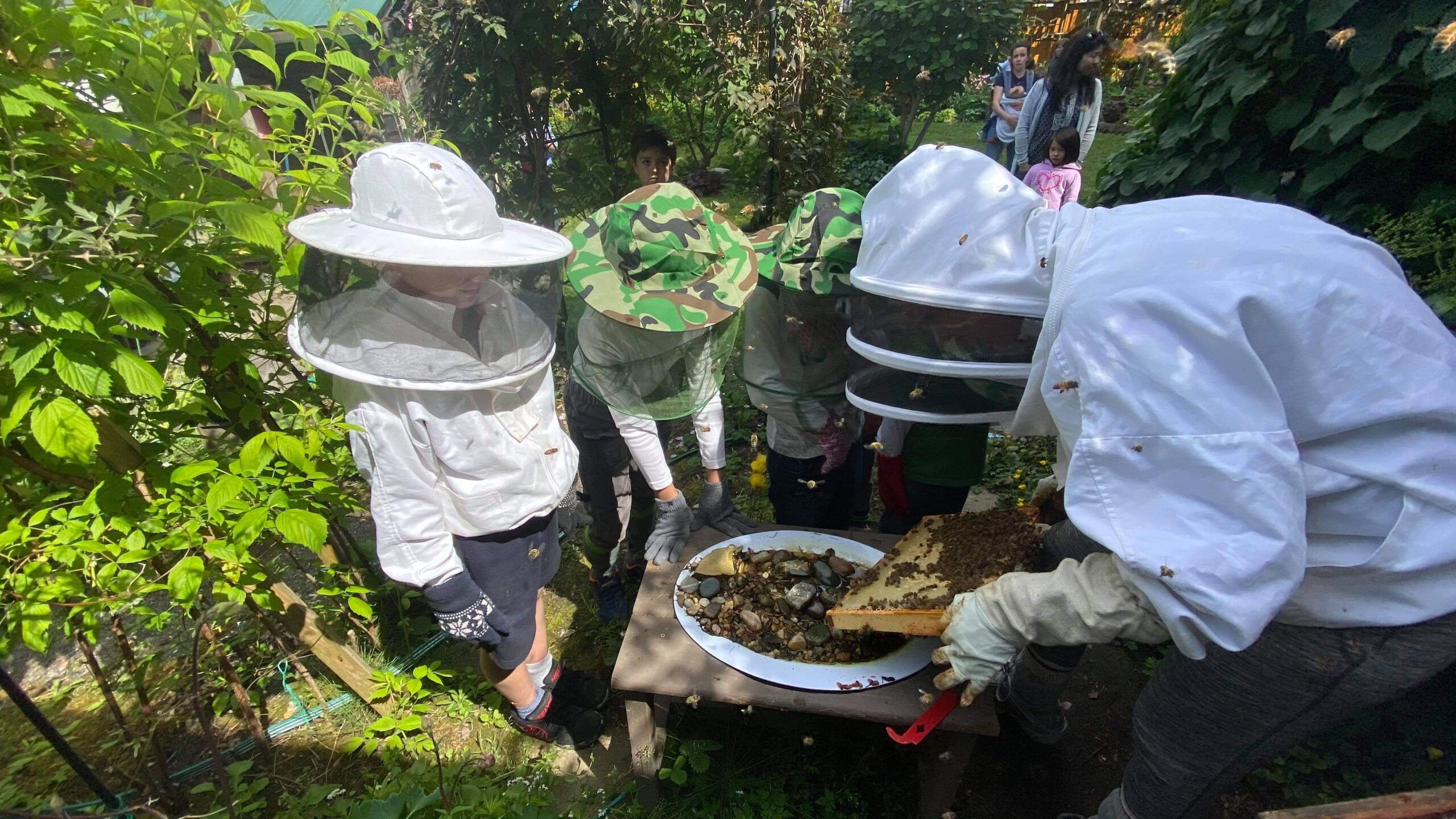

Over the past few years, I’ve invited kids from the Catholic homeschooling community to come and learn about the bees. Thomas suits up to be my helper, and after a lesson, we make a trip to the hive and hope to see a baby bee being born, or, even more exciting for the kids, the Queen.
But there is one bee who is usually overlooked, until we do the classroom part of the class: the worker bee.
Worker bees, all female, make up most of the hive. There can be 60,000 of them at the height of the summer. They do almost all of the work in the hive. From the moment they are born out of the wax, they are enlisted as nursery maids, cleaning out cells, and caring for the eggs.
When they are 22 days old, with less than two weeks left to live, they leave the hive and begin their work as foragers. Each forager can fly up to 12 kilometres in a day, at 15 kilometres an hour, gathering nectar and pollen from up to 100 flowers. It takes thousands of honeybees collecting nectar from over two million flowers to make one pound of honey. With all of those hundreds of flowers, and hundreds of kilometres flown, each honeybee will only make 1/10 of a teaspoon of honey in its life.
Can we even fathom the amount of faithful and diligent work that the bees do every single day of their lives to make one-tenth of a teaspoon of honey? They will die before tasting the honey they spent their lives making. When they collect nectar, they actually swallow it into their honey stomach (different from their food stomach) and let it mix with special enzymes. They pass it on to other bees, who chew it for an hour or so, and pass it along multiple times before finally loading it into a cell. It is nectar, but is also now, partially, bee. And all of this effort and sacrifice to make food another bee will consume.
Honey is known for how wonderful it tastes on toast with melted butter, but it is also so very good for you. It is full of beneficial minerals, and antioxidants known to help heal burns, sore throats, colds, asthma, and allergies. Honey fights diabetes and reduces blood pressure. It is a complete food, made up of all you would need to survive, and it doesn’t go bad.
Is it any surprise that God uses honey as a Eucharistic symbol in the Old Testament? In Psalm 81, Our Lord admonishes the Israelites, reminding them of his faithfulness to them in rescuing them from the slavery of Egypt. He tells the people to open their mouths, that he might feed them. “I would feed you with the finest of the wheat, and with honey from the rock I would satisfy you.”
What is honey from the rock? Rocks do not produce honey, and I’ve never yet heard of honeybees nesting in stone, but I could be wrong. Honey from a rock is an unexpected, impossible provision. This verse in the Psalms is actually quoting Deuteronomy 32. Our Lord begins, “Give ear, O heavens, and I will speak; and let the earth hear the words of my mouth. May my teaching drop as the rain, my speech distil as the dew, as the gentle rain upon the tender grass, and as the showers upon the herb.”
He reminds the people of his faithfulness to them and continues, “He made him suck honey out of the rock.”
Only a few verses beforehand, God refers to himself as the Rock. “The Rock, his work is perfect; for all his ways are justice. A God of faithfulness and without iniquity, just and right is he.”
God himself is the rock from which he wishes to feed the people. The sweet, nourishing, healing food is the Body and Blood of Christ. Like the bee, Our Lord gave everything, unto death, without recompense, to provide us with complete nourishment, all we need to survive, spiritually. (There are stories of saints such as Catherine of Siena who survived for years with only the Eucharist as food.)
Our God has put signs of his love and faithfulness, of his Catholicity, all around us. I really do believe that children have hearts and souls made, in their innocence, to absorb these signs and keep them close to their hearts. And when they grow and, perhaps, need to remember his love and faithfulness, the truths they learned in childhood can be a hint and comfort.
(Due to an editing error, the first paragraph of Colleen Roy’s July 10 contained several mistakes. We apologize and have corrected the online version of the column — Editor.)
We welcome letters to the editor about articles in The B.C. Catholic.







