


In your June 14 story “Pope Francis’ emphasis on synodality cited in joint Catholic-Orthodox statement,” the photo that you selected depicts Pope Francis and the Coptic Orthodox Pope Tawadros II. It is an unfortunate selection of a photo because the story is about the Eastern Orthodox churches, not the Oriental Orthodox (which includes the Coptics).
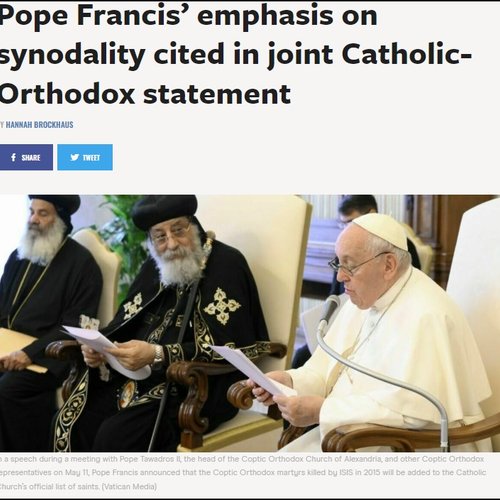
The Oriental Orthodox are the churches formerly known as monophysite. Dialogue with Oriental Orthodox churches, particularly during the papacy of St. John Paul II, led to profound agreements about the issues that led to the Oriental Orthodox churches rejecting the Council of Chalcedon in 481 AD. This is an important dialogue; however, the 14 story is about dialogue with the Eastern Orthodox churches (Greek, Russian, etc…), most of whom are Byzantine.
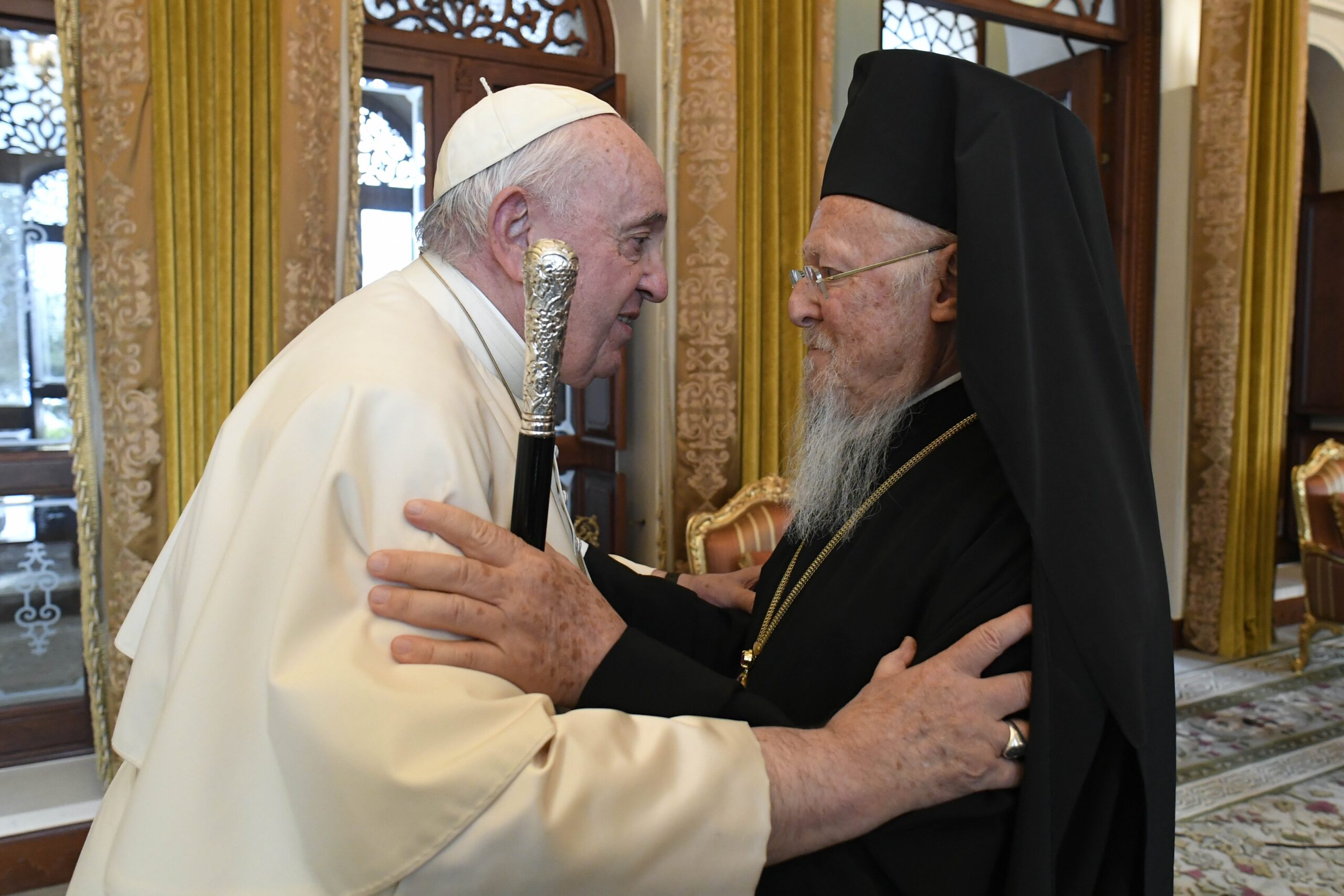
Photos of Patriarch Bartholomew of Constantinople with Pope Francis would be a good example of the healthy relations with these churches.
Bartholomew is also known as the Ecumenical Patriarch because of his role as primus inter pares of the Eastern Orthodox churches. He frequently visits for joint press conferences with various dicasteries. He also visits Pope Francis almost annually for the June 29 Feast of Sts. Peter and Paul. Bartholomew is also identified with the Sept. 1 Day of Prayer for Creation. Together with Pope Francis, he has encouraged churches to work together in care for the environment.
Nicholas Jesson
Ecumenical and Interfaith Relations, Roman Catholic Archdiocese of Regina
A couple of months ago, I went to confession in a state of utter despair.
My world was absolutely shattered. And in a world where we throw away that which is broken, I was desperately trying to pick up the fragments of my life and trying to put them back together again. All I could think about was how it shattered, how it could shatter again, and how bloodied and wounded my own hands were in picking up and inspecting each jagged piece.
One thing the priest said to me that stood out was along the lines of “heroic act of faith.” I had entered the confessional dreadfully fatigued but left with a sense of alertness at the word “heroic.”
As I pondered this word, I admit feeling a small sense of pride. (Oh, how quickly the devil attacks). I thought about my life’s problems and how heroic I was. I thought about how hard I was trying despite the adversity I was facing. I decided that “yes, I am amazing. I can be loving. I can be merciful. I can rise through any challenge because I have God on my side….” It all sounds great in theory, but I’ve recently been reminded, as I have been before, how fallible that way of thinking is.
Jesus says, “Sine me nihil potestis facere!”” “Without me you can do nothing!’”
Heroic virtue has nothing to do with my supposed abilities or God “supporting” my decisions and vision of a good, moral life.
Heroic virtue is about allowing God to direct my thoughts and actions towards the life he has designed for me. A life that the Good Shepherd promises is full and good. It requires trusting God’s will for my good, despite what I may think would bring my soul justification and peace. All God asks is that I trust and surrender.
St Josemaria Escriva once said, “Should I be surprised at all at ‘my’ foolishness? I will put Jesus into everything that is mine. And then there will be no foolishness in my conduct: and, if I would speak correctly, I should talk no more of what is ‘mine’, but of what is ‘ours’.”
My righteousness and pride in trying to control every facet of my life has only served to let me stray deeper into the pits of despair. I was constantly trying my best to be the best, and in my own self-sufficient way of living, I never left any room for God to work in my life despite outside appearances of devout practices of my “faith,” which actually was just scrupulosity in disguise.
If I invite God into my life and my decision making, my life is no longer my own, but as suggested by St. Josemaria, it is ours. I would therefore belong to God and belong to the light, where fear and darkness may only serve to sharpen my, at many times, inconstant faith.
We aren’t meant to face the world alone. And we are not alone. God is always with us, and it would be for our benefit if we could actually proclaim and let, as the saying goes, Jesus take the wheel! With humility, one can let God take control and we, as sons and daughters of Christ, can truly become conduits of God’s love and mercy, and express that heroic virtue that God freely gives.
As for me, Philippians 4:13 has a whole new meaning. In the past, this verse has gotten me through comparatively minuscule trials such as passing tests, getting through a tough day at work, or surviving a physical education class. But these words have transcended into something new in my life: “I can do all things through Christ who gives me strength.”
It isn’t I who can do all things, but it is God, but only when I am docile enough to surrender my will and let him reign over my faculties. Of course, this is easier said than done, but mindful practice makes perfect. We are, after all, called to achieve this perfection, not by our own merits but rather through our trustful surrender.
Airra Whelan
Richmond
Re your June 12 story “Pietra Fitness more Catholic than Catholic yoga”:
In trying to market her brand of yoga, Pietra Fitness founder Karen Barbieri claims she was uncomfortable with yoga’s Eastern spiritual roots. In the more than 40 years I’ve been acquainted with the practice, even in India, I’ve never encountered anything more than its health-enhancing poses and its focus on breathing, calming the mind, physical flexibility, and strength … never any religious promotion or connection of any kind.
Alison ten Bohmer’s claim that the poses of yoga “can symbolize an offering or represent a physical prayer to Eastern gods” is quite the spin. Practising yoga in a Catholic context is laudable, but in marketing Pietra Fitness is there a need to misrepresent mainstream yoga?
By the way, Christianity also has its spiritual roots in the East. Jesus and his disciples were from Palestine, and early theologians and doctors of the Church such as St. Augustine of Hippo, St. Athanasius of Alexandria, St. Gregory of Nazianzus, St. Basil the Great etc., were not from the West.
J. Sterling
Surrey
I am a senior and in all my years of taking yoga I have yet to come across any reference to religion, eastern or otherwise.
I’ve taken many fitness classes and Pietra Fitness is the only one that brings up religion.
I tend to stay away from any product that “puts down” another product to make itself look good.
Pietra Fitness is Catholic yoga and I’m very disappointed in The B.C. Catholic for helping to advertise it. If they want to advertise in the newspaper, let them pay for it like any other product.
Margaret da Costa
Coquitlam
In the May 8 issue, reader Eileen Hetherington wrote in a letter to the editor regarding COVID immunization:
“I am shocked that The B.C. Catholic would promote breaking the law by publishing anti-mandate viewpoints.”
Publishing different points of view has never been illegal. Not getting immunized during COVID was never illegal. It brought some dire consequences such as no travel and sometimes even losing a job. But many passionate and practising Catholics have chosen to suffer the consequences for what they believe was right by following the science and their conscience. Many top scientists also disagreed about many issues during the pandemic.
We all had to make and follow our own decisions based on conscience and research.
Marianne Werner
Vancouver
We welcome letters to the editor about articles in The B.C. Catholic.







