

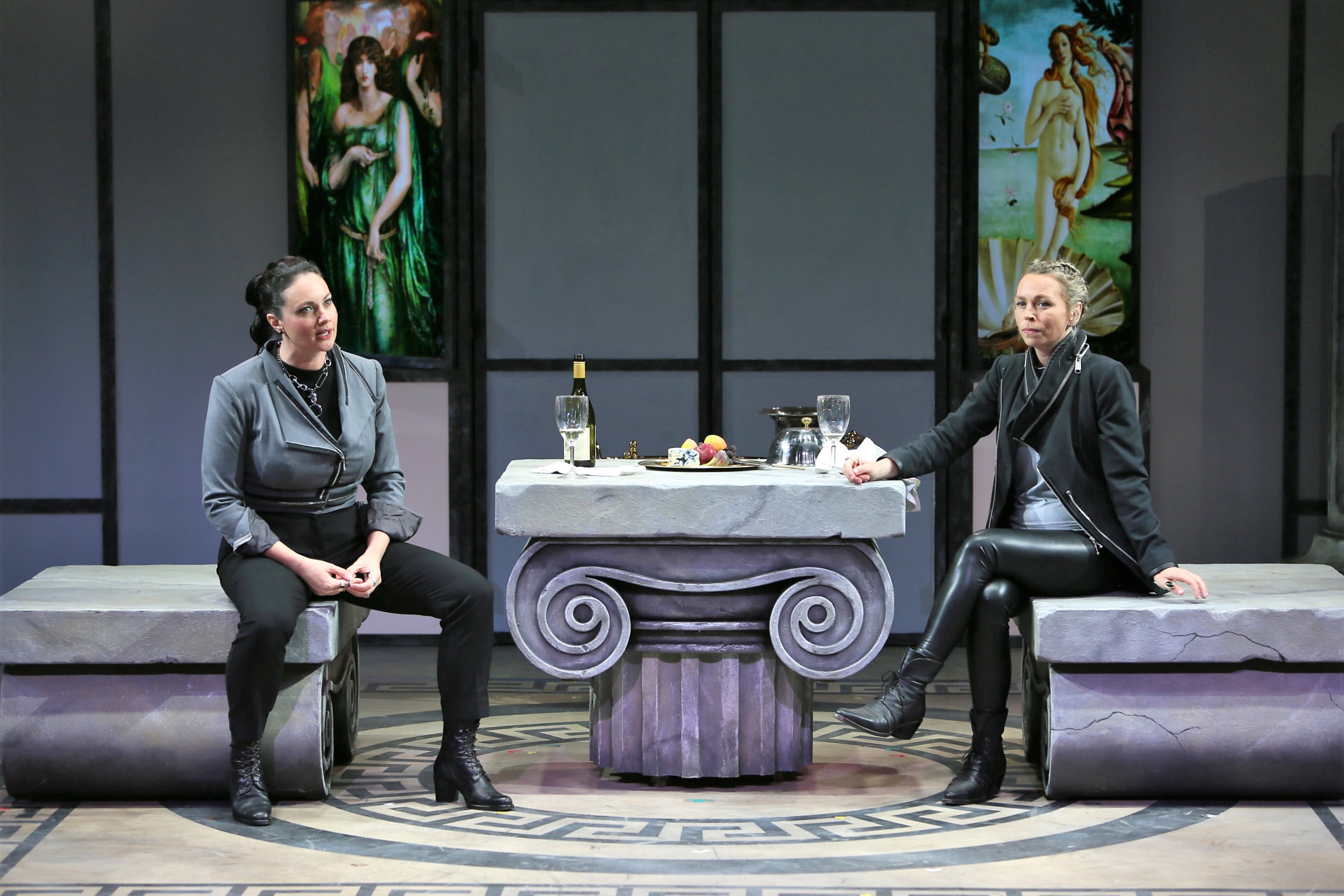

In these days of “Me Too” and political correctness, it is not surprising to see women actors play parts originally penned for men – a tradition of inclusivity that goes back at least to the days of Sarah Bernhardt, who played Hamlet to great acclaim.
Bard on the Beach is participating in this growing trend with both of its mainstage productions of As You Like It and Julius Caesar.
Of course when we go to the theatre, we all participate in pretense. Actor Joe Smith is no more Hamlet than anyone else – man or woman. So why should it matter if a woman is playing Hamlet or any other “male” role? It’s all part of the pretense of theatre, especially as in Shakespeare’s day women’s parts were played by boys.
Moreover, this season at Bard on the Beach, the company is asked to perform in two different plays on alternate nights. Inevitably, then, parts have to be allocated to the company members in the most satisfactory manner possible, with several “male” roles played by women.
Then, too, it must be recognized that the director and artistic manager cast actors according to those who audition for the part and who are available for the run of a planned production.
Perhaps this is what contributed to the decision to cast Jennifer Lines in both mainstage productions in roles originally written for male characters: the Duke (now the Duchess) in As You Like It, and Mark Antony in Julius Caesar.
Lines, who is extremely well cast in both her roles, is an actor who has performed superbly in a multitude of Vancouver productions over the years. Now she and other women, as well as the men, do much to bring alive Julius Caesar.
The play about an authoritarian head of state, the conspiracy to end his sway, and the bloody aftermath that follows does have considerable relevance in today’s world where so many heads of state seem to threaten democracy. The stylized modern costuming and the creative minimal set, with nods to both the world of Rome and of today, allow the production to move both smoothly and convincingly. The use of modern weaponry and projected pictures on the screens that form the back wall of the performance area emphasize the message of history so relevant today.
In furtherance of this, Andrew Wheeler in the title role turns in a suitably bombastic performance, while the rest of the cast throw themselves into the action with due enthusiasm, whether it be in the tense debates among the conspirators, the excitement of the mob scenes, or the violence of battle.
Indeed, if the production falters, it is because it is not sufficiently nuanced. Though the play demands that much of it be delivered at top volume, quieter scenes need to be more gently handled. So, for example, Andrew McNee as Brutus, presented by Shakespeare as an intellectual Stoic, well conveys the intensity of his dilemma as to whether or not to join the conspirators. However, the key scene when he is alone in his study debating his concerns would be more effective were his soliloquizing not delivered at the same volume as his funeral speech, purportedly being delivered outdoors to a hostile mob.
This is unfortunate in that this is as much a play about personal concerns and differences of opinion as it is about clamorous political and armed rebellion. It comes as something of a relief when a gentler tone is set, as in the charming and moving scene between Brutus and his young servant prior to the fateful battle at Phillipi.
That so much of the rest of the play is proclaimed, rather than merely spoken, becomes somewhat tiresome and robs it of some of its force – a force so apparent in the larger scenes when the production delivers well its message.
Despite its drawbacks with its production of Julius Caesar, Bard on the Beach once again lives up to its fine reputation by making Shakespeare not only effectively entertaining, but also markedly relevant to the world in which we live.
We welcome letters to the editor about articles in The B.C. Catholic.







