

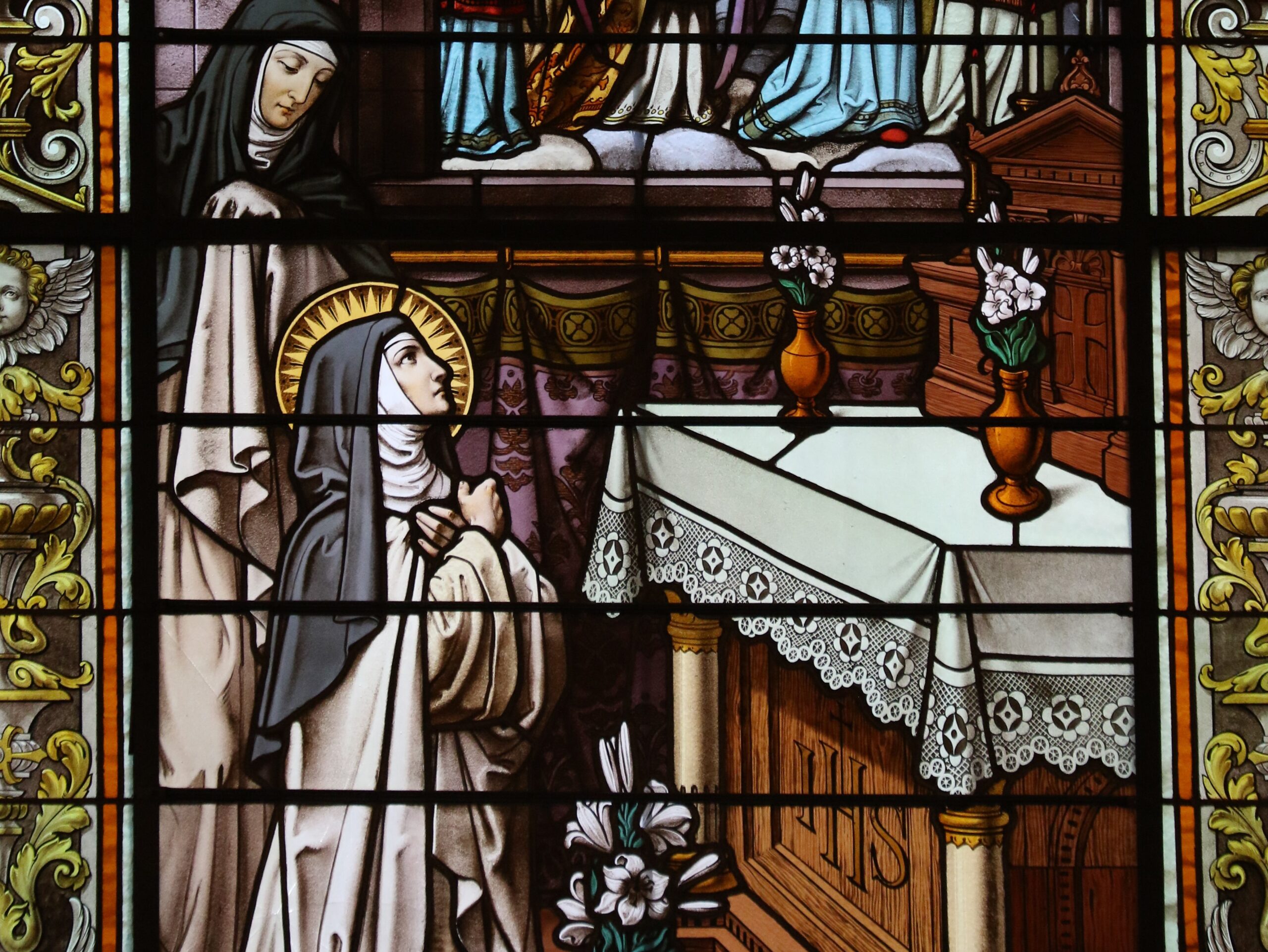

St. Juliana of Cornillon was born in Belgium about 1191. She became an orphan at the age of five and was entrusted with her sister Agnes to the care of the Augustinian nuns. Eventually, Juliana became an Augustinian nun.
Juliana made rapid progress in both learning and spirituality. She read the writings of Church Fathers and had a great love for Our Lady, the Passion of Christ, and especially the Holy Eucharist. She frequently meditated on Jesus’ words: “And lo, I am with you always, to the close of the age” (Mt 28:20).
Pope Benedict XVI said, “When Juliana was 16 she had her first vision which recurred subsequently several times during her Eucharistic adoration. Her vision presented the moon in its full splendour, crossed diametrically by a dark stripe. The Lord made her understand the meaning of what had appeared to her. The moon symbolized the life of the Church on earth, the opaque line, on the other hand, represented the absence of a liturgical feast for whose institution Juliana was asked to plead effectively: namely, a feast in which believers would be able to adore the Eucharist so as to increase in faith, to advance in the practice of the virtues and to make reparation for offences to the Most Holy Sacrament.”
Juliana kept the private revelation to herself for about 20 years, then she shared it with two women devoted to the Holy Eucharist – Blessed Eva and Isabella. Pope Benedict said, “The three women established a sort of ‘spiritual alliance’ for the purpose of glorifying the Most Holy Sacrament.” Due to their efforts, the Feast of Corpus Christi was celebrated in some dioceses during the lifetime of St. Juliana. The saint died on April 5, 1258. Pope Urban IV instituted the Solemnity of Corpus Christi for the whole Church in 1264. He asked St. Thomas Aquinas to write the liturgical texts for the feast. As a result the saint composed some famous hymns: Pange lingua, Tantum ergo, and Panis angelicus. Pope Benedict XVI said, “They are masterpieces, still in use in the Church today, in which theology and poetry are fuse.”
St. John Paul II wrote, “In many places, adoration of the Blessed Sacrament is also an important daily practice and becomes an inexhaustible source of holiness.”
Venerable Fulton John Sheen said that on the day of his Ordination, he made the resolution to spend a continuous Holy Hour every day in the presence of Our Lord in the Blessed Sacrament.
In his autobiography, Treasure in clay, Bishop Sheen listed the reasons for daily Holy Hour:
“First, the Holy Hour is not a devotion; it is a sharing in the work of redemption… In the Garden, Our Lord contrasted two ‘hours’ – one was the evil hour ‘this is your hour’ – with which Judas could turn out the lights of the world. In contrast, Our Lord asked: ‘Could you not watch one hour with Me?’ In other words, He asked for an hour of reparation to combat the hour of evil; an hour of victimal union with the Cross to overcome the anti-love of sin.”
“Secondly, the only time Our Lord asked the Apostles for anything was the night He went into His agony…. As often in the history of the Church since that time, evil was awake, but the disciples were asleep. That is why there came out of His anguished and lonely Heart the sigh: ‘Could you not watch one hour with Me?’ Not for an hour of activity did He plead, but for an hour of companionship.”
“The third reason I keep up the Holy Hour is to grow more and more into His likeness. As Paul puts it: ‘We are transfigured into His likeness, from splendor to splendor.’ We become like that which we gaze upon. Looking into a sunset, the face takes on a golden glow. Looking at the Eucharistic Lord for an hour transforms the heart in a mysterious way as the face of Moses was transformed after his companionship with God on the mountain.”
Pope Benedict XVI said, “It is comforting to know that many groups of young people have rediscovered the beauty of praying in adoration before the Most Blessed Sacrament.”
We welcome letters to the editor about articles in The B.C. Catholic.
儒利亞納光榮聖體聖事
科尼永的聖儒利亞納於 1191 年至 1192 年間出生於比利時。她在五歲時成為孤兒,她和姐妹艾格尼被託付給奧斯定會修女照顧。最終,儒利亞納成為了奧斯定會修女。
儒利亞納在學習和靈修方面都取得了快速的進步。她閱讀了聖教教父的著作,對聖母、基督苦難,尤其是聖體聖事有著極大的愛慕。她經常默想耶穌的話:『看!我同你們天天在一起,直到今世的終結。』(瑪竇28:20)
教宗本篤十六世說:『當儒利亞納16歲時,她有了她的第一個神視,隨後在她的朝拜聖體期間多次出現。她神視見到了月滿的光輝,有一黑色條紋橫過其中。我主使她明白向她所顯示的意義。月亮象徵著教會在地球上的生命,另一方面,不透明的線條代表沒有瞻禮禮儀,儒利亞納被要求有效地懇求這瞻禮的制定:也就是說,一個瞻禮,信徒將能夠朝拜聖體聖事,以增加信心,在德行實踐中進步,並對至聖聖事的冒犯進行賠償。』
儒利亞納將這個私人啟示保留了大約20年,然後她與兩位致力於聖體聖事的女子——真福亞娃和依撒格分享了它。教宗本篤十六世說:『三位女子建立了一種「精神聯盟」,目的是光榮至聖聖事。』由於他們的努力,在聖儒利亞納仍在世的時候,一些教區慶祝了基督聖體瞻禮。聖人於 1258 年 4 月 5 日去世。教宗烏爾巴諾四世於1264年為整個教會制定了基督聖體瞻禮。他請聖托瑪斯·阿奎那為盛宴撰寫禮儀文本。結果,聖人創作了一些著名的讚美詩:信友立齊來,皇皇聖體和天使之糧。教宗本篤十六世說:『它們是傑作,今天仍在教會中使用,其中神學和詩歌融合在一起。』
聖若望保祿二世寫道:『在許多地方,朝拜聖體也是一種重要的每日神業,並成為聖德取之不竭的源泉。』
可敬富爾頓主教在他被祝聖司鐸時下定決心每天在聖體前作一個連續小時的聖時。在他的自傳中,富爾頓主教列出了每天聖時的原因:
『首先,聖時不是只是敬禮; 這是參與救贖工程… 在山園裡,我們的主對比了兩個「時辰」——一個是邪惡的時刻「這是你的時刻」—猶達斯可以用這時辰熄滅世界的光。相比之下,我們的主問:「你們竟不能同我醒寤一個時辰嗎?」換句話說,祂要求一個小時的賠償來對抗邪惡的時刻;一個小時與十字架的受害者結合,以克服對罪的反愛。』
『其次,我主唯一一次向使徒們有所要求,就是祂陷入痛苦的那天晚上。 自那時以來,在教會的歷史上,經常是邪惡醒著的,但門徒卻睡著了。這就是為什麼從祂痛苦和孤獨的心中發出歎息:「你們竟不能同我醒寤一個時辰嗎?」祂要求的不是一小時的活動,而是一小時的陪伴。』
『我堅持聖時的第三種原因是越來越像祂的聖容。一如保祿所說:「我們眾人以揭開的臉面反映主的光榮的,漸漸地光榮上加光榮,都變成了與主同樣的肖像」我們變得像我們凝望的那一位。望著夕陽,臉上泛起了金色的光芒。仰望聖體聖事一小時,心靈從一種奧秘的方式改變,就像梅瑟在山上與天主相伴后,他的面孔發生了變化。』
教宗本篤十六世說:『令人欣慰的是,許多年輕人團體重新發現了在至聖體前朝拜祈禱的美麗。』
We welcome letters to the editor about articles in The B.C. Catholic.







