

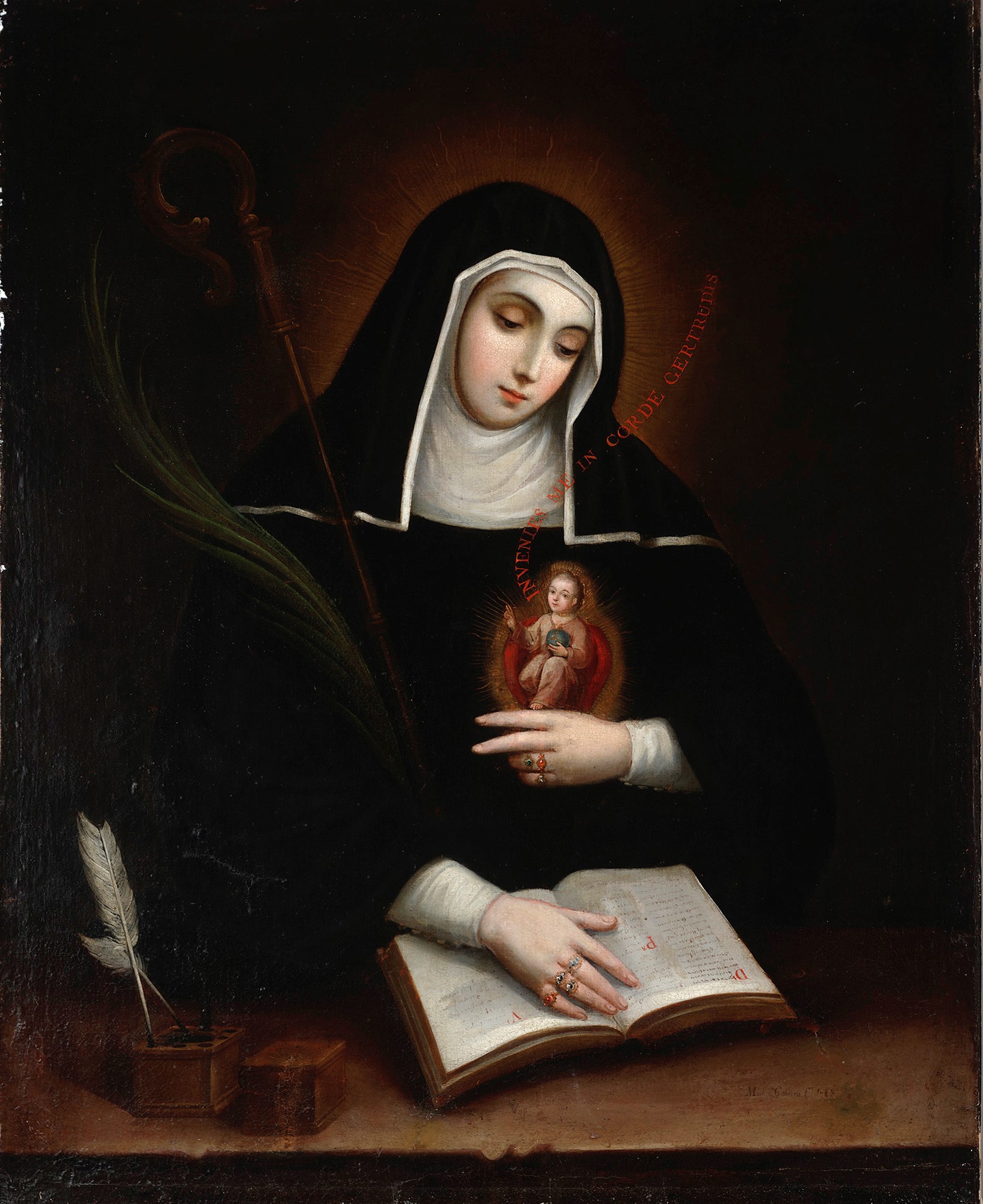

St. Matilda of Hackeborn was the sister of Abbess Gertrude of Hackeborn. When Matilda was seven, her mother brought her to visit her elder sister Gertrude, who was then a nun in the monastery of Rodardsdorf, in Switzerland. Matilda was attracted to the monastic life and entered the monastery as a schoolgirl. In 1258 Matilda became a nun at the convent, which in the meantime had moved to Helfta, near Eisleben in modern-day Germany.
Pope Benedict XVI said that when Matilda was still very young “she became the principal of the convent’s school, choir mistress and novice mistress, offices that she fulfilled with talent and unflagging zeal, not only for the benefit of the nuns but for anyone who wanted to draw on her wisdom and goodness.”
In 1261 the five-year-old St. Gertrude the Great was entrusted to the convent. The young saint was under the care of Matilda, who was 20 years of age. In 1271 or 1272, Matilda of Magdeburg also entered the convent. Pope Benedict XVI commented: “So it was that this place took in four great women two Gertrudes and two Matildas the glory of German monasticism.”
At the age of 50, Matilda experienced both spiritual and physical suffering. She confided to St. Gertrude the Great and another religious sister the special graces and private revelations she received from God since childhood. However, Matilda did not know that they were writing it all down.
When she found out that Gertrude the Great had almost completed a book of her revelations she was deeply troubled until she had a vision of Christ holding in His hand the book and said, “All this has been committed to writing by my will and inspiration; and, therefore you have no cause to be troubled about it.” Our Lord let her know that those revelations would cause many to increase in His love. He wished the book to be called “The Book of Special Grace.”
Regarding the spirituality of Matilda, Pope Benedict XVI said, “Her visions, her teachings, the events of her life are described in words reminiscent of liturgical and biblical language. In this way it is possible to comprehend her deep knowledge of Sacred Scripture, which was her daily bread. She had constant recourse to the Scriptures, making the most of the biblical texts read in the Liturgy, and drawing from them symbols, terms, countryside, images, and famous figures.”
Matilda had a special love for the Gospel. Our Lord said to her: “Consider the immensity of my love: if you want to know it well, nowhere will you find it more clearly expressed than in the Gospel. No one has ever heard expressed stronger or more tender sentiments than these: ‘As my father has loved me, so I have loved you (Jn 15:9)’.”
At the age of 25, St. Gertrude the Great had a vision of Christ (January 27, 1281). She referred this mystical experience as her “conversion.” Pope Benedict XVI said, “Her biographer points out two directions of what we might describe as her own particular ‘conversion’: in study, with the radical passage from profane, humanistic studies to the study of theology, and in monastic observance, with the passage from a life that she describes as negligent, to the life of intense, mystical prayer, with exceptional missionary zeal…. She filled her heart with the most useful and sweet sayings of Sacred Scripture. Thus she was always ready with some inspired and edifying word to satisfy those who came to consult her while having at her fingertips the most suitable scriptural texts to refute any erroneous opinion and silence her opponents.”
The life of St. Gertrude the Great was full of extraordinary mystical experiences. These experiences were recorded, over an eight-year period, in her Revelations. She was one of the first to promote devotion to the Sacred Heart of Jesus. She died on November 17, 1301 or 1302. The saint said, “Bodily and spiritual affliction are the surest sign of Divine predilection. Gratitude for suffering is a precious jewel for our heavenly crown… Man should always firmly believe that God sends just that trial which is most beneficial for him.”
Share your thoughts by sending us a letter to the editor.
德國神視者愛聖經
哈克伯恩的聖瑪蒂爾達是哈克伯恩的修院院長日多達的妹妹。瑪蒂爾達七歲時,她的母親帶她去探望她的姐姐日多達,日多達當時是羅達茲多夫修院的修女。瑪蒂爾達被修院的生活所吸引,並以女學生的身份進入修院。1258年,瑪蒂爾達成為修道院的修女,同時修道院已搬到赫爾夫塔。
教宗本篤十六世說那時瑪蒂爾達還是十分年輕:『她成為修道院學校的校長,唱經濟團的導師和初學者的導師,她以才華和不懈的熱情履行了這些職責,不僅是為了修女們的利益,也是為了任何想以她的智慧和善良中得益的人。』
1261年,五歲的聖女日多達被委託給修道院。這位年輕的聖人由20歲的瑪蒂爾達照顧。在1271年或1272年,馬格德堡的瑪蒂爾達也進入了修院。教宗本篤十六世評論說:『因此,這個地方接納了四位偉大的女性,兩位日多達和兩位瑪蒂爾達,這是德國修院的榮耀。』
50歲時,瑪蒂爾達經歷了精神和身體上的痛苦。她向聖女日多達和另一位修女吐露了她自小從天主那裡得到的特殊恩典和私人啟示。然而,瑪蒂爾達並不知道他們正在把這一切寫下來。當她發現日多達幾乎完成了她的啟示書時,她深感不安,直到她看到基督手裡拿著這本書的視像時她說:『這一切都是我旨意和啓發所寫的;因此,您沒有理由為此煩惱 。』我們的主讓她知道,這些啟示會使許多人在祂的愛中增長。他希望這本書被稱為「特別恩典之書」。
關於瑪蒂爾達的靈性,教宗本篤十六世說:『她的神視,她的教導,她生活中的事件都用讓人聯想到禮儀和聖經語言的文字來描述。通過這種方式,可以理解她對聖經的深刻瞭解,這是她每天的食糧。她經常求助於聖經,充分利用禮儀中閱讀的聖經文本,並從中汲取標記、術語、鄉村、圖像和著名形象。』
瑪蒂爾達對福音有著特別的熱愛。我們的主對她說:『想想我愛的浩瀚:如果你想清楚地瞭解它,你找不到比福音更清楚地表達它的地方了。從來沒有人聽到過比這些更強烈或更溫柔的情感:「正如父愛了我,同樣我也愛了你們;你們應存在我的愛內。(若15:9)」』
25歲時,聖女日多達看到了基督的神視(1281年1月27日)。她將這種神視的經歷稱為她的『皈依』。教宗本篤十六世說:『她的傳記作者指出了我們可以描述為她自己特殊「皈依」的兩個方向:在研究中,隨著從俗世的人文主義研究到神學研究的全面過渡,在修院的遵
循中,從她描述為疏忽的生活,到強烈、奧秘的祈禱生活,帶著非凡的使徒熱情…她用聖經中最有用和最甜蜜的話語填滿了她的心。因此,她總是準備好一些鼓舞人心和啟發性的話語來滿足那些來諮詢她的人,同時觸手可及的最合適的經文來駁斥任何錯誤的觀點,使她的對手沉默。』
聖女日多達的一生充滿了非凡的神秘經歷。這些經歷在她的啟示錄中記錄了八年。她是最早促進對耶穌聖心敬禮人之一。她於 1301 年或 1302 年 11 月 17 日去世。這聖人說:『身體和精神上的痛苦是天主神聖偏好的最可靠標誌。對苦難的感恩是我們上天冠冕的珍貴寶石……人應該始終堅信,天主所賜的就是對他最有益的試煉。』







