



Recently I demonstrated the scam you see here to a large group of friends. Cybersecurity requires ongoing education. I actually followed the scam through nearly to completion, using a Chromebook I set aside for this sort of thing.
Even though this scam looked like many dozens of others I’ve seen, it was in fact different. I assumed it was a straightforward credit card heist. Get the person to believe they’ve won something and then have them pay a small fee for the prize.
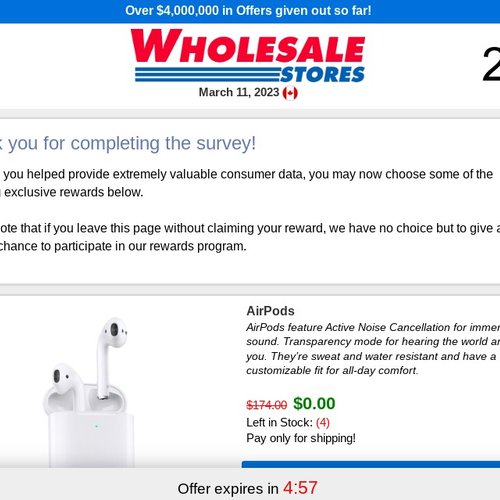
In this case the person completes a survey (Image 1) that arrives via email, usually incorporating an official logo or one that looks remarkably similar to that of a well known company. It doesn’t matter how the survey is answered. All paths lead to the same conclusion. To hurry you along, a countdown clock is displayed on some screens. You don’t want to miss out, right?
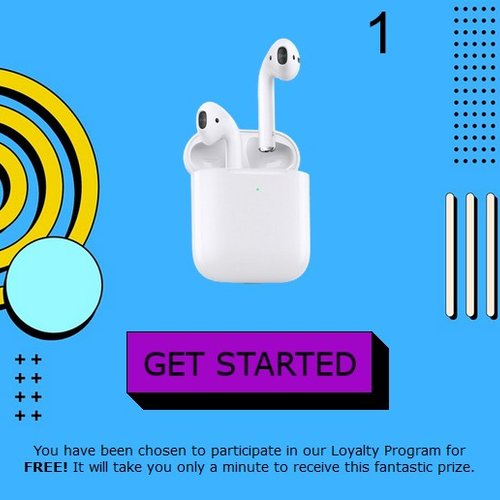
Where this scam differs is that you may actually receive the item promised. However, if you take the time to read the very fine print, and in this case it was many pages long, you find that by claiming your reward, supposedly air pods (Image 2) at the low price of $9.90 (Image 3), you are in fact agreeing to pay the full price later, and that furthermore, you will be billed every month for other “prizes” that will be auto-billed, typically in the $50 to $100 a month range. Yikes! Some may not notice these extra charges until months later.
What a mess. Deep in the fine print you also find language that in essence says you won’t take legal action against the company, and that you won’t join any potential class action.
Interestingly, there was a customer support number that actually answered when I called. There was no hint of a boiler room operation. The person said he was working from Calgary. I questioned him on this, noting that the fine print all referred to a Utah operation. His answer was that he looked after Canadian customers. I decided against engaging any further with him.
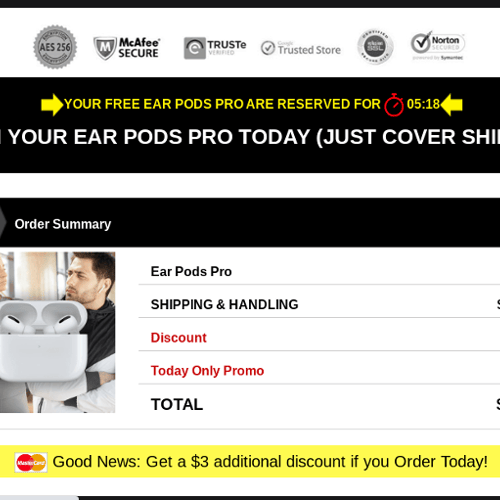
Notice how some of the pages from this scam are plastered with official logos (Visa, MasterCard, McAfee, Norton, and more) to convey an aspect of security. This is particularly visible on the screen where credit card data is entered in order to pay for the “free” item through a discounted shipping fee (Image 4).
This particular scam survey appears to promise earbuds that look remarkably like those produced by Apple. Of course, they are sure to be cheap knock-offs and the Apple name appears nowhere.
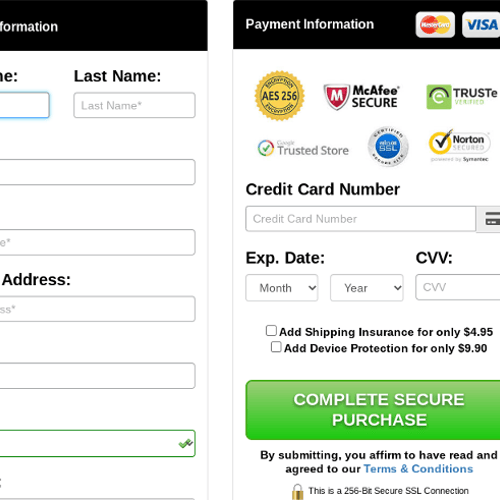
Don’t be stampeded by countdown clocks and references to low stock, as we see in this scam. Again, scams like this are persistent. They exist because people fall for them. They exist because they make money for the perpetrators. Don’t aid their cause. The old adage applies here: if it appears to be too good to be true, it (probably) is.
Follow me on Facebook (facebook.com/PeterVogelCA), or on Twitter (@PeterVogel).







