


Sixth Sunday of Easter, Year A
First Reading: Acts 8:5-8, 14-17
Second Reading: 1 Pt 3:15-18
Gospel Reading: Jn 14:15-21
“I will ask the Father, and he will give you another advocate, to be with you forever,” Jesus told his apostles. “The Paraclete, the Holy Spirit, whom the Father will send in my name, will instruct you in everything, and remind you of all that I told you.”
Accordingly, the apostles handed on not only what they had received from Christ, but also what they had learned “at the prompting of the Holy Spirit,” says Vatican II. Together, it makes up a single “deposit of faith.”
By their words, their example, and the institutions they established, the apostles first transmitted that deposit in a “living” manner, producing what we call sacred tradition. Eventually, some of them and their associates wrote part of it down, producing what we call sacred Scripture.
Like sacred Scripture, sacred tradition does not err, because it is “accomplished in the Holy Spirit,” says the Catechism of the Catholic Church.
“Tradition” comes from the Latin traditio: “a handing down.” To ensure that the deposit of faith would continue to be handed down, the apostles appointed successors and gave “instructions that when these should fall asleep, other approved men should succeed them in their ministry,” as Pope Clement, Peter’s third successor, told the Corinthians.
In fact, today’s bishops have “taken the place of the apostles” in such a way that “whoever listens to them is listening to Christ and whoever despises them despises Christ and him who sent Christ,” says the Catechism.
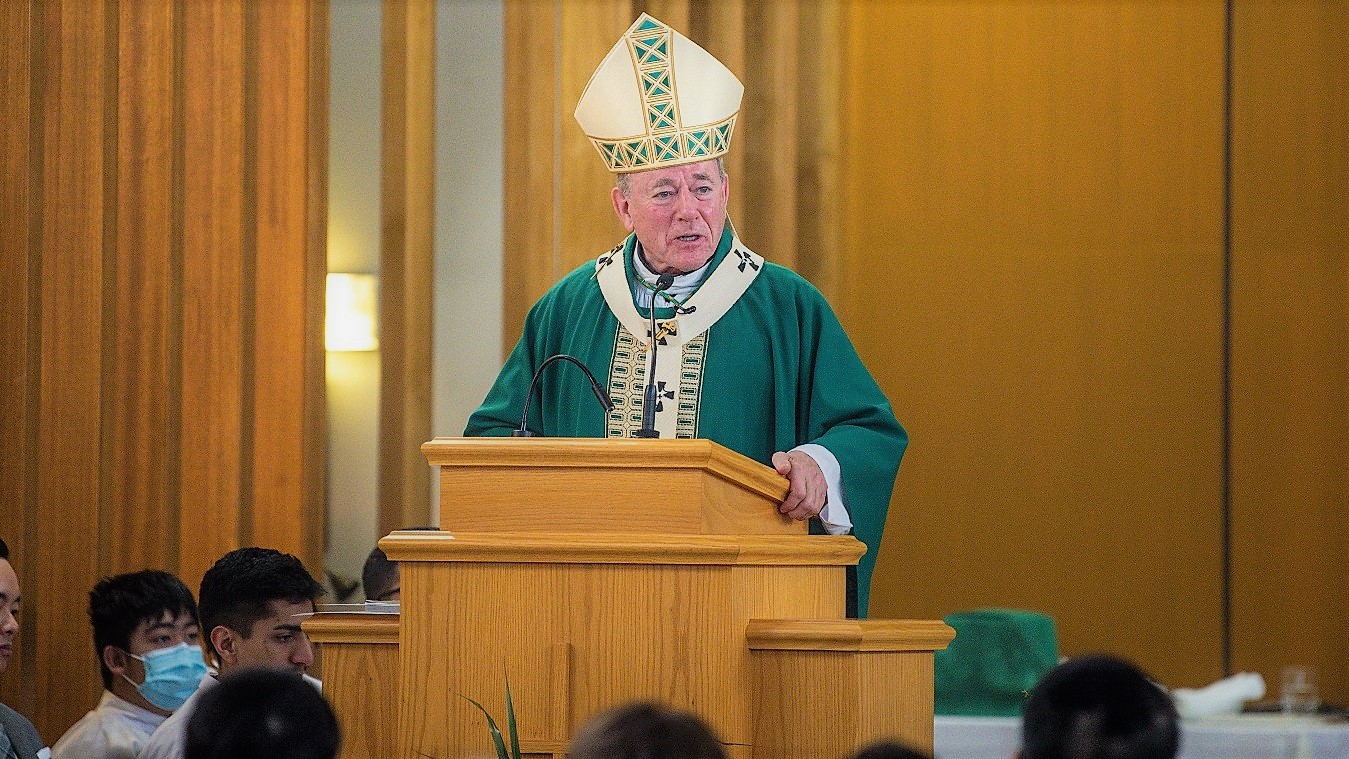
Sacred tradition, then, means God’s revelation as handed on by the apostles and their successors, right down to Archbishop J. Michael Miller of Vancouver.
Through sacred tradition, God, who spoke once, for all, in the past, continues to converse with the Church, says the Catechism. “The living voice” of the Gospel “rings out in the Church” and the Father’s self-communication remains “living and effective,” present and active.
Thus the Church perpetuates and transmits to every generation her doctrine, life, and worship – all that she is and believes – and the Holy Spirit leads believers “to the full truth,” making Christ’s Word “dwell in them in all its richness.”
“Christian faith,” therefore, “is not a religion of the book”: not “a written and mute word, but incarnate and living,” says the Catechism.
With the authority Christ gave her (her magisterium, from the Latin magister, “teacher”), the Church interprets the deposit of faith, written or oral, in His name. She is not its superior, but its servant. At God’s command, with the Holy Spirit’s help, she listens to it devotedly, guards it with dedication, and expounds it faithfully.
Moreover, under the Holy Spirit’s guidance, she gradually gains insight into what she is passing on. The deposit of faith does not change, as if an acorn became a maple tree, but, like a living thing, it grows, as when an acorn becomes an oak tree.
It grows through believers’ study and contemplation, through their intimate sense of spiritual realities, and through the preaching of the bishops, the apostles’ successors, who receive, at their ordination, the sure charism (gift) of truth.
In fact, among all the Holy Spirit’s gifts to the Church, this charism has “primacy,” says Vatican II, for the Holy Spirit himself subjects even those endowed with other charisms to the bishops’ authority.
“What the soul is to the human body, the Holy Spirit is to the Body of Christ, which is the Church,” says the Catechism. Therefore, he joins “all the parts of the Body” to one another and to their Head, Christ, just as our own soul unites all the parts of our body.
In fact, the Holy Spirit is “the principle of every vital and truly saving action” in the Church. For example, He works in every sacrament, as we hear in the First Reading. Peter and John prayed for the people; then they “laid their hands on them, and they received the Holy Spirit.”
Father Hawkswell teaches The Catholic Faith in Plain English, with new insights in both print and YouTube form at beholdvancouver. org/catholic-faith-course. Father is also teaching the course in person on Sundays from 2 to 4 p.m. at the John Paul II Pastoral Centre (4885 Saint John Paul II Way, 33rd Avenue and Willow Street, Vancouver) and on Mondays from 10 a.m. to noon in St. Anthony’s Church Hall, 2347 Inglewood Avenue, West Vancouver. Next week’s topic is “Consecrated Life.”







