

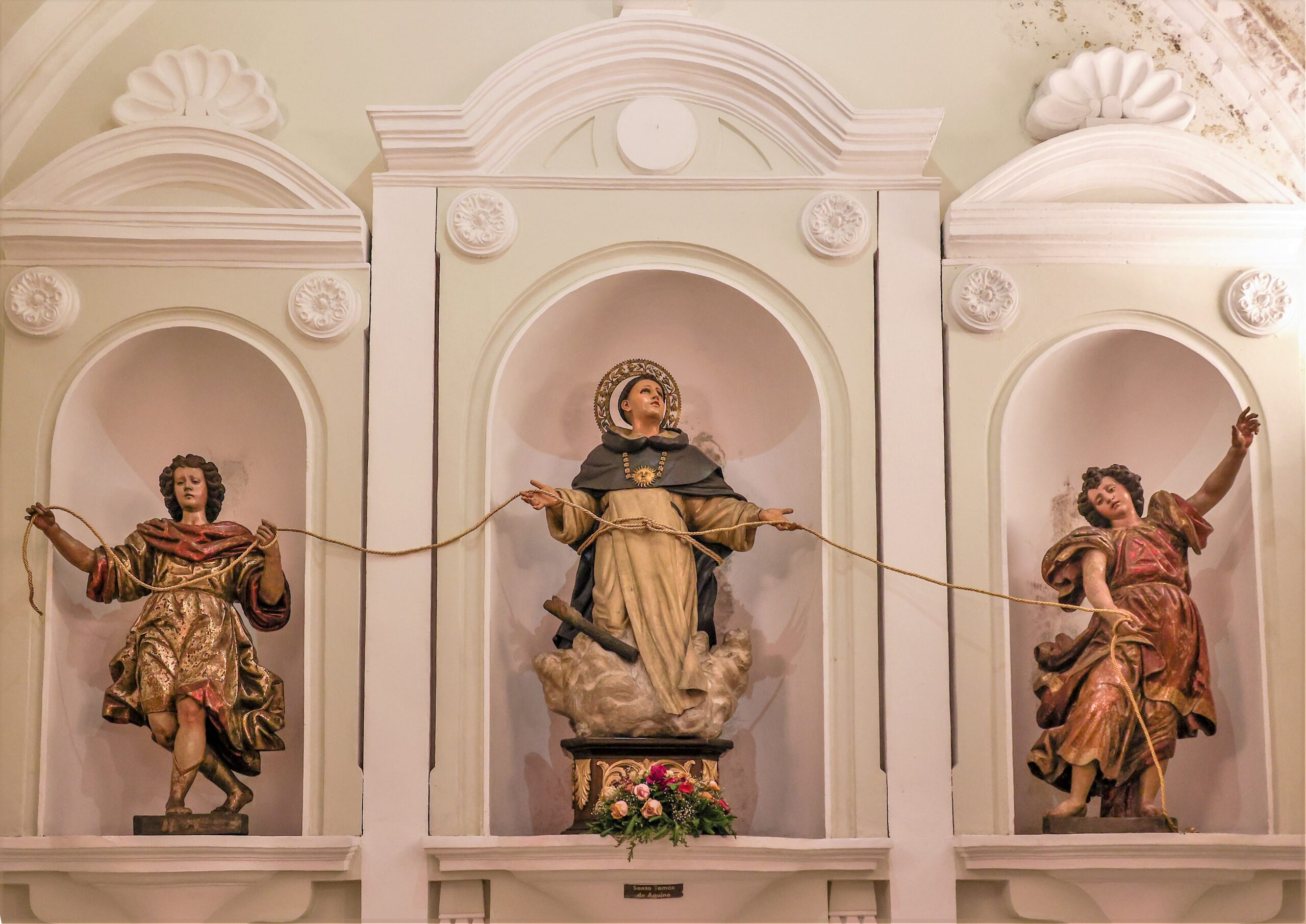

The masterpiece of St. Thomas Aquinas is the Summa Theologiae. Pope Benedict XVI said, “It contains 512 questions and 2,669 articles. It consists of concentrated reasoning in which the human mind is applied to the mysteries of faith, with clarity and depth to the mysteries of faith, alternating questions with answers in which St. Thomas deepens the teaching that comes from Sacred Scripture and from the Fathers of the Church, especially St. Augustine.”
The Summa Theologiae is divided into three parts. St. Thomas wrote, “Because the chief aim of sacred doctrine is to teach the knowledge of God, not only as He is in himself, but also as He is the beginning of things and their last end, and especially of rational creatures, as is clear from what has been already said, therefore, in our endeavour to expound this science, we shall treat: (1) Of God; (2) Of the rational creature’s advance towards God; (3) Of Christ, Who as man, is our way to God.”
The First Part of the Summa Theologiae considers the nature of God, the perfections of God, the mystery of the Holy Trinity, creation, angels, humans, the human intellect, and the human will. Pope Benedict XVI pointed out that St. Thomas demonstrated that the human being is “a reality desired by God as such and possessing an inherent value.”
The Second Part of the Summa Theologiae considers man as the image of God. St. Thomas wrote about the last end, happiness, human acts, and human passions. Benedict XVI explained that the human being “seeks to do actions that build him up, that make him truly man; and here the moral law comes into it. Grace and reason itself, the will and the passions enter too. On this basis St. Thomas describes the profile of the man who lives in accordance with the Spirit and thus becomes an image of God. Here Aquinas pauses to study the three theological virtues faith, hope and charity followed by a critical examination of more than 50 moral virtues, organized around the four cardinal virtues prudence, justice, temperance, and fortitude. He then ends with a reflection on the different vocations in the Church.”
In the Third Part of the Summa, St. Thomas considers Christ the Saviour. St. Thomas wrote in the beginning of the Third Part: “Forasmuch as our Saviour the Lord Jesus Christ, in order to save His people from their sins (Matt 1:21), as the angel announced, showed unto us in His own Person the way of truth, whereby we may attain to the bliss of eternal life by rising again, it is necessary, in order to complete the work of theology, that after considering the last end of human life, and the virtues and vices, there should follow the consideration of the Saviour of all, and of the benefits bestowed by him on the human race. Concerning this we must consider (1) the Saviour himself; (2) the sacraments by which we attain to our salvation; (3) the end of immortal life to which we attain by the resurrection.”
In 1273, St. Thomas preached throughout Lent on the Apostles’ Creed, the Ten Commandments, the Our Father, and the Hail Mary. Benedict XVI commented: “The content of the Doctor Angelicus’ preaching corresponds with virtually the whole structure of the Catechism of the Catholic Church. Actually, in catechesis and preaching, in a time like ours of renewed commitment to evangelization, these fundamental subjects should never be lacking: what we believe, and here is the Creed of the faith; what we pray, and here is the Our Father and the Hail Mary; and what we live, as we are taught by biblical Revelation, and here is the law of the love of God and neighbour and the Ten Commandments, as an explanation of this mandate of love.”
The Holy Father pointed out that after St. Augustine, among the ecclesiastical writers mentioned in the Catechism of the Catholic Church St. Thomas is cited more than any other, at least 61 times. The daily reading of the Catechism of the Catholic Church is very helpful for the deepening of the faith.
Share your thoughts by sending us a letter to the editor.
多馬斯清晰地教導信仰
聖多馬斯·阿奎那的傑作是神學大全。教宗本篤十六世說:『它包含512個問題和2,669篇文章。它包括集中的推理,其中人類的思想被應用於信仰的奧秘,清晰而深入地應用於信仰的奧秘,交替提問與答案,其中聖深化了來自聖經和教父們的教導,特別是聖奧斯定。』
這神學大全分為三部分。聖多馬斯寫道:『因為神聖教義的主要目的是教導天主的知識,不僅是天主自己,而且因為祂是事物的開始和最後的終結,特別是理性的受造物,從前面已經說過的內容中可以清楚地看出,因此,在我們努力闡述這門科學時:我們將對待:(1)天主的;(2)理性的受造物向天主邁進;(3)基督,祂作為人,是我們通往天主的道路。』
神學大全的第一部分深思天主的本性,天主的美善,三位一體的奧秘,創造,天使,人類,人類的智力和人類的意志。教宗本篤十六世指出,聖多馬斯表明,人是「天主所願意的現實,並具有內在的價值。』
神學大全的第二部分深思人是神天主的肖像。聖多馬斯寫了人的終向,快樂,人類的行為和人類的情感。本篤十六世解釋說,人類『尋求採取行動來建立他,使他成為真正的人;在這裡,道德律法進入其中。恩典和理性本身,意志和情感也進入。在此基礎上,聖多馬斯描述了按照聖神生活的人的形象,從而成為天主的肖像。在這裡,阿奎那停下來研究信望愛這三種超性美德,然後對50多種倫理德行進行了批判性的審視,這些美德圍繞著明智、公義、節制和勇毅這四樞德。然後,他以對教會中不同聖召的反思結束。』
在大全的第三部分,聖多馬斯深思基督是救世主。聖多馬斯在第三部分的開頭寫道:『因為我們的救主耶穌基督,為了拯救祂的子民脫離罪孽(瑪竇福音1:21),正如天使所宣佈的那樣,以祂自己的位格向我們展示了真理的道路,藉此我們可以通過復活獲得永生的幸福,為了滿全神學的工作,這是必要的, 在考慮了人類生命的最後目的,以及美德和惡習之後,應該考慮所有人的救主,以及祂賦予人類的好處。關於這一點,我們必須考慮(1)救主自己;(2)我們獲得救恩的聖事;(3)我們通過復活獲得的不朽生命的終結。』
1273年,聖多馬斯在整個四旬期講道使徒信經、十誡、天主經和聖母經。本篤十六世評論說:『這天使般神師講道的內容幾乎與天主教教理問答的整個結構相對應。事實上,在教理和講道中,在像我們這樣重新委身福傳的時代,絕不應該缺少這些基本主題:我們相信什麼,這裡是信仰的信經; 我們祈禱的,這裡是我們的天主經和聖母經 ;以及我們所生活的,正如聖經啟示所教導的那樣,這裡是對天主和近人的愛的律法,而十誡為對這愛的誡命的解釋。』
教宗指出,在聖奧斯定之後,在天主教教理問答中提到的教會作家中,聖多馬斯被引用的次數超過任何其他作家,至少61次。每天閱讀《天主教教理問答》,對信仰的深化很有幫助。







