


When selecting a movie to watch, many of us are drawn to those bearing the names of actors or directors who have contributed to previous favourites. Sometimes, the result is disappointing.
A recent example of such a film is Here, directed and scripted by Robert Zemeckis – the man who gave us Back to the Future and several other much-loved films – and starring Tom Hanks (among other familiar actors), a true audience favourite.
Here attempts to tell the story of a plot of land and the dwellings erected on it, with a time frame ranging from prehistory, to Indigenous people, to the American Revolution, and to the present day.
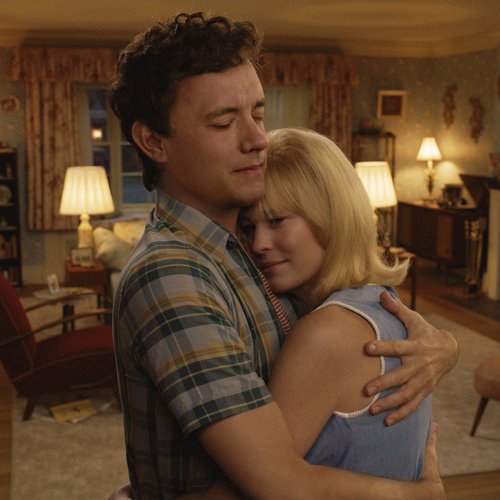
Tom Hanks and Robin Wright in Here. (OSV News photo/Sony Pictures)
Largely focusing on one room in a house built on the land, Here shows a succession of families presented in a multitude of scenes set in the living room of the house. In a series of overlapping scenes that merge with one another, viewers see the various families pursuing their ordinary lives: getting married, raising families, and dealing with sickness and death. As such, the film attempts to show the universality of human experience. The problem is that it is all too simply familiar and ordinary in its universality. The result is rather like a summary of soap operas with none of the drama.
In fact, the only remarkable aspect of the film is that AI was used to age and de-age the actors. But is there any real advantage in seeing Hanks as he appeared in the television series Bosom Buddies, other than to remind us of how old we are getting? Nor is there much to be gained by watching a room reflect the changing fashions of interior decorating. In short, as vignette follows vignette, one is merely reminded of the passing of time.
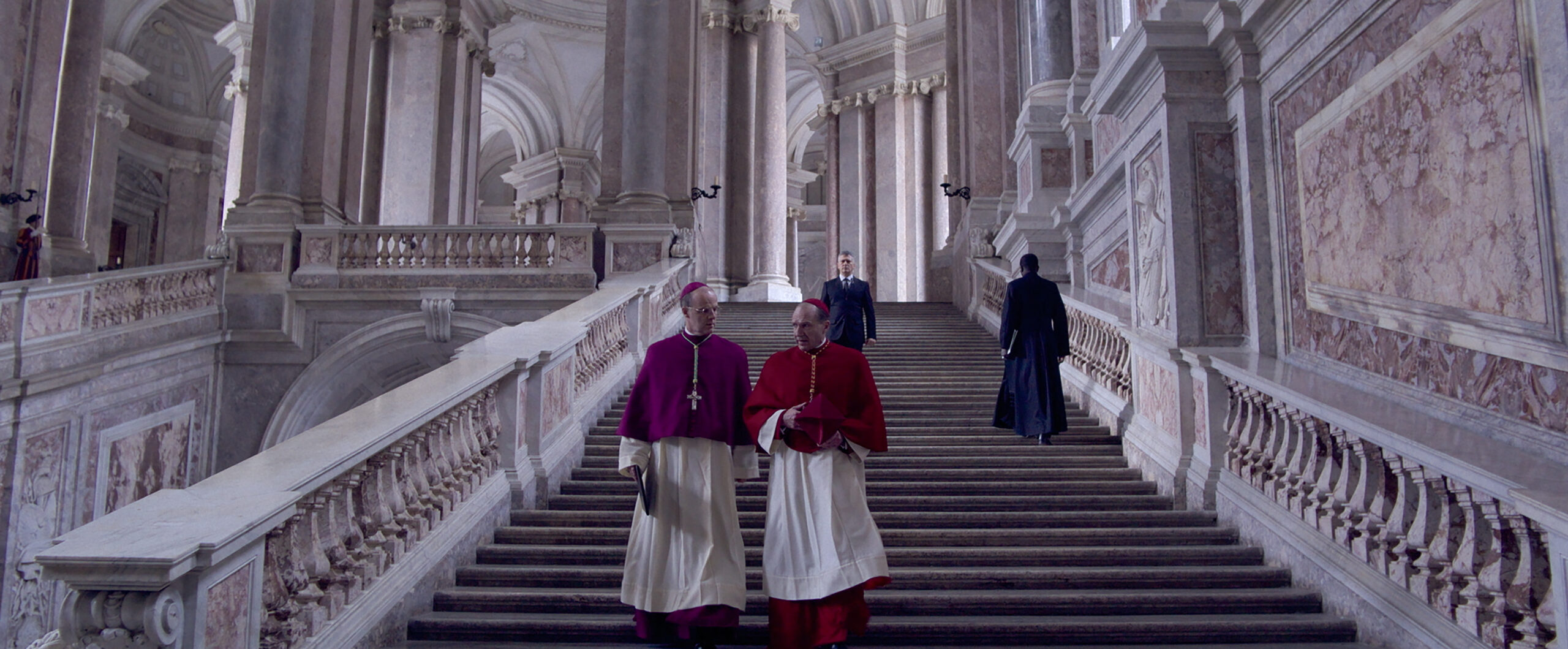
For me, at least, the widely praised film Conclave also proved to be a disappointment, especially as it has been universally praised by critics and is certain to be prominent in the upcoming awards season. With a stellar cast, including Ralph Fiennes, Stanley Tucci, and John Lithgow, directed and written by Peter Berger and Edward Straughan, and based on the novel by Robert Harris, the film focuses on the conclave called after the death of a Pope.
When a conclave is called to elect a new Pope, the cardinals come to it with a multitude of agendas – some perhaps hoping to be chosen as the new Pontiff, others hoping not to be. At the same time, a conclave clearly calls on the College of Cardinals to choose a leader who will guide the Church through challenging times.
It is largely in this latter area that Conclave disappoints, since for much of its running time the focus is on whether to elect a “conservative” or “liberal.” Obviously, this is an issue facing the Church today, but what of the many other issues? As one expects, the film partly focuses on sexual scandal, but much else that is worthy of consideration is ignored. What approach should the Church take to the refugee crisis, global warming, AI, world hunger, growing secularization, and the pessimism of so many? These are largely glossed over or ignored completely, yet they would surely feature enormously in the selection of a new successor to St. Peter. At best, they are merely hinted at.
It is true that the film generates some suspense as the cardinals engage in a series of votes while attempting to agree on a nomination for the papacy. It is also true that some conflicts of a very human nature arise, such as when the cardinals discuss their choice.
Many will find the portrayal of the election process fascinating. The cast, as is to be expected, performs nobly, though most of the time, they merely have to look serious and worried. But in the end, all of this is a missed opportunity to help the audience understand the challenges the Church faces in determining the role it should play in the modern world.
Nor is the film redeemed when, in its climactic development, there is suddenly introduced what I can only describe as a “Hail Mary pass” – a desperate attempt to save the situation. Suddenly, the plot involves a dramatic shift. Some may view this as a final attempt to show at least one of the issues facing the Church today, but in its decidedly melodramatic (and unlikely) unfolding, it is merely risible – certainly nothing that one can consider a serious treatment of a papal conclave.
In short, as is appropriate at this time of year, when choosing which film to watch, one should not be fooled by intriguing wrapping – it’s what’s inside that matters.
Your voice matters! Join the conversation by submitting a Letter to the Editor here.







