



4th Sunday of Advent, Year C
First Reading: Mi 5:2-5a
Second Reading: Heb 10:5-10
Gospel Reading: Lk 1:39-45
The readings for the first three Sundays of Advent urged us to repent because Christ is coming:
- “Be on guard so that your hearts are not weighed down with dissipation and drunkenness and the worries of this life.”
- “Prepare the way of the Lord; make his paths straight.”
- “Whoever has two coats must share with anyone who has none; and whoever has food must do likewise.”
The readings for the Fourth Sunday are different. The first recounts Micah’s prophecy that the one who would rule Israel would come from Bethlehem. The second explains that God has replaced burnt offerings with “the offering of the body of Jesus Christ once for all,” re-presented in the Mass. The third describes how John the Baptist leapt in his mother’s womb when Mary, carrying Jesus, visited Elizabeth.
Together, they constitute a brief history of the event that occurred in Bethlehem 2,024 years ago and its consequences for the whole human race. They invite us to pause in our preparations for Christmas—both exterior and interior—and simply reflect on the event we are celebrating.
We are all familiar with the injunction: “Don’t just stand there; do something!” Today, whether it be Christmas Eve or Christmas Day, we are urged: “Don’t just do something; stand there!”
The coming of God as a man, one of us, was predicted by the prophets. Eventually, it occurred: the prophecies were fulfilled. When it happened, it changed our whole way of life because it changed the way humans relate to God.
In his poem The Turn of the Tide, C.S. Lewis describes Christ’s birth as the center of a wave—a ripple that spread out from Bethlehem along the “nerves of the universe,” perceived as a “deathly stillness,” a “silence,” followed by a “shock of returning life” that set “galaxies to tingle and rock.”
That birth had cosmic significance, but it was also an event in human history. Many of us, indeed, see it as nothing more. We cannot appreciate it for what it truly is unless we believe, as Elizabeth praised Mary for believing, that God would fulfill his promise.
In his book Crossing the Threshold of Hope, Pope St. John Paul II described the “great temptation” to reduce the divine to the human. However, he added, “The challenge comes from God himself, since he really became man in his Son and was born of the virgin.”
“Could God go farther in his stooping down, in his drawing near to man?” he asked. “In truth, it seems that he has gone as far as possible. He could not go further. In a certain sense, God has gone too far!”
“Precisely because [Christ] called God his Father, because he revealed him so openly in himself, he could not but elicit the impression that it was too much. Man was no longer able to tolerate such closeness, and thus the protests began”: first among the Jews and then among the Muslims. “Neither can accept a God who is so human,” the Pope said. They protest that “it is not suitable to speak of God in this way”; that “he must remain absolutely transcendent… pure majesty.”
In a sense, “God revealed too much of himself” to us, “too much of that which is most divine, that which is his intimate life,” the Pope said. He did not mind that “such an unveiling would in a certain way obscure him” in our eyes because we are “not capable of withstanding an excess of the mystery”; we do not “want to be pervaded and overwhelmed by it.”
Regardless of the pressures of Christmas Eve or Christmas Day, let us set aside time to let ourselves “be pervaded and overwhelmed” by the mystery we are celebrating.
“Don’t just do something; stand there!” As the psalmist says, “Be still, and know that I am God.”
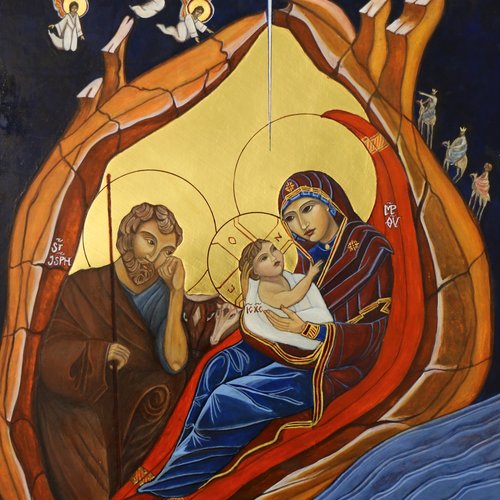
A celebration for all peoples
Christmas, Year C
First Reading: Midnight: Is 9:2-4, 6-7; Dawn: Is 62:11-12; Day: Is 52:7-10
Second Reading: Midnight: Ti 2:11-14; Dawn: Ti 3:4-7; Day: Heb 1:1-6
Gospel Reading: Midnight: Lk 2:1-16; Dawn: Lk 2:15-20; Day: Jn 1:1-18
“In the beginning was the Word, and the Word was with God, and the Word was God,” but today, “the Word became flesh and lived among us.” To us “is born this day in the city of David a Saviour, who is Christ, the Lord.” Today “a child has been born for us, a son given to us; authority rests upon his shoulders; and he is named wonderful counsellor, mighty God, everlasting Father, prince of peace.”
In the past, God spoke to us through prophets; today “he has spoken to us by the Son,” who is “the reflection of the Father’s glory and the exact imprint of God’s very being.”
“The Lord has bared his holy arm before the eyes of all the nations”; “the people who walked in darkness have seen a great light.” According to his grace and mercy—not “because of any works of righteousness that we had done”—all “the ends of the earth” shall see his salvation.
Today, God the Son, through whom “all things came into being,” without whom “not one thing came into being,” humbled himself to become a creature in his own creation.
Tragically, many consider Christ’s birth to be an “optional extra” that we can tack on to our religious belief if we like. (Even some Catholic parents tell their children about Santa Claus and his reindeer, but leave them to find out about the Incarnation on their own!)
Pope St. John Paul II, in the declaration Dominus Iesus, vigorously denied this relativist view of Jesus Christ. God has only one plan of salvation for the whole world, the document says: “realized in the mystery of the Incarnation, death, and resurrection of the Son of God; actualized with the cooperation of the Holy Spirit;” and extended “to all humanity and to the entire universe.”
“No one, therefore, can enter into communion with God except through Christ, by the working of the Holy Spirit,” it says, regardless of whether they know Christ or not. His uniqueness gives him “an absolute and universal significance whereby, while belonging to history, he remains history’s centre and goal.”
In “Jesus Christ, the incarnate Son of God, who is the way, the truth, and the life, the full revelation of divine truth is given,” the document says. This revelation will continue to be “the true lodestar” in history for all humanity, because “the truth, which is Christ, imposes itself as an all-embracing authority.”
The Christian mystery, in fact, overcomes all barriers of time and space, and accomplishes our unity. “From their different locations and traditions all are called in Christ to share in the unity of the family of God’s children… Jesus destroys the walls of division and creates unity in a new and unsurpassed way through our sharing in his mystery.”
In summary, “Jesus Christ has a significance and a value for the human race and its history which are unique and singular, proper to him alone, exclusive, universal, and absolute. Jesus is, in fact, the Word of God made man for the salvation of all.”
This Christmas, therefore, let us stand tall and unabashed as we celebrate his birth. Let us unapologetically wish everyone, regardless of their religion or lack of it, a “blessed Christmas,” not just a “happy holiday.” With the Church, let us celebrate Christmas for its full octave (eight days), and not stop just because the presents have been opened.
Let us realize, as St. Paul said in his Letter to the Philippians, that we “live in an age that is twisted out of its true pattern.” Among its people, let us “shine out, beacons to the world, upholding the message of life.”
Father Hawkswell is again teaching “The Catholic Faith in Plain English,” with new insights, in both print and YouTube form, at beholdvancouver.org/catholic-faith-course. He is also teaching the course in person on Sundays (2 – 4 p.m. at the John Paul II Pastoral Centre, 4885 Saint John Paul II Way, 33rd Avenue and Willow Street, Vancouver) and Mondays (10 a.m. – noon in St. Anthony’s Church Hall, 2347 Inglewood Avenue, West Vancouver). The title of the Jan. 5 talk is Supernatural Life. The course is entirely free of charge and no pre-registration is necessary.
Your voice matters! Join the conversation by submitting a Letter to the Editor here.







