



My wife and I went to a local law firm recently to update our wills. Our previous law firm, which we used in 2014, had gone out of business. Medical assistance in dying (MAiD) was not even on the horizon then.
Things were going fine with the young, 30-something lawyer regarding components such as the will, power of attorney, and representation agreement. However, when it came to the advance directive, there was some hesitation on the lawyer’s part to prepare a document that met our needs.
We wanted it specifically written that we did not want MAiD or euthanasia. He was very reluctant to prepare a document that specific and said the firm’s current non-MAiD advance directives were the best he could do given the current law and that it couldn’t be predicted with certainty what the law would look like in 20 or 30 years.
He prepared a draft document and sent it to us, along with the other documents, for our review a few weeks later. The advance directive was very generic and essentially stated that the doctor had the say in whether our conditions were treatable and could advise our family accordingly on whether measures could be taken to prolong or end our lives.
I explained that we did not want my death—or my wife’s—on the heads of anyone standing by, be it the lawyer, doctors, medical staff, or family. I explained that we wanted our passing to be “traditional,” with no intercession on anyone’s part to hasten our death beyond what God ordained. We also explained that, yes, we knew this might mean terrible pain depending on the nature of the illness.
The lawyer would not move from his position and offered to exclude the advance directive from our will documents without charging us.
I researched the topic and found Delta Hospice had advance directive documents. I signed up and received them, then shared them with the young lawyer. He began to shift his position, producing a revised draft, which was closer to what we wanted but still did not explicitly state that we opposed MAiD or euthanasia.
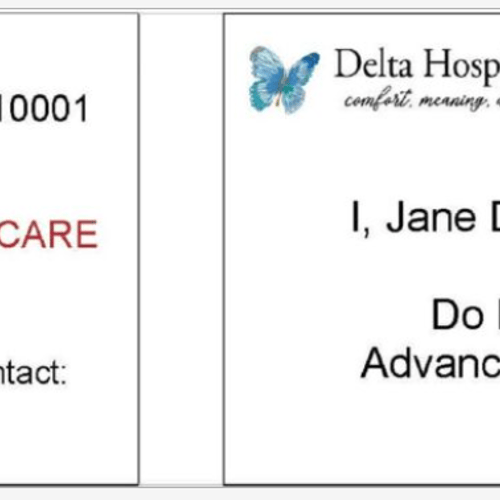
Do Not Euthanize wallet cards from the Delta Hospice Society.Wallet-Sized DNE Card.
I explained that I wanted that wording included for greater certainty so no one could later interpret our wishes. Again, he would not include more specific wording. In the end, I told him I was disappointed that he and his law firm could not meet our needs. I believe intergenerational friction may also have played a role.
I want to alert Catholics that they may encounter secular resistance when preparing wills and advance directives. When researching law firms, they should start by asking how the firm handles advance directives and whether they will accommodate wording that varies from the boilerplate templates that streamline their work and are researched to withstand legal tests. I suspect they become nervous when asked to step outside these templates, as it likely requires additional research.
Catholics preparing advance directives may want to consider the Delta Hospice template, which is very specific on these matters. Providing this to prospective law firms can help gauge whether they have any issues creating a document that meets faith-based needs. Clients should address these concerns before paying for will services. If a lawyer appears unwilling to include opposition to MAiD or euthanasia directly in the directive, it would be wise to seek another firm whose values align with Catholic teachings.
Your voice matters! Join the conversation by submitting a Letter to the Editor here.







