
10th Sunday in Ordinary Time, Year B
First Reading: Gn 3:8-15
Second Reading: 2 Cor 4:13 – 5:1
Gospel Reading: Mk 3:20-35
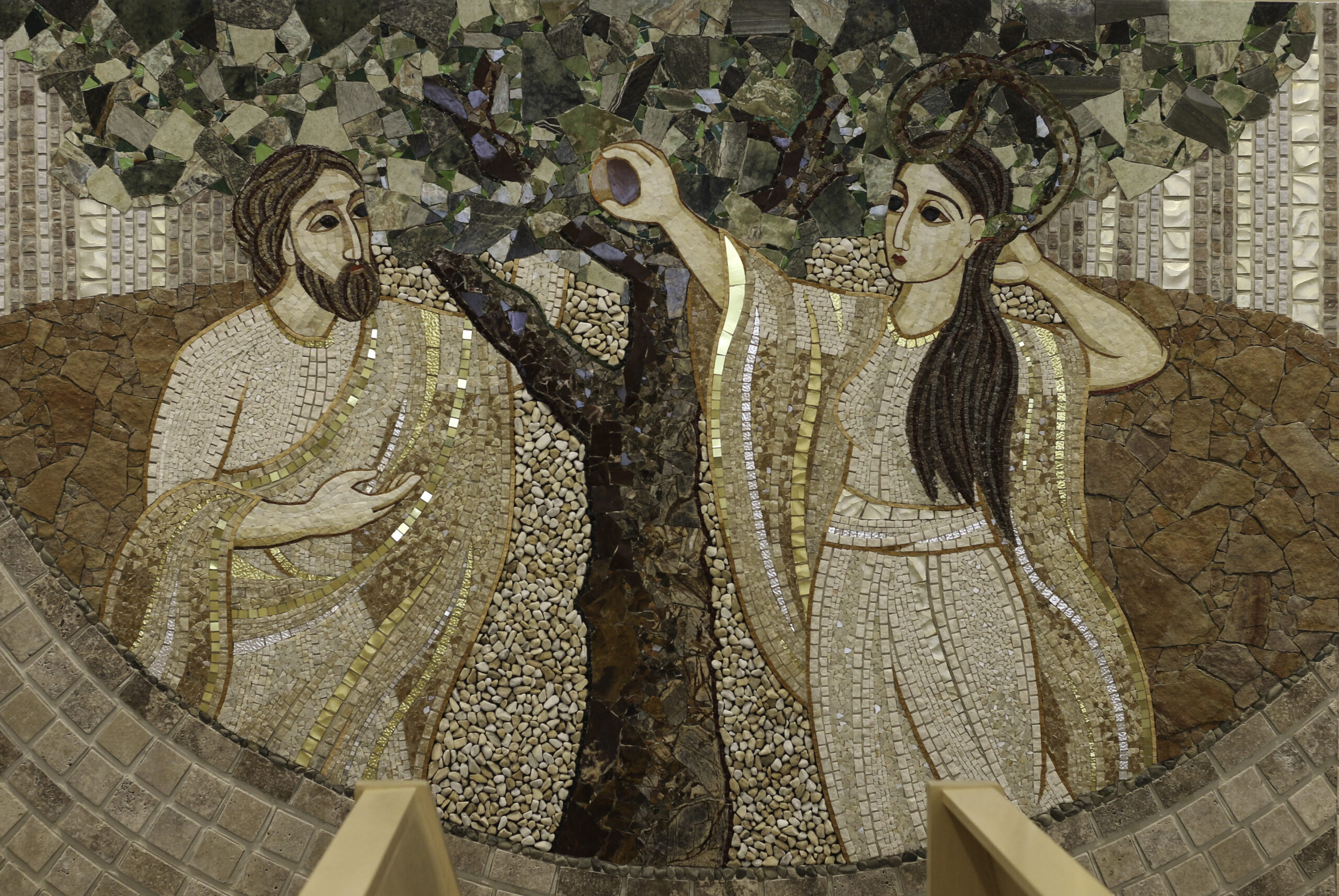
This Sunday’s readings describe the “original sin.” They do so in “figurative language,” says the Catechism of the Catholic Church, but it really happened, and it has “marked the whole of human history.”
What was that sin?
God created Adam and Eve in a “state of holiness and justice.” However, being created and not self-existent, they had to “freely recognize and respect” their “insurmountable limits,” symbolized by “the tree of knowledge of good and bad,” from which they were not free to eat. “The moment you eat of it, you are surely doomed to die,” God warned.
We cannot imagine what Adam and Eve understood by “die,” St. Pope John Paul II noted, for they had never seen death. God was asking them to trust him, like a mother warning a child who knows nothing of burning not to touch a hot stove.
However, “man, tempted by the devil, let his trust in his creator die in his heart and, abusing his freedom, disobeyed God’s command,” says the Catechism.
What motivated Adam and Eve was not the pleasures of the senses, for there was no pleasure (including sexual pleasure) they did not already enjoy. Nor was it covetousness for earthly goods, for the whole world was theirs.
It was the desire for self-assertion, said St. Augustine. They wanted to be like God without him, before him, and not in accordance with him, says the Catechism.
As a young man wants an allowance from his father, they wanted something that would be theirs, not God’s, says C.S. Lewis. From this, they would pay God “a reasonable tribute,” but they would plan for their own pleasure and security.
They stopped trusting God, said Pope Benedict XVI. Tempted by the serpent, they began to see him as a “rival” curtailing their freedom. They tried to be independent of him to “obtain from the tree of knowledge the power to shape the world” and make themselves gods.
“This is what man’s first sin consisted of,” says the Catechism. Similarly, “all subsequent sin” has been “disobedience toward God and lack of trust is his goodness.”
Deceived by “the serpent,” like Adam and Eve, we think “something is missing” in our lives if we do not sin, said Pope Benedict: namely “the dramatic dimension of being autonomous.” To become “fully ourselves,” we think, we must occasionally say “no” to God.
“Isn’t that the way it always is?” a child asked after I had told her how Adam and Eve sinned. “Daddy says don’t go near the cliff, because it’s dangerous. But I go because I want to see for myself.”
Young children say, “Drugs are harmful; I’ll never do drugs,” but by their teens, they want to find out for themselves.
After studying the commandments, a woman said, “I sometimes wish I had committed these sins so I would know for myself they were wrong.”
No; we must trust God. C.S. Lewis said, “We must get rid of the idea (which surfaces in every temptation) that there is some place apart from him into which he forbids us to trespass, some kind of delight which he does not appreciate or arbitrarily forbids.”
Suppose you take a dog on a leash past a turnstile, Lewis said. “He tries to go through on the wrong side and gets his lead looped round the post. You see that he cannot do it, and therefore pull him back. You pull him back because you want to let him go forward.”
Similarly, he said, “God not only understands, but also shares, our desire for fullness of life, complete and ecstatic happiness. He made us for no other purpose… However, he knows, and we do not, how it can be attained, really and permanently.”
As St. Paul says, we can trust God not only for the temporary pleasures we can see, but also the eternal pleasures we cannot see.
Your voice matters! Join the conversation by submitting a Letter to the Editor here.