

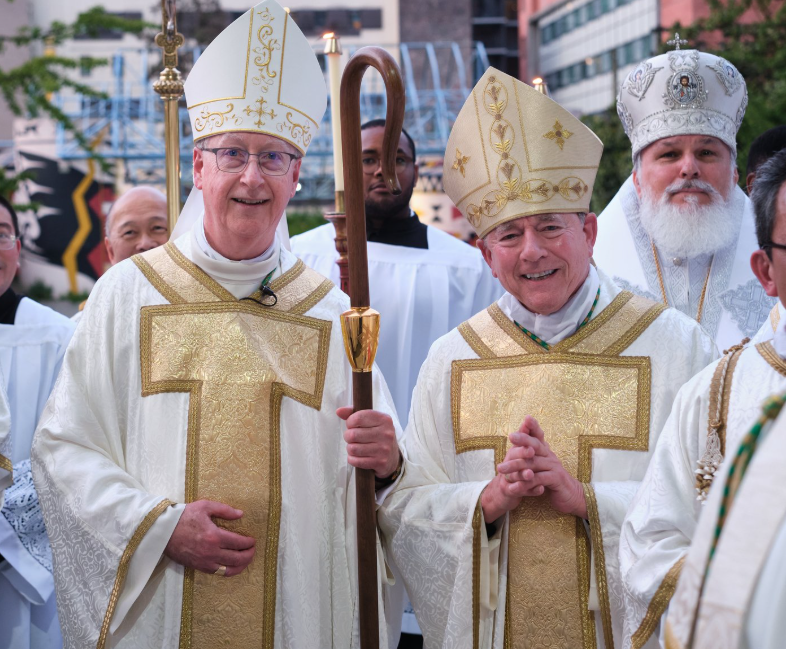

It’s been a busy few weeks, so we’re taking this space to catch up on recent letters, including some farewells and welcomes for Archbishop Miller and Archbishop Smith. — Editor
I congratulate Archbishop J. Michael Miller for his foresight and the initiatives he introduced to foster vocations in our Archdiocese.
As a past president of the Serra Club of Vancouver, I saw how his strategy of appointing young priests as vocation directors helped build strong, authentic relationships with youth. With Serra Club support, these directors visited schools and parishes, promoting a culture of vocations.
Fathers James Hughes and Mark Schwab stood out for their charisma and dedication. The founding of Redemptoris Mater Seminary and the St. John Vianney Fund further strengthened vocational growth, inviting seminarians from around the world.
What a legacy Archbishop Miller leaves after 18 years of pastoral leadership.
Cleto Dos Remedios
Vancouver
The parishioners of Pembroke, Ont., were blessed to have Archbishop Richard Smith — then Bishop Smith — as our shepherd. I understand what the people of Edmonton must feel in saying goodbye to a good bishop.
I now pray that Our Blessed Mother will wrap her arms around Archbishop Smith as he begins his new mission in Vancouver, leading her Son’s flock with strength and love.
Susan Dagenais
Pembroke
Catholics across the Archdiocese are invited to pray, fast, and witness to human dignity.
The first 40 Days for Life campaign in Vancouver began in 2010 through a collaboration of Catholic and pro-life leaders, including Betty Green, John Hof, and Cecilia Von Dehn, with support from the Archdiocese.
Archbishop Miller’s 2010 letter encouraged us to be “ardent witnesses to the dignity of human life,” and Father Larry Lynn, our pro-life chaplain, continues to lead with compassion and clarity.
Today, all 77 parishes have been invited to participate. Whether by joining the vigil at 32nd and Willow, hosting Eucharistic adoration, or praying the Reverence for Life prayer, every effort unites us in responding to 2 Chronicles 7:14.
Could The B.C. Catholic help spark renewed interest in parishes that haven’t yet joined? This is the largest coordinated pro-life witness in the world — and well worth promoting.
Nancy Lim
Member, 40 Days for Life Coordinating Team
Vancouver
When the Archdiocese moved its central office from Robson Street, the homeless shelter remained on site for another seven years thanks to Archbishop Miller, who secured an agreement with the developer to keep the doors open until new accommodations were found.
That meant 100 to 120 homeless men had a warm bed every night and coffee in the morning. Yes, the freight elevator sometimes failed, the ceiling leaked, the washers broke, and staff worked through power outages by flashlight. But laughter, kindness, low wages, and prayer filled that place.
Two men ran the shelter, on call nearly every day of the year. I don’t believe they ever got the recognition they deserve.
But God knows. And so does anyone who ever walked through those doors.
Marianne Werner
Vancouver
Canada should be ashamed of itself for now leading the world in liberal euthanasia laws. For four years, we’ve embraced the delusion that MAiD helps people. It does not.
It was a reckless idea from the start, inflicted by lawmakers blind to its damage. I pray that one day, through the grace of our Creator, our leaders will see the light.
Pierre Blancard
North Vancouver
It was recently reported that Abbotsford school trustees Jared White and Mike Rauch, both Catholic, were censured for expressing concerns about biological males in women’s sports and bathrooms.
My response is: has the world gone mad?
What parent wants their daughter sharing a change room with a biological male? Or competing against someone with higher testosterone and greater muscle mass? Or facing someone who doesn’t experience periods, cramps, or the challenges of female physiology?
Where are the feminists? Have we forgotten what fairness means?
To every woman: do you feel safe? Has anyone asked?
Thank you, trustees White and Rauch. “Well done, good and faithful servant.” (Mt 25:23)
Juliette deGerecht
Abbotsford
The caption on page 7 of your June 14 issue calls Father Forget’s gravestone “a century old.” That can’t be, since he died in 1964, just 61 years ago.
Jane Gaffney
Surrey
(Editor’s note: You’re quite right. We apologize for being 39 years early!)
Thank you for your July 14 article on the Right to Recover Act. As the administrator of the Facebook group Navigating Schizophrenia in Canada, I want to express our strong support for this legislation and our concern about the expansion of euthanasia to people with mental illness.
Our group faces two key challenges. First, Facebook restrictions make it difficult to share news articles that show this issue is gaining national attention. Second, many advocacy campaigns ask supporters to write to their MPs, but realistically, most people don’t have the time or confidence to do that.
That’s why we’re urging your readers to sign a simple but important petition by the Euthanasia Prevention Coalition: www.nomaidformentalillness.ca. It takes only a minute, but it sends a clear message to our lawmakers: people with mental illness deserve treatment and hope—not a lethal injection.
Thank you for continuing to shed light on this urgent issue.
Olga Gallegos
Navigating Schizophrenia in Canada
Barrie, Ont.
Having noted your July 14 story Sea Sunday message highlights injustice faced by seafarers, your readers might like to know that Deacon Dileep Athaide and I visit cargo ships in Vancouver’s harbour.
The two of us go to the Anglican Church’s Mission to Seafarers, located not far from the SeaBus terminal. In this blue building we are provided with Bibles and a printing machine for leaflets to remind sailors of God’s Word. After all, most seafarers are away from church and home for months.
The sailors all speak English, so we just have to be careful to climb the steep gangways and avoid injury on steel structures. An attendant records our ID and allows us to visit the crew messroom.
Dileep and I find ways to leave rosaries and Gospel messages in the recreation lounge. They are told how to come to Mission to Seafarers where they can communicate with relatives using the WiFi, spend U.S. dollars at the store, watch TV, or rest quietly in the chapel.
An opportunity for Vancouver citizens is to give away some used clothing or National Geographic magazines. Drop them off at 140 Waterfront Rd.
The next opportunity for your readers comes on Christmas Eve, when a Tymac pilot boat takes us out to the 15 or so ships anchored at English Bay and the inner harbour so we can deliver goody bags to each and every sailor.
Douglas M. Donald
St. Edmund’s Parish
North Vancouver
At the end of Paul Schratz’s July 28 column, he bemoaned the fact that we have not heard the stories of a good death. Very true — nobody seems to be interested.
Although we have in Jesus the greatest storyteller of all time, in our Church we often prefer a more legalistic approach: telling others what to do and what not to do. Yet everyone who has experienced the death of a loved one has a story to tell.
Let us focus on stories of a good death to encourage those who are timid or unsure how to act in the face of death. Let us begin collecting these stories. Publish them in every edition of The B.C. Catholic (death does not occur only in November), and hold storytelling circles in our parishes and even in coffee shops.
I remember the death of my mother at age 95 with gratitude.
We, her three daughters, had promised her that she would be cared for in her own home until she died. By the grace of God, we were able to keep that promise.
The last two and a half years of her life — when I cared for her — were some of the best years of my life. The more my mother became dependent, the more I loved her.
She died on a Sunday, after I returned from Mass. Her bed had been in the living room, right in front of the balcony door, for the last five years. Visitors had coffee at the round table next to her bed. She was always included.
When I once mentioned to her family doctor — who visited her regularly at home (good old Europe) — that she might live to be 100, he replied: “Do not wish it upon her. Her suffering would be too much.”
Yes, we gave her pain medication as prescribed, and she never complained. Although she no longer remembered my name, she remained sweet and utterly patient.
After her death on that sunny Sunday in August, we sat by her bed, said a prayer, and had coffee. Later, after the funeral home took her away, I suddenly realized that strangers would wash her. The thought hurt me.
I called the funeral home the next day. They kindly invited me to come and wash her myself, together with the wife of the funeral director.
We have so many things to learn and to feel grateful for.
Marianne Werner
Vancouver
Your voice matters! Join the conversation by submitting a Letter to the Editor here.







