

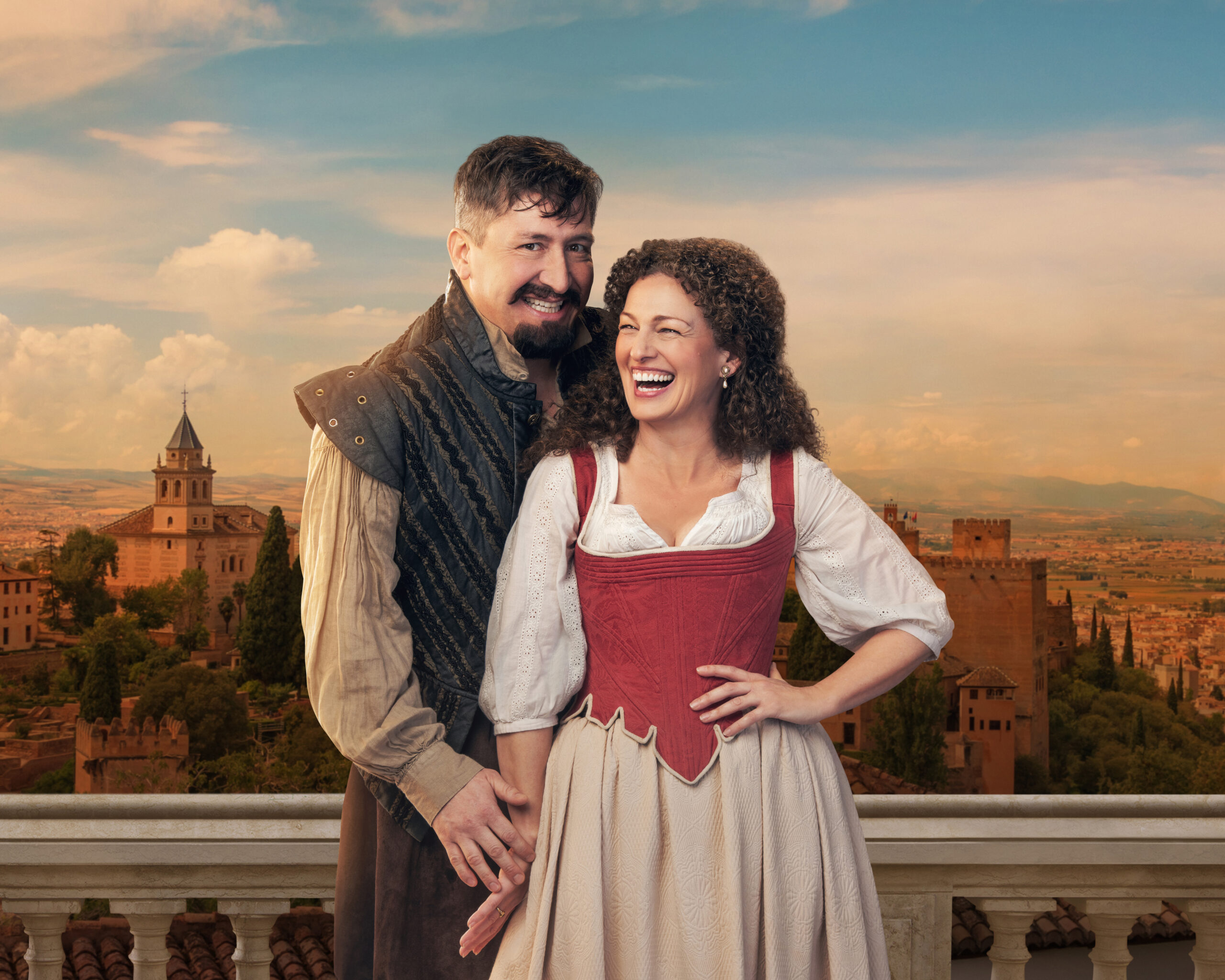

Imagine, if you will, asking three teenage, energetic students to act out a skit in which they convey the plot of Romeo and Juliet, playing all the roles, and aiming to score laughs. The result almost certainly will be lots of over-acting, histrionic exaggeration, and, ultimately, only occasional real comedy.
Well, that seems to be what is expected in performances of The Complete Works of William Shakespeare (abridged) [revised] [again], currently part of Bard on the Beach’s Second Stage program. As a bookend to this, in the second half of the play, Hamlet is similarly treated. In between, a scattering of Shakespearian references and a few generalities pay scant attention to the rest of the canon.
I can understand and applaud the fact that the Bard company wishes to go beyond the standard Bard works, which they have presented (in some cases several times) over the past 30 years. Thus, this year, they fortunately offer two excellent productions: Much Ado About Nothing and Two Gentlemen of Verona – both examples of the high standards we have come to expect of Bard on the Beach and both well worth seeing.
Other seasons have successfully included non-Shakespeare works, such as Rosencrantz and Guildenstern Are Dead and Shakespeare in Love. However, The Complete Works is not in the same class, being nothing more than a tedious, overwrought barrage of farcical nonsense.
In fairness, I must point out that the play has been widely presented to considerable audience satisfaction in London and elsewhere. The Bard cast of three hurl themselves into the proceedings with energetic and fast-paced activity, and the production manages to come up with some inventive staging moments and a few genuine laughs.
Sadly, as a fondly good-humoured summary and satire of Shakespeare’s plays, it simply does not work. That such a thing might be done with skill and affection was brilliantly illustrated in the original production of Beyond the Fringe, scripted by the masterful Peter Cook. And, if you are looking for a richly comical view of Shakespeare, search out the brilliantly entertaining and hilarious British television series Upstart Crow.
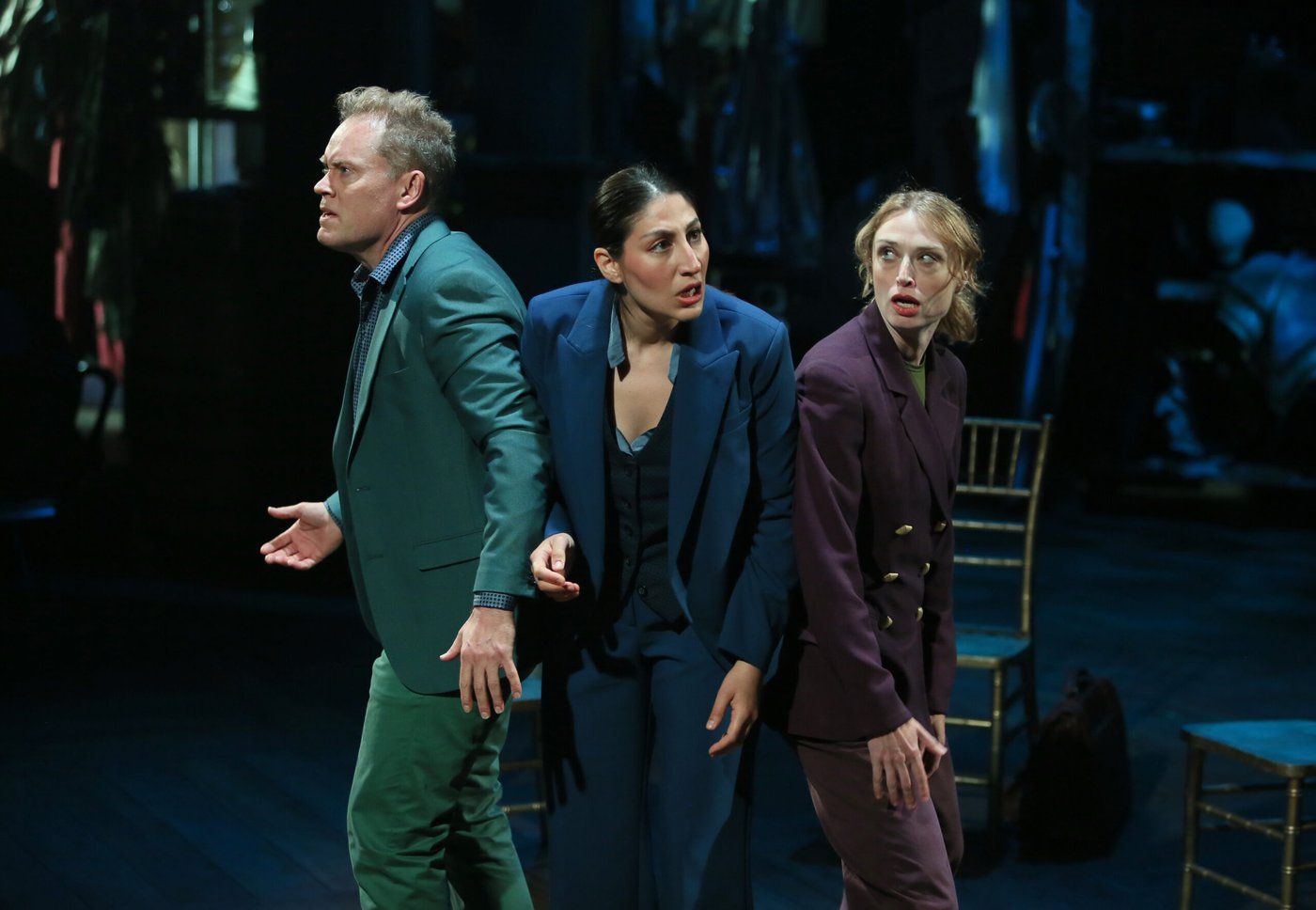
Again, to be fair, the Bard on the Beach opening night audience of The Complete Works seemed to enjoy the proceedings, which include lots of cross-dressing and audience participation (all of it reflective of British pantomime without the Principal Boy and Dame), but I was hoping for more than the obvious gags, tumbling down stairs, and deliberately ham acting.
The irony of all this is that the final production of the Bard’s season, The Dark Lady, could, with greater authenticity and considerably greater entertainment value, be dubbed The Complete Works of Shakespeare (Abridged).
The Dark Lady is, in effect, an attempt to solve one of the great Shakespearian mysteries: How was it possible for an apparently unremarkable young man from Stratford, whose education had provided him with “small Latin and less Greek,” to produce such an amazing body of work, making him the greatest writer who ever lived?
To answer this, there have, of course, been many suggestions, including authorship by contemporaries of Shakespeare, including Christopher Marlowe (who, apparently, did not die in that tavern brawl), the Earl of Southampton (to whom the first 17 sonnets are addressed in the hope that he will abandon his fondness for males and, instead, marry a woman so that his looks and lineage will last), and Ben Jonson, responsible for the publication of the First Folio edition, begging the question, why didn’t he claim them as his own?
All these wildly unlikely theories cause me to subscribe to Winston Churchill’s finding that it was not William Shakespeare who wrote the plays, but, rather, a man called William Shakespeare!
However, The Dark Lady attempts to show that the Bard’s genius was brought to full flourish because he was inspired by a woman who became his muse, his mistress, and the subject, “the dark lady,” of the sonnets. According to this theory, adopted by playwright Jessica Hill, Emilia Bassano was a woman who was certainly a part of English aristocratic life at the time of Shakespeare, but, more importantly, was a woman of culture, well-educated and creative – all this at a time when women were expected to be none of these things.
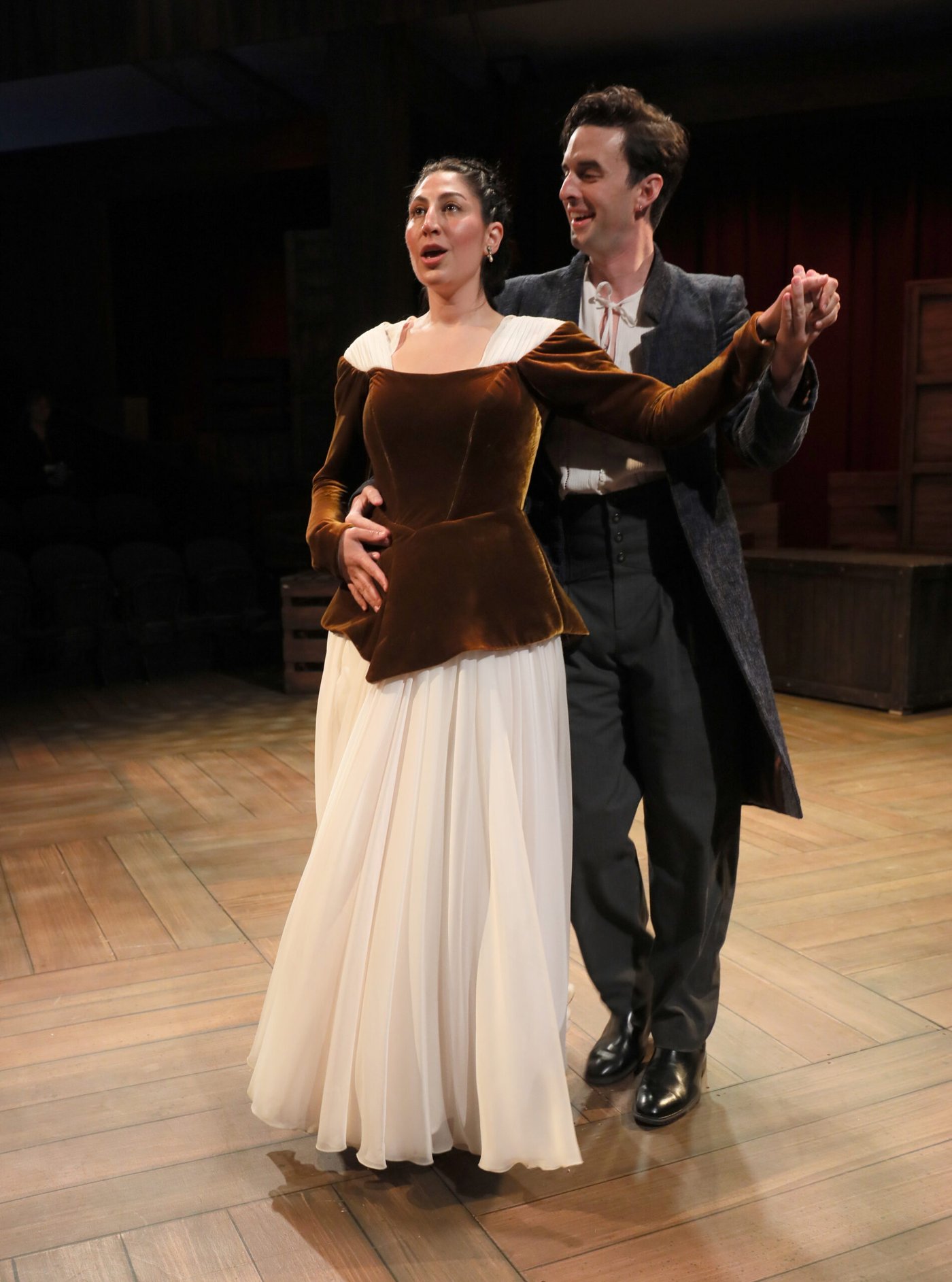
That Shakespeare actually knew the woman is probable; that she helped him to achieve dramatic greatness is a beguiling theory, well illustrated by The Dark Lady. Thus, the play not only traces the affair between the two, but also tries to show Bassano helping Shakespeare rise above the antifeminism of the age and to give strength to his female characters. Some might argue that the example of Elizabeth I might have served the same purpose, but here the theory is further boosted, among other indications, by the names “Emilia” and “Bassano” appearing widely throughout the plays.
Whether one subscribes to the theory or not, the play is a dramatic tour de force – entertaining, challenging, and complex. Impressively and creatively staged and directed by Maya O’Connell, and superbly acted by Arghaven Jenell and Nathan Kay, this is indeed a provocative feminist piece of theatre. It prompts consideration of the nature of genius, proposes an interesting literary theory, and reminds one of the amazing achievement of Shakespeare, who created characters as diverse as Portia, Lady Macbeth, Cleopatra, and Beatrice.
I only wish I could have seen the play when I was many years younger: it might well have inspired me to greater heights of learning when I was at Oxford, preparing for my finals. As it is, The Dark Lady has certainly helped me greatly to reassess my views of the Shakespeare canon, as well as proving a superbly stimulating and entertaining evening of theatre. It is an excellent closing production for the Bard on the Beach season.
To this point, however, as I mentioned at the outset, it is clear that the company attempts variety in its presentations by sometimes going beyond the Bard’s works. I wonder, then, why the works of Marlowe, Webster, and others have not been included in the company’s presentations. It certainly is a case of “O rare Ben Jonson”! Why not include in future seasons Edward II, Doctor Faustus, or Volpone? And, speaking selfishly, I would love to see something by Webster (challenging though he may be). I have only ever had one opportunity in a long life of theatre-going to see such a play, many years ago – The White Devil, in a rather disastrous production, starring the great Glenda Jackson at the Old Vic.
I’m not subscribing to the theory that if a thing is worth doing, it’s worth doing badly, but it does seem that the Bard company is ignoring what could fill a rather obvious gap in its program. Meanwhile, however, we can enthusiastically applaud the fact that three of its four current productions (and perhaps even four) will delight audiences until September.
Here’s to Bard on the Beach!
Your voice matters! Join the conversation by submitting a Letter to the Editor here.







