

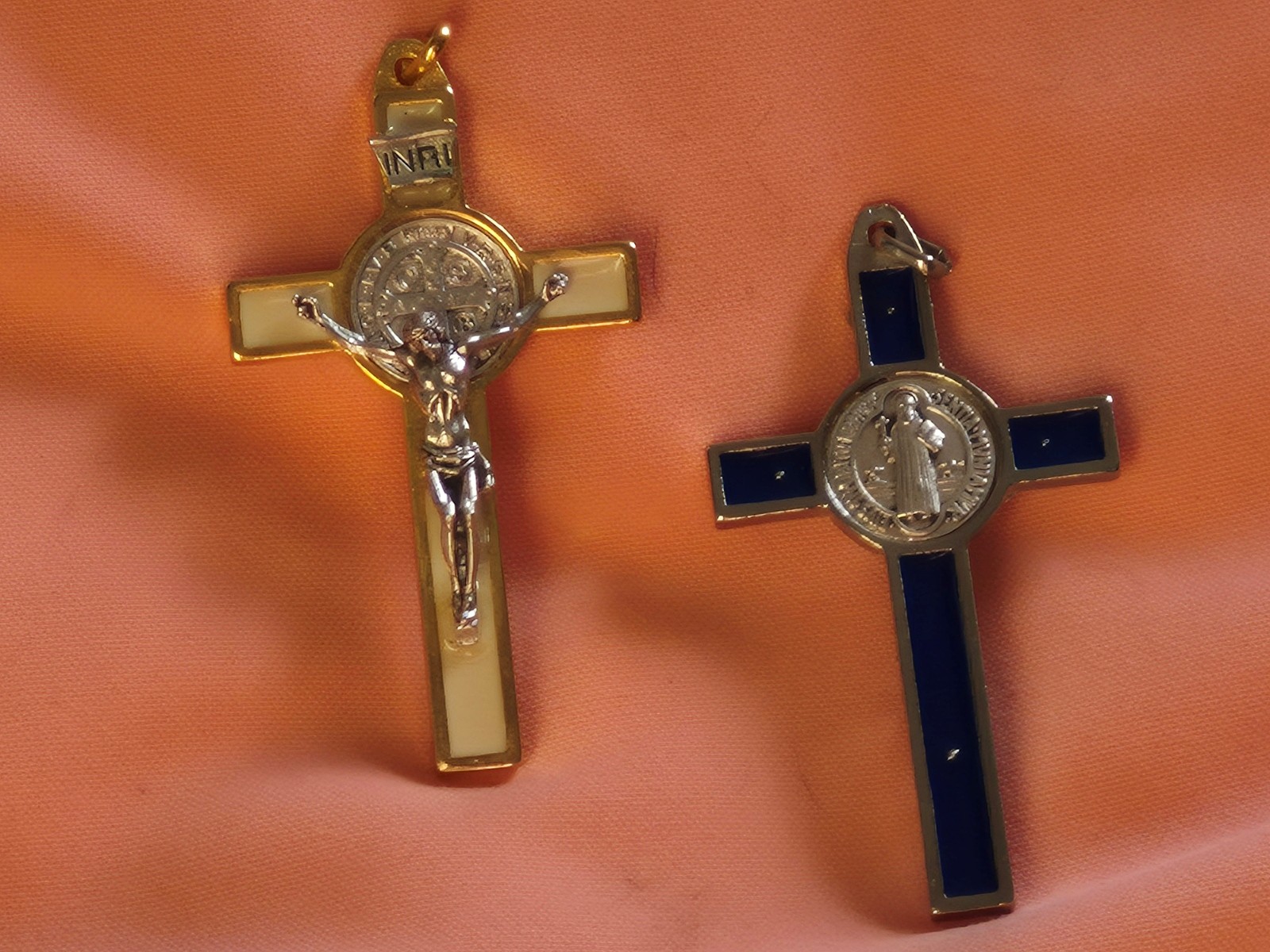

Sometimes Catholics get a bad rap for all their holy accessories — medals, rosaries, prayer cards, statues, holy water, etc. And it can be hard to explain to non-Catholics why and how we use these things — officially known in the Church as sacramentals — to help us be better Christians. More often than not, those who aren’t Catholics (and even some who are) view these items as unnecessary at best, and superstitious or even evil at worst.
The upcoming July 11 Feast of St. Benedict, whose medal is a favourite of many Catholics, is a great time to examine the role of such sacramentals in our lives of faith.
According to the Catechism of the Catholic Church, sacramentals “are sacred signs which bear a resemblance to the sacraments. They signify effects, particularly of a spiritual nature, which are obtained through the intercession of the Church.” (No. 1667)
Notice the words “they signify effects,” which clearly sets to rest the argument that sacramentals are idols or magic touchstones. By their nature, sacramentals must always lead us to Christ. The use of holy water should recall our baptism. Praying the Rosary should prompt us to contemplate the various stages of the life of Jesus and all that he did for us. Wearing a blessed medal that is dedicated to a saint can be a reminder that striving for virtue is every Christian’s duty.
The Catechism goes on to say that “these expressions of piety extend the liturgical life of the Church, but do not replace it” (No. 1675). Of course, it doesn’t make much sense to wear a St. Benedict medal and never pray or attend Mass. However, there have been many stories told over the years of people who seemingly had no life of faith but because their grandmother or godparent gave them a medal to wear, they eventually came back to the faith. Likely such conversions, or reconversions as the case may be, can largely be attributed the prayers of the one who gave the item, but the efficacious power of a sacramental cannot be discounted as it can serve to remind the bearer of God.
There are also countless stories of miraculous events that have occurred, seemingly through the wearing of or association to a sacramental. Of course, God can perform a miracle at any time in any way he desires. Also, we often don’t have the complete picture of any given situation. There could be factors at play, including supernatural ones, that are affecting outcomes. Maybe that grandparent has just completed their 100th Rosary for their grandchild’s conversion. Maybe someone’s guardian angel intervened. Maybe it’s a combination of all these. We know that an inanimate piece of plastic or medal has no “power” in and of itself, but what it signifies can lead us to the power of the one who does.
Father Boniface Hicks OSB does a great job of explaining the significance of the St. Benedict medal in an Ascension Presents video. As a Benedictine priest, Father Hicks makes sure to distinguish between the ability of the medal to lead people to contemplate the life of St. Benedict, and thereby the life of Christ, as opposed to any ability of the medal itself. He says that with sacramentals “the power that they draw from is the power of Christ and his Cross, which has conquered evil.”
Amazingly, the priest points out, one little medal can pack in a lot of meaning and lead to a lot of fodder for prayerful contemplation — which is exactly what St. Benedict would want. The front of the medal contains a cross, which was the foundation of everything St. Benedict did, but also several letters which stand for Latin phrases that not only proclaim faith in Christ, but also repel evil. Considering the times we live in, these might even be worth committing to memory, including “Vade Retro Satana” or “Begone Satan!” You never know when “Ipse Venena Bibas” or “Drink the Poison Yourself” might come in handy.
The back of the medal contains an image of the fifth-century saint, whom many believe is the father of western monasticism. He is depicted with a chalice with a snake crawling out of it and a raven, both of which are references to the times his own monks attempted to poison him, but he was able to recognize and repel the evil, once with the help of the raven.
Perhaps one of the reasons this particular medal is so popular is because St. Benedict is regarded as a patron of a happy death. Again, it’s not that by simply wearing the medal one will be granted a good death, but that the life of St. Benedict will remind the wearer to properly prepare for death, always aware that heaven is the goal.
Lazzuri writes from her home in Nova Scotia, where she lives with her husband, four of her six children, and her mom. She can be reached at clarelazzuri@gmail.com.







