

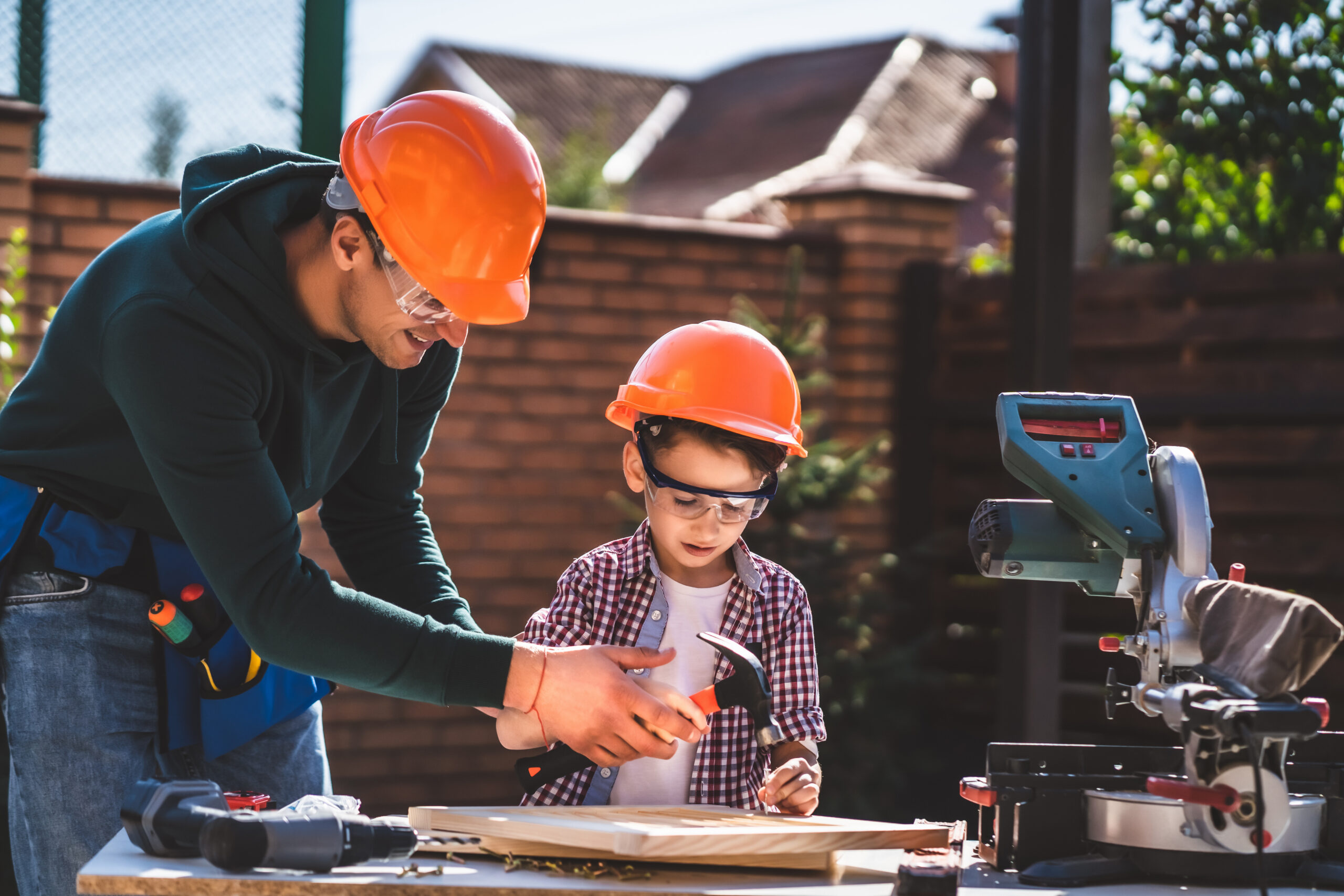

A father is the scaffolding around the growing structure of his child.
I first heard this analogy from Dr. Maria Fedoryka in the Humanum video series. She explained that while a mother’s genius is to create a space for a child to exist with unconditional acceptance, a father’s genius is to be “scaffolding,” — the “solid structure within which a person can flourish.”
My father was a tall, solid man who was often happy and sometimes scary (6’4” with an Irish temper). When I rode on his shoulders, I felt fearful, but also in awe. Being lifted that high gave me a new perspective. Fathers push security boundaries to encourage children to reach further, discover more, and venture beyond comfort. When kept in check, those “scary” qualities comfort children and assure them their father is in control.
As I grew older, my father’s structure was still there for me but in new ways. When I was a young adult, we fought about my curfew and I rashly moved out with a university classmate. My father let me know he did not agree with my decision (he was right about that — I moved home two months later), but when he visited my apartment, he brought a toolbox he’d put together for me and he patched up all the holes in the walls. He left me the toolbox. His support was love.
A child observes what his father has built his life on. He sees the very person of the father as a model of how to live. That is why, when the child gets older and recognizes the father’s faults, he may be devastated, thinking that everything he believed was false.
In reality, the father does not make the scaffolding intentionally. He does not carefully erect it by teaching the child to do certain things which are helpful and then to avoid others that are not. The father, in fact, IS the scaffolding. Not just what he wants to present to the child, not just what he wants to teach the child, not what he gives the child or what he says to the child, but his entire being (personality, character, body, actions) forms the structure within which a child flourishes — or struggles.
When young, the child stands inside this scaffolding, observing its construction, beauty or ugliness. This structure answers, for good or for bad, all the child’s big questions: Does life have guiding principles? What’s worth caring about? What is a man? How should I treat others? Whether intentionally or not, the father provides answers through his person. The child makes life decisions based on these observations.
Masculinity provides this gift, states Fedoryka. A mother’s genius, though related, differs. She provides unconditional acceptance integral to the flourishing of a person. The father provides conditions for growth beyond that. Children need motherly acceptance — first — to know, deep-down, they are of great value. With this, they can move forward in life. Both gifts are necessary. The mother’s unconditional acceptance lays groundwork for the father’s outward structure.
Weak structure or absent structure leaves children feeling unprotected, flailing in the unconstrained open air, without boundaries. The child will act out — like Bob, from The Outsiders — who drank and fought because he wanted “somebody to tell him ‘No’. To have somebody lay down the law, set the limits, give him something solid to stand on.” Of course, this ended in tragedy.
Conversely, overly rigid structure makes children want to break free, mistakenly thinking no constraints are the answer. Both scenarios statistically result in less success, less happiness, and greater negative outcomes. Sociologist Brad Wilcox found young men raised without a father are more likely to go to prison than to college.
Even good dads aren’t perfect, but imperfections can highlight what good fathers really are. A dad’s faults are darkness that defines light, showing the perfection in the imperfect.
A number of years ago, my dad had three strokes. One night, as I cried in agony, I begged God for a way out of the pain. Suddenly, clarity fell into my blackness, revealing a truth about my father. I saw all the good he had done — his love and support over the years. Beside the good sat the bad — his faults, anger, intemperance. I realized his gift to me was his love, support, and the times he deprived himself for me. His faults were his own and had nothing to do with me. They were products of the self-centredness each person is born with. But none of that mattered because he never intended his faults for me. He had only gifted me with the good.
Distance helps us see this — it certainly isn’t apparent when you are a child, and your dad is overreacting and losing his cool. Or when you are a teen and rebelling against his rules. But, once viewed from a distance, the father’s unique gift becomes apparent.
Most fathers know they are important, but don’t realize how vitally important. Can’t moms do everything if necessary? Fathers may feel extraneous, but they’re needed even when unable to “fix” situations.
During the baby stage a husband can feel as useful as a heating pad warming up his chilled wife after late night feedings, says Sue Dvorak in Apparently. This, she says, is a symbolic example of how dads are “difference-makers” because, “by his presence, by not flinching at what is needed … by providing warmth, physical or otherwise … the father provides key support, the support that helps keep their team in the game.”
All this to say that, even when seemingly not contributing, he is. As the children grow older, the father’s role gains importance. He’s a gatekeeper to the bigger world they are entering.
I ran these ideas by my husband and want to end with an idea he considers to be the most important, something a priest once told him: the majority of what you teach your children depends on how you treat your wife. Children closely observe parental interactions and take them deeply to heart. James Stenson said when a child sees his father kiss his mother, he feels as though his father kissed him.
Perhaps we’ll not grasp a father’s full importance until we reach the next world. Meanwhile, fathers can take to heart that being the best structure doesn’t mean spending more time with your children or taking them to more activities or being extra “child-focused,” (although some time with them is necessary).
Being their best structure means being the best man you can be — virtuous despite inevitable faults, and struggling daily to be honest, reliable, hardworking, and kind.
Your voice matters! Join the conversation by submitting a Letter to the Editor here.







