

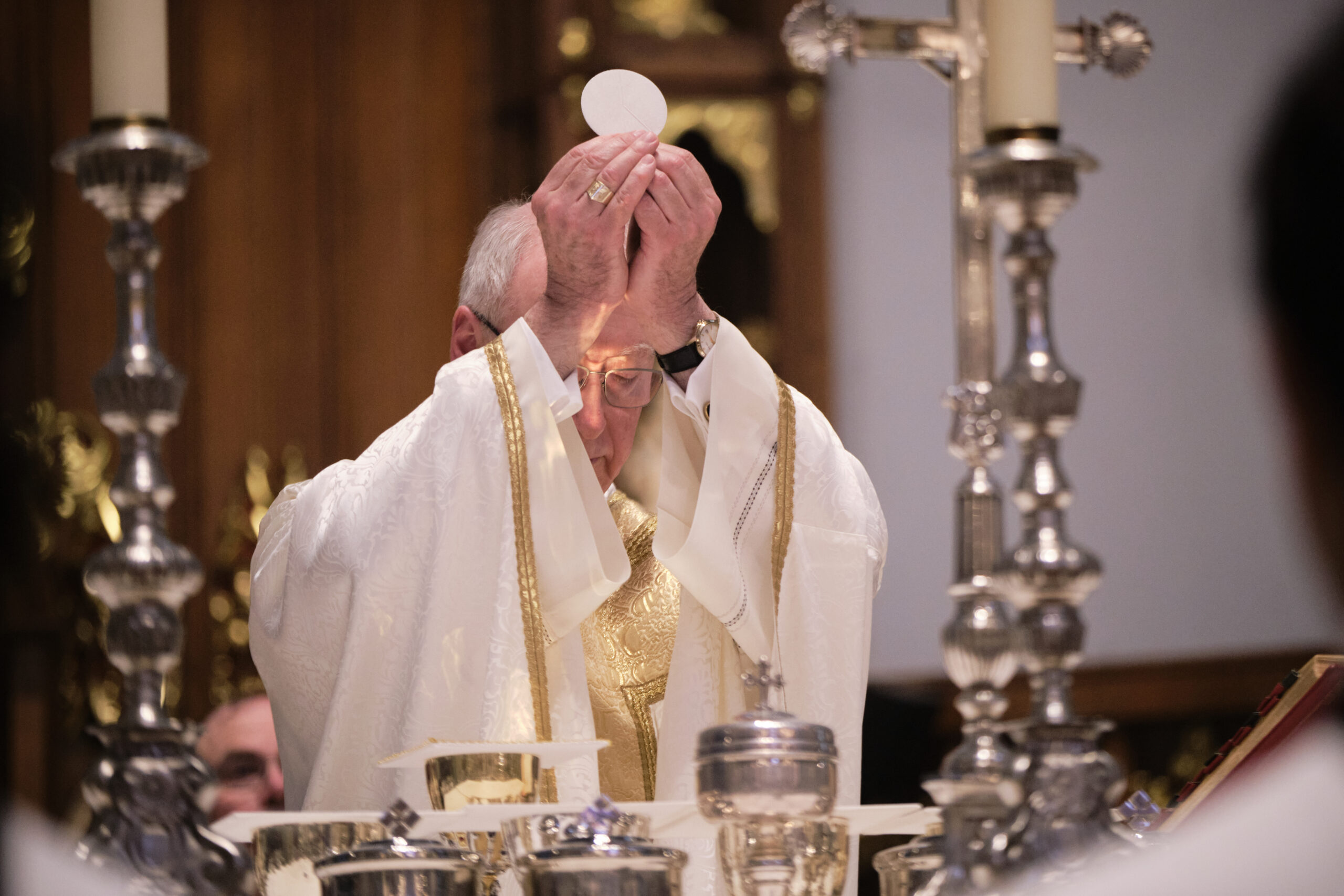

Corpus Christi (The Most Holy Body and Blood of Christ)
First Reading: Gn 14:18–20
Second Reading: 1 Cor 11:23–26
Gospel Reading: Lk 9:11b–17
“Let me solemnly assure you,” Jesus said, “if you do not eat the flesh of the Son of Man and drink his blood, you have no life in you” — divine life.
Those who actually heard these words took them at face value, exclaiming, “This sort of talk is hard to endure! How can anyone take it seriously?” However, Jesus did not try to soften it, even when many refused to “remain in his company any longer.”
In this Sunday’s Second Reading, St. Paul recounts how Jesus took bread and wine, changed them into his body and blood by his words, fed them to his apostles, and said, “Do this in remembrance of me.” The Church has always understood this as a command to the apostles and their successors “to repeat his actions and words until he comes again.”
When this understanding was first seriously challenged, during the Protestant Reformation, the Church declared solemnly that at the consecration of the Mass, “the whole substance of the bread” is changed into “the substance of the body of Christ” and “the whole substance of the wine” is changed into “the substance of his Blood,” a change the Church calls transubstantiation.
In the Eucharist, Christ gives us his body to eat: the body he fed to his apostles at the Last Supper, which he sacrificed to his Father on the cross, which rose from the dead, and which is now in heaven with his Father.
Therefore, the Eucharist is not just the mystery of the body and blood of the Lord, but also the mystery of the life and death of the Lord. The Catechism of the Catholic Church calls it “the memorial of Christ’s Passover,” foreshadowed in the Old Testament by Melchizedech and now re-presented to us sacramentally.
It is also the sacrifice of the Church, Christ’s mystical body, for not only does the Church make the offering with her Head, but also she herself is offered with her Head. The whole Christ, Head and body, is both Priest and Victim.
After the consecration, the priest says the anamnesis, or memorial prayer; for example, “Father, we celebrate the memory of Christ, your Son. We, your people and your ministers, recall his passion, his resurrection from the dead, and his ascension into glory.” This memorial is not just a recollection of past events: in the Mass they “become in a certain way present and real.”
The Mass re-presents Christ’s sacrifice on the cross, perpetuates its memory, and applies its saving power to the forgiveness of our daily sins. The sacrifice of the cross and all the Masses ever said anywhere are one single sacrifice; we are present at the Last Supper and the crucifixion.
If we believe this, why do we have to be commanded to go to Mass? Why do we ignore God’s invitation, make excuses, or turn up unprepared? Can we possibly insult God more deeply?
We do not have to fully understand the Mass, or enjoy it, or find it interesting or entertaining. What we “get out of” Mass, regardless of our feelings, is nourishment for our divine life.
Of course, the Mass is not magic: “whoever eats the bread or drinks the cup of the Lord unworthily sins against the body and blood of the Lord.” We must fast from food and drink (other than water) for one hour before Communion and go to confession first if we are in mortal sin.
However, courtesy demands that we also put Mass ahead of sports or holidays, dress appropriately, take pains to arrive early, devoutly make the sign of the cross with holy water, greet Jesus by genuflecting toward him in the tabernacle, kneel down and talk to him rather than our neighbours, keep our attention on him as far as we can, talk to him lovingly and intimately after Communion, and stay until the end of Mass.
Father Hawkswell has now finished teaching The Catholic Faith in Plain English for the summer. The whole course will remain available in written form and YouTube form at beholdvancouver.org/catholic-faith-course until it starts again, with new insights, on Sept. 7.







