

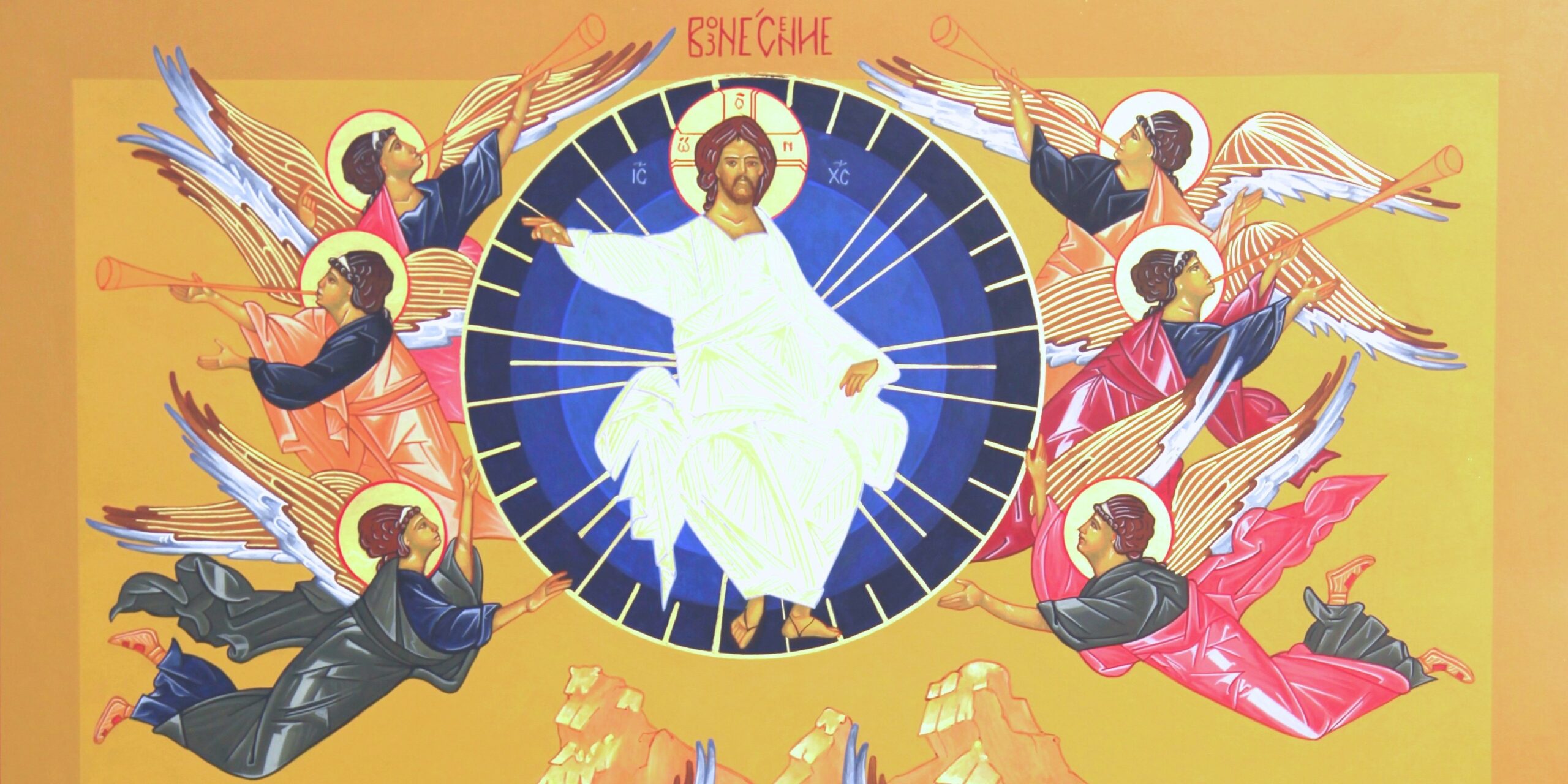

Ascension Sunday, Year C
First Reading: Acts 1:1–11
Second Reading: Heb 9:24–28; 10:19–23
Gospel Reading: Lk 24:46–53
Jesus’ Resurrection was essentially different from that of the people he himself had raised from the dead, says the Catechism of the Catholic Church: his body was filled with the power of the Holy Spirit and he shared God’s life in all its glory.
His body was authentically his own, but it possessed the new characteristics of a glorious body: not limited by space and time, but able to be present how and when he willed, as we have been hearing in the Mass readings for the last few weeks. His humanity could no longer be confined to the earth, but belonged henceforth to the realm of heaven.
Accordingly, 40 days after his Resurrection, Christ returned to his Father: he was lifted up before the apostles’ eyes and “a cloud took him from their sight.”
It sounds like the end of Jesus’ story as man. However, it is more accurate to call it the beginning of our story as God.
“The Son of God became man so that we might become God,” the Catechism quotes. “The only begotten Son of God, wanting to make us sharers in his divinity, assumed our nature, so that he, made man, might make men gods.”
The Ascension is the event by which Christ, who existed as God the Son before all ages, with the same nature as God the Father, entered God’s glory in his full humanity and (as we say in the Creed) sat down, confirmed in authority, “at the right hand of the Father” as a man like us “in all things but sin.”
In the Ascension, God accepted Christ’s sacrifice. Now he is at the heart of the Godhead in his humanity; humanity is what we and God have in common. As humans, we can now reach our fulfilment – everlasting happiness with God in heaven – by entering into the Godhead.
We do it by becoming a member of Christ’s Mystical Body. “No one has gone up to heaven except the one who came down from heaven: the Son of Man, who is in heaven,” Jesus said.
“I am the way,” he said; the only way we can enter heaven is in him, like an organ in his body, living with his life – the only kind of life that can survive in heaven (just as marine life is the only kind of life that can survive in the sea).
We are not born with this supernatural life; we must be rebegotten, or reborn. Jesus told Nicodemus that if he wanted to enter God’s Kingdom, he must be “begotten from above” – that is, “begotten of water and Spirit.”
That is precisely what happens to us in the sacrament of Baptism, which has two elements.
First, after we renounce sin and Satan, Baptism frees us from the original sin that we inherited at our natural birth as part of our fallen human nature. This is what John’s baptism had already done for the apostles.
Second, after we declare our belief in God the Father, God the Son, and God the Holy Spirit, we are reborn with their nature. This Baptism is what Jesus promised his apostles. Our new birth does not kill our human nature, but perfects and transforms it, so that it can survive in heaven, in the heart of the Godhead.
However, Baptism is only a beginning; now the new life must grow. We must maintain our rejection of sin and Satan, hold fast to our belief in the Holy Trinity, and nourish our new life with Christ’s body and blood in the Mass.
Then, as St. Paul says, “since we have confidence to enter the sanctuary by the blood of Jesus,” and “since we have a great priest over the house of God, let us approach with a true heart in full assurance of faith, with our hearts sprinkled clean from an evil conscience and our bodies washed with pure water.”
Father Hawkswell is again teaching “The Catholic Faith in Plain English,” with new insights, in both print and YouTube form, at beholdvancouver.org/catholic-faith-course. He is also teaching the course in person on Sundays (2 – 4 p.m. at the John Paul II Pastoral Centre, 4885 Saint John Paul II Way, 33rd Avenue and Willow Street, Vancouver) and Mondays (10 a.m. – noon in St. Anthony’s Church Hall, 2347 Inglewood Avenue, West Vancouver). The title of next week’s talk is The Beatitudes.
Your voice matters! Join the conversation by submitting a Letter to the Editor here.







